Sunday, 26 May 2013

Buck vs "Aliens vs Predator": or, shouting at screens


ALIENS vs. PREDATOR: REQUIEM

Colin and Greg Straus, 2007, USA

So the trailer looked faintly, vaguely promising and my friend said let’s see it, and I thought hell why not? So the pending incomprehensibility starts early… what the hell is happening, you ask? Who is where…?… hey, turn on a light so I can see… ah, that’s a Predalien. Alidator. Whatever. Another fanboy conversation makes it on the big screen: what if an Alien and a Predator, you know, did it! At this point of development, the fan boy gets his Alien and Predator action figures out and starts to dismember them and alternate heads and limbs, etc, to fully explore the potential of the concept to his friends. And at some point they decide that it should totally like have Predator dreadlocks… but more so.

Whatever. So...

The kid gets it.

There go the disposable winos, hahaha.

A women steps out of a taxi… in full military fatigues. Bet that will come in handy later. ... what's happening?... badly lit, badly edited, etc.....

Halfway through, an alien slaughters a man in front of his wife and daughter, who then have to run for their lives and luckily stumble upon other survivors. The child is put to sleep and one of the other wafer-thin characters asks whether the little girl is okay, and the mother answers, “She’s had a bad day.”

And at this point, having been laughing quietly and squirming at every cliché and inanity, I said out loud at the screen, “What does that even mean?!” Honestly, I could not help myself. It was such a redundant, preposterous character response in the supposed context of alien invasion and seeing your husband/father killed. But it was okay because the rest of the audience had been laughing unashamedly at the ridiculous execution, the tired obviousness and incomprehensible fight scenes. I don’t believe I have ever shouted out loud at the cinema screen before… that’s what the stupidity of this film will do to you.

Another fanboy fantasy sabotages a franchise. Of course, that wasn't the end of such shenanigans and weirder things were still to come.


Sunday, 12 May 2013

"Evil Dead"


EVIL DEAD
Fede Alvarez, 2012, USA
It is probably inevitable that “they” would get around to remaking that notorious and beloved horror classic “Evil Dead”. Early reports were that this update was surprisingly pretty good. Raimi was overseeing it… they made a bold decision to de-Ash it, which seemed to me to be the kind of move that opens up the original premise to other interesting ideas… I went in to be won over.

This Fede Alvarez remake is justabout minute-to-minute awful.

The dialogue is so weighted down with exposition and stupidity and so badly rendered that it is stillborn upon delivery. The group of twentysomethings that go to the cabin in the woods are a bunch of rejects from “Scream” and “Final Destination” sequels who can barely muster a decent line-reading between them, despite the cast having mostly respectable resumes. Badly acted; terrible dialogue; characters behaving like total idiots (did I mention all that?); a Book of the Dead that looks like some teenager’s home-made “Evil Dead” graphic novel homage… nail-gun action which feels more stupid than goofy; bad post-Japanese horror demons; goopy, brutal and unintentionally hilarious; po-faced and nasty, not to mention ill-considered, especially in regards to re-representing the tree rape… And then, hey, she’s resurrected all clean and angelic like? And then she gives some stupid kick-ass punchline and… well, even Ash only got around to dumb-fun punchlines in the sequels… Oh dear oh dear.

I went with a couple of good pals on the first afternoon screening; there were just three of us in the cinema and we spent the entire time, beginning to end, heckling and ridiculing and snorting with disbelief.

Its twenty-first century nastiness is very much in vogue and that has perhaps obscured its overall redundancy with some, but when I think of bad remakes, this is exactly the kind of thing I am thinking of. It’s worse because it seems so in earnest. All that insistent backstory is a bore and doesn’t matter one fig because the characters are so bad and uninteresting. More backstory and more explanation! This seems to be a first strategy for remakes … but for the most part it does not help. I shall argue that this does work in Rob Zombie’s Halloween” (and like 2012’s “Maniac”, that is how you “re-imagine” if you are going to do that “re-imagining” stuff) but… well, this “Evil Dead” remake has a screenplay by Fede Alvarez and Rodo Sayagues and, by all accounts Diablo Cody too, but the film sounds and acts as if the writing chores were outsourced to a fourteen year-old horror fan. In a world where everything we liked as youths is being regurgitated, this could be thrown on the heap with other victims of fanboy sabotage. For all my problems with “Cabin in the Woods”, at least that had an agenda to wrestle with: this “Evil Dead” offers nothing but murkier lighting, bad characters and a more thoughtless kind of brutality to its source material. It is ultimately un-scary and uninvolving as a consequence.

And the Bruce Camplbell cameo is the bonus insult.

Go back to the original to see how this stuff is really done. Nothing to see here.

Monday, 1 April 2013

Devil Dog: Hound of Hell


DEVIL DOG: HOUND OF HELL

Curtis Harrington, TVmovie 1978, USA

DOG OWNERS! Does your non-Caucasian maid clutch her cross when she sees your new puppy? Over time, do your children become giggly, distant and callous? Does your wife suddenly become one half ice-maiden, one half seductress? Do you sense EVIL behind your pet’s furry, indifferent visage? Then, unfortunate owner, you may well be the owner of … a DEVIL DOG!

Director Curtis Harrington felt that “Devil Dog” was ridiculous from the start, and so it is. But Harrington has no understanding of the genre or the material; he is straightforward TV-style director and has no imagination to know that the trick of horror is to embrace the absurd. If done successfully, this can turn the preposterous into something genuinely scary, black-humoured, even satirical and transcendent - like “The Omen” and “The Exorcist”, the evident inspirations for below-par fare such as this. A demonic dog that possesses a household could be fine satire on bourgeois and/or suburban mores, but we do not get any of this. The handsome dog generally looks cute. The characters are bland stock types, with Kim Richards obviously far too old to play a ten year-old; and she isn’t the only special effect that doesn’t work. Notoriously, the revelation of the devil dog’s true form is bad stuff and badly filmed. Unintentional hilarity abounds.

The film is more successful, if at all, in small moments when the kids grow increasingly alien to the parents, giggling secretly, dashing off and behaving detached from adult affection and authority. Perhaps the most genuine creepy scene is when the father (Richard Crenna) heads up into the attic only to find that his family are indulging in black magic. This inherent uneasiness of this moment hints at what might have been.  

Why on earth would The Devil Himself want a pedigree dog raped to spawn evil pups that… well, that just go into a family and cause trouble? Is this spawned by the hubris of a Christian suburban family, thinking That the Devil is directly interested in them and will always infiltrate in some way, even through cute puppies? What on earth do the forces of Evil hope to achieve? I can only venture that they want to start early on the son, who enters school politics and, inevitably, appears to be using nasty means to achieve success. But if the kid is meant to rise to Damien Thorn levels of power, it isn’t clear, and starting in some undistinguished family and suburban school does look like the forces of Evil are taking a longshot.

More fun and interesting is reading the narrative as the insanity of the father. You see, it is actually him that is doing the killing, suffering from paranoid delusions about his family and pet. It’s all in his head! There is even a hint from an incidental television news report which states a man went on a killing spree and said his dog told him too. But this is not the film to tease out such ambiguous possibilities. Rather, it achieves that so-bad-it's-good accolades in both bad-horror and bad-TVmovie camps, so it certainly isn't without charm.

CLICK


Frank Coraci, 2006, USA


All American Man-child Asshole – Adam Sandler! – chasing the All-American dream of climbing the corporate ladder to ridiculous wealth gets a supernatural visit that endows him with a remote control that, um, can control his universe. Ooh,  manchild dads are great when they bring gifts home, but bad when work means they have no family time, etc etc. Like much of this mainstream Hollywood piffle, it conveys America’s confused desires for both money and some supernatural intervention in order to have it all. And fart gags.
 
Fat is funny. Sex-changes are funny. Dog shagging is funny (well...). And then it’s all a dream and highly insulting, leaving nothing but another film with a false happy ending (shouldn’t he lose his job? Wasn’t that why he couldn’t go on a family holiday in the first place?), made up of crass emotional, superficial and personal social criticism (it’s pretty much all your own fault) and the bottom line is that we need even better gizmos to make the world work for our own interests. Oh, and supernatural interventions to make us better people … or something.

Wednesday, 27 February 2013

"Life of Pi", in words and pictures, or: storytelling for those that choose it.


LIFE OF PI

A novel by Yann Martel
A film by Ang Lee (2012, Tawian/USA)
(More than ever, this will contain huge spoilers.)

-1-: In Words

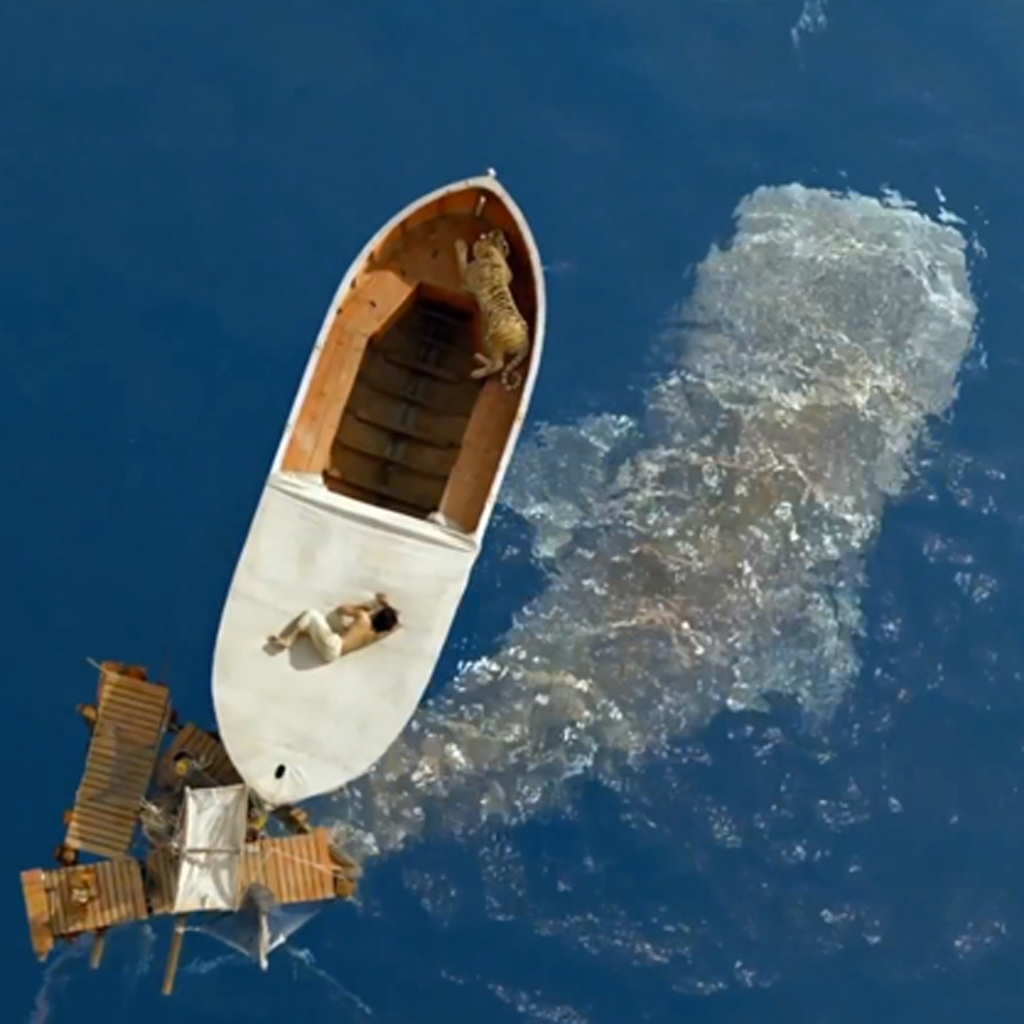
Yann Martel’s novel “Life of Pi” bears what I consider to be all the hallmarks and clichés of award-winning literature: a protagonist with a gimmicky name; religious overtones and symbolism (mistaking this for automatic poignancy); post-modern usage of and reverence for story-telling (story-telling is magical!); unreliable narrator; magic-realism; throw together and stir in some historical national crisis. At worse, these feel like the tropes of authors with affections of importance and significance whilst feeling a step disconnected from what is authentic. But Martel’s novel is an example of how these tropes can be made to work and is a fascinating and playful confection, setting up a fantastic premise of a young man trapped on a lifeboat with a Bengal tiger and milking and working the limitations of this scenario for all their worth. How would you survive this scenario?, the book asks, and proceeds to pay great attention as to how our protagonist Pi uses his knowledge, resourcefulness and trial and error to stay alive and fend off the big cat. Martel does not anthropomorphise the tiger – named Richard Parker – but respects the animal for all its primal splendour and terror. By the time the book segues onto the carnivorous island, the sleight-of-hand into more magic-realism is barely jarring due to the lengthy attention paid to detailing already incredible circumstances.

The older Pi, recounting this remarkable tale of survival, says that this is a story that will make the listener believe in God. As a child growing up in India in a zoo, amongst the animal kingdom, Pi is named after the French word for swimming pool, piscine, but abbreviates it to a transcendental number to avoid being mistaken for “pissing”. He trades the crude mispronunciation of his name for something that implies that, well, he is the centre of a watery universe. Pi tries and adopts features of many religions that he becomes fascinated by – a little of this, a little of that – creating in effect his own belief system whilst ignoring the incompatibility and conflicts between any two faiths. When his family is forced to move to Canada – due to national troubles – taking the zoo along with them, the ship is sunk in a storm and only Pi survives, alone with a small menagerie that is quickly reduced to just he and the Bengal tiger. He is indeed strained to his most primitive state, albeit one that calls on his God to guide and save him; but these prayers do not in a way that smother his dilemma and the detail. Keeping from being eaten by Richard Parker becomes his life cause and purpose.

Of course, it is the ending that truly elevates ‘Life or Pi’, for Martel’s work on making the life boat scenario convincing works to distract us from the fact that we are reading a fable. Which version do we wish to believe, Pi asks in conclusion: the one where Richard Parker is the manifestation of his primal, murderous side needed to survive catastrophe, or the prettier version with the animals? And ultimately, does this not cast religion simply as recourse to denial, storytelling and lying in order not to confront our very natures and the truth of things? Does it not cast into light the very brittle nature of the civilised when confronted by nature? In a Godless world where you can pick-and-choose your beliefs and faith, what would Noah do had his Ark been sunk and only he and a few hungry animals were left alive?

Pi’s tale is full of ambiguity. Does it condone lying because storytelling is so “magical”? Or is it a colourful exposure of the fiction of religious fancy? For all its dressing-up in faith, “Life of Pi” never loses sight of the carnivorous, chaotic and arbitrarily cruel inclinations of nature. Its symbolism is far more in the service of the world and psychology around Pi rather than religion. Rather, the key to the novel is surely the fleeting passage where Pi mentions that all animals are a little crazy. Temporary craziness is the key to the novel and religion may certainly be seen as mostly decoration acting like the main attraction.


-2-: In Pictures

Craziness is also the one theme that Ang Lee’s film of the novel does not truly address – screenplay by David Magee. Nevertheless, its symbolism remains intact because it is faithful to Martel’s text. When stranded on the life-boat during the storm, who does Pi see swimming towards him in the manic waves but Richard Parker, the symbol of his pending madness and violence? Pi screams and seemingly fends the tiger off, but the big cat appears again from the depths beneath the tarpaulin at the precise moment that Pi becomes confrontational and murderous. Pi spends his time taming the madness that threatens to consume him, but almost gives in to it during the second storm where he throws open the tarpaulin. And so on. The affection Pi eventually and inevitably has for Richard Parker has great resonance. (But there is a clue that Pi senses he may be losing his mind earlier, for when he swims mid-storm to the cabin to save his family, a zebra swims past him: How would a zebra be come to be there? we briefly think – knowing later that the zebra represents a friendly sailor, this moment nods towards Pi being overwhelmed by tragedy earlier even than Richard Parker's appearance.)

The film is a little softer version of the novel, mostly because the novel is gorier and the ending is perhaps less spelt out. The ambiguity is there almost despite the film being more literal: it is as if Magee’s script takes Pi a little more at face value but Ang Lee isn’t quite buying it. Perhaps this is why Rafe Spall’s writer character seems to embody the film’s weaknesses, as being the journalist that plays into the parlour game of fable-telling (the character acts as the equivalent of those in the audience being distracted by shiny objects). In truth, the lengthy back-story serves well to hint that Pi is in fact a fabulist all along, a bullshitter of the most charming degree. The writer is the sentimental audience, missing Pi’s greater heroism and the true horror of his ordeal by choosing a fancy tale. Nevertheless, Martel’s novel does leave it’s mark in showing how we tend to fall for stories and Lee matches that with a similarly fanciful and beguiling aesthetic.

Visually, the film is a wonder, an extravaganza of physical and computer-generated special effects. The storm sequence is a small masterpiece of action, effects and size; literally awe-inspiring (it is film that really needs to be seen on the big screen). The shot of Pi suspended in the ocean looking at the sunk ship on the seabed below is perhaps the one moment in cinema where I actually wondered if it could be matched by 2D (of course it can, but it is the first time in my cinema-going that I have actually doubted). Indeed, ‘Life of Pi’ is the one 3D film where 3D felt complimentary, and mostly subtle. It is a very bright and colourful film, which helps immensely to combat the light-loss that 3D currently carries; it looks somewhere between splendid animated nature book, state-of-the-art cinematic wonder and Asian kitsch, and it is always surprising, inventive and beautiful.

And the storm sequence is then matched by Richard Parker as a remarkable and convincing special effect. Richard Parker is as much a marvel as “The Lord of the Rings’” Gollum, rendered with convincing physicality and fearsomeness. It is true that so engrossing is the performance of the tiger and Suraj Sharma as Pi that it is easy to forget just what a special effects piece the entire film is. And we are invited in by the warmth of Irrfan Khan as the elder Pi and the vitality of Sharma as the younger, and then to be devastated by Sharma’s near one-take, heart-rending performance where he reveals all from a hospital bed.

But for all this, it is in truth an upsetting tale that has remarkable crossover appeal. I myself am surprised that it has seemingly metamorphosed into an instant family favourite: both times that I saw “Life at Pi” in different towns, the audience was made up of parents and very young kids; there were many children as young as five watching. I would have felt it too distressing at times for younger children, and yet there they were engrossed. As Fox UK boss Cameron Saunders says, with the typical condescension and cynicism of salesmen and businessmen:

“‘Slumdog Millionaire’ was perhaps the closest comp, because we knew it was going to be great filmmaking, run into the awards corridor, have an ethnic slant, and it was a challenging film that could appeal to audiences.”

For me, the trailers for “Life of Pi” were mostly a  misrepresentation of the text, focusing on selling it as a boy-and-his-tiger high adventure: “A life of adventure! A life of hope! A life of triumph! A life of Pi!” Hmm, not a life of tragedy, horror and stark survival, then? And a little more apt: “Believe the unbelievable”. Another trailer, which is otherwise mostly a good summary of the film, adds “A life of friendship”. To which I raise an eyebrow and become sniffy. But it really isn’t quite a Disney’s Mowgli tale (and Disney’s Mowgli is not Kipling’s Mowgli) and yet one can see how this pitch would have helped make this a family film, getting an audience to try out something both appealing and testing. Some critics have berated it for being simplistic in its discourse on religion, but it is not that film either; and if it is simplistic in some way, it is still more revealing and insightful about the mechanics of religion than Terence Malick’s “Tree of Life” (“Tree of Life” has other virtues, but its smug symbolism are surely only poignant to those satisfied with themselves for identifying them: and for them, at least Pi ends up on a beach in a crucifixion pose).

Just as Martel uses each sentence, Ang Lee uses all tricks and resources of cinema to make us buy into the splendour of storytelling, to fool us into believing that storytelling is perhaps one of the greatest forces of nature of all, if not faith. If it feels soft and superficial to some, making it look like a cosy mainstream adventure yarn, well the film itself is all about deceptive appearances. Indeed, it is a film where, more than most, you can take away from it what you want most to see.


P.S. - Rhythm & Hues, the special-effects company that won an Academy Award for "Life of Pi" has filed for bankruptcy. A bizarre and sorry state of affairs. (Thanks to Steve H for the heads-up.)

Saturday, 16 February 2013

"Tonight's class - Adaptations of Dracula and Frankenstein..."


 My friend Kiri runs films courses at the Oxford University and is currently working on a book on the history of British film studios. A status update on facebook about her course triggered a brief discussion on Universal monsters, Lego, et cetera, which I shall share here...  (Thank you Kiri and John)

KIRI BbWALDEN:           Tonight's class - Adaptations of Dracula and Frankenstein...
BUCK THEOREM:           Have you seen guy Maddden's "Dracula: pages from a virgin's diary", Kiri? It mades good work of the boring half of Stoker's novel by giving it a dancing theme (and indeed, ignores the entire Gothic first half).

KIRI BbWALDEN:           No, I haven’t!
JOHN A C ALLEN:           Many of each. None definitive in my opinion. Always close but no cigar

KIRI BbWALDEN:           It's interesting though that Lego have chosen the Lugosi and Karloff versions for their recent figures. The 1931 Universla films are still iconic, no matter how far from the characters in the novels thet actually are.
JOHN A C ALLEN:           I see the Universals and Hammers as separate stories in their own right really. Like you said they have virtually nothing to do with the novels. Some adaptations have come close but always fail in one aspect or another. People can't seem to resist interfering and there have never been 'pure' versions. I always thought animation was the answer. Imagine Dracula in a Mignola-ish blocky style with a colour pallette of black, white and red only.

KIRI BbWALDEN:           I’d watch that!

BUCK THEOREM:           I think "Dracula" has a weaker, more rambling second half - the rambling is fine as prose, but a problem for film - which leads to wide interpretation and re-invention ("Oliver Twist" has a similar problem) and perhaps this is why there has never been a "definitive" version. "Dracula" and especially "Frankenstein" end on fairly contemplative and metaphysical notes too, where the showdowns have elements of anti-climax, so this also contributes to the disconnect between original text and the demands of Gothic-horror cinema. ... On the other hand, Guy Madden's re-invention of "Dracula" as only the novel's second half and done as dance wins points for sheer gusto, surely? And Universal's versions are so broad and mimicable, no wonder they have become the enduring staples they are (the wolfman has not weathered so well because the prospect of the werewolf has been met mostly by the progress in special effects). Karloff's version of the Frankenstein monster in particular is a fantastic piece of mime and I am not sure it has been bettered, despite being only distantly related to Shelley's novel.


JOHN A C ALLEN:           The Universal movies (and the early Frankensteins in particular) really boil down to the strength of the lead players and the indelible charisma they managed to show. Karloff had been in (I think) over 200 films by the time Frankenstein came around and he and Lugosi (Lugosi in particular) were very undervalued as actors (critics of Lugosi's 'wooden' acting should look at his portrayal of Ygor in the third and fourth Frankensteins where he is as blackly comic as Ernest Thesiger is in 'Bride'). James Whale of course has to be included as pivotal with his assimilation of expressionism and mixing together or many elements into a strong whole. Once the Laemmle family lost control of the studio, Whale concurrently lost control of his movies and retired. And let us not forget Jack Pierce (who incidentally died a pauper!) who created most of the stable of iconic monsters we know so well today, and that Universal Studios profit so much from. As Pierce was unceremoniously sacked (for being too slow and painstaking) during the late forties he didn't give us Creature from the Black Lagoon but he was behind all the others. In recent years the Karloff, Lugosi and Chaney estates have managed to claw something back in the way of licensing of likenesses but decades after the money horse bolted the stable.


KIRI BbWALDEN:           Another interesting thing, both Chaney and Lugosi later played Frankenstein's monster too, with the Karloff makeup (it didn't look right).
JOHN A C ALLEN:           Chaney was the only one who played the big four - wolfman, dracula (Son of Dracula), Frankenstein's monster (Ghost of Frankenstein) AND the mummy once or twice. In Abbott and Costello Meet Frankenstein (actually a really good film) Glenn Strange injured himself just before an elaborate stunt and Chaney (in a rare sober moment of magnanimosity) put on the Frankenstein outfit (he'd already played the part years before) and did the shot to keep the film on schedule (at was running late thanks to Bud Abbott's drinking and the 'zany pair's card games).
Glenn Strange was cast when producers were stuck for a big guy to play the monster in House of Frankenstein and Strange (working as a stuntman and heavy in westerns) appeared in Jack Pierce's make up room to have a scar applied. Legend has it Pierce took one look at his griselled face and straight away rang the horror producers saying 'I've found your new monster!'
Fact: Glenn Strange was Butch Cavendish in the Lone Ranger TV series.


Monday, 4 February 2013

"Barry Lyndon": something classic; something classical


BARRY LYNDON
Stanley Kubrick, 1975, UK

 
Kubrick imagines Thackery’s novel as a sequence of classical paintings come to life. There is indeed a mostly static, painterly quality to Kubrick’s version of Redmond Barry’s picaresque tale; it is a quality that creates the sense that the drama is not so much in motion as dried before the eye in watercolours and acrylics as the dialogue ossifies into the paintwork. The innovation to achieve this effect was for Kubrick and his crew to utilise new lenses and lighting techniques deliberately aimed at capturing the natural light of the era. The mostly Irish landscapes, castles and drawing rooms are breath-taking, standing in for a variety of European locations. It is a sumptuous visual feast. Indeed, the film’s detractors accuse the film of being all style over substance, but this visual emphasis surely acts as surrogate for Thackery’s literary eloquences and authorial indulgences; how better to translate the descriptive passages of a nineteenth century novel? Perhaps none condemn quite as much as Chris Petit: 

Given the singular lack of drama, perspective or insight, the way the film looks becomes its only defence. But the constant array of waxworks figures against lavish backdrops finally vulgarises the visual sumptuousness

[Chris Petit, Time Out Film Guide 2011*]

The lack of what might be seen as conventional engagement with the characters may indeed be the point: that is, we always seem to be at a remove from them and never asked to follow their emotional wavelength, but rather to observe. They are mostly all players and poseurs of one sort or another, and how petty they seem against the magnificent countryside and extraordinary halls decorated in gigantic paintings. When we do need to engage, where it seems to count the most are in the instances and issues of parenthood in the film, and here Kubrick does take time to ensure that we connect. This is not only between Barry and his fated son, but also his rivalry with his stepson Lord Lyndon, Lord Lyndon and his mother; and indeed Barry and his own mother. The other characters that register most with Barry are also those that represent father-figures to him, but nearly all these relationships are doomed or absurd. Everyone is so very much playing their part and affecting their role in society that Lyndon’s lies infect even the deathbed of his unfortunate son. But then, what else does Lyndon have but his lies?

Overall, the film is populated by perfectly formed little sequences of dialogue and interaction, acted by a litany of brilliant character actors. We can luxuriate in the ridiculous dandyish mannerisms of the men of titles and money that Barry and his cohort Chevalier de Balibari (a ridiculously made-up Patrick Magee) con of their money. The mostly highly stylised performances are delightful in their detail: consummate, preposterous, just the right side of caricature. And see the minister turn the wedding into a hilariously overheated pulpit sermon; watch as Barry’s humble rose-cheeked mother becomes a formidable pasty-faced matriarch. A personal favourite is Leonard Rossiter’s early turn as a blustering English soldier. It is the men that are the most ridiculous, preening, blustering, indulging in ridiculous duels. Kubrick is quietly scathing at the artificial nature and ridiculous performances of the patriarchy in this society, which is the one that Barry invests in so much that he pursues the status far beyond his means and loses his own self in that pursuit and never seems to learn how artificial it all indeed is.       

Redmond Barry himself is a somewhat intangible character: Ryan O’Neill does not possess a twinkle of eye to make Barry a rascal and, although he is certainly treacherous and mercenary. But we never really get a grip upon him. Perhaps then this is the point: he is trapped in the ever-changing events of his own life. Desperately trying to manoeuvre himself around the other players on the social stage, coveting their positions, Lyndon lies, elaborates and trudges on ahead to any token status he can get himself into. This is why, when he finally marries Lady Lyndon (Marisa Berenson), he barely knows what to do in the marriage except have affairs and put on airs. The impression is that O’Neil only really finds his footing and actor’s strengths in his role as a father, and the loss of his son being the one sequence of true emotional resonance. But actually Ryan gives a great anti-performance, as Jason Bellamy elaborates: 


for the most part his performance is quiet, reserved, inward, even when Barry is puffing out his chest with pride or arrogance. It's an approach that serves the character well, underlining Barry's lack of original character, right down to that light Irish accent that sounds as if Barry was never fully invested in his roots. O'Neal is, in essence, an actor playing an actor. And what's remarkable is that while Barry is always in the midst of a performance, O'Neal never seems to be.

http://www.slantmagazine.com/house/2011/10/the-conversations-barry-lyndon/

Perhaps the weakest link is between Lord Lyndon in his incarnations as a boy and as a man: the casting feels inconsistent. As a child, Lyndon is played by Dominic Savage, who comes across as composed, watchful and defiant; as an adult played by Leon Vitali, he suddenly becomes immature, over-emotional, possessed of a sobber’s mouth given to quivering at all concerns.

What “Barry Lydon” also possesses is one of the greatest voice-overs in cinema. Where most are redundant and insulting, Kubrick offers a droll, amusing, critical, detached commentary, perfectly voiced by Michael Hordon. Its commentary allows criticism and narrative flow; it does not so much guide, fill in gaps or tell you what you are already seeing; rather it waves its hand archy, points and shrugs and pours another drink whilst elucidating on the cautionary tale that is Barry Lydon’s life. It does not truly moralise either, keeping its aloofness to the end so that ambiguity and our own conclusions can be made.

In a discussion about ‘pure cinema’ ~ which is seemingly to mean the triumph of the visual over narrative ~ it seems incongruous that “Barry Lydon” has seemingly met with the most indifference of Kubrick’s oeuvre as a pretty piece of nothing when modern critics are enraptured by the arguably indulgent gesturing of Malick’s “Tree of Life”. Kubrick’s film is about the superficial, the pursuit of it when natural beauty is in plain sight; it is about the rotten absurdity of Nineteenth Century society and a dry scathing satire on the pursuit of money and celebrity and all those shiny tokens that have led many to lead empty lives. And Barry’s life is ultimately an empty life, a search for all the wrong things. If he ever becomes self-aware is left open to conjecture by Kubrick, but there is no doubt that it all plays out like pretty tragedy and farce. Also, it is surely one of the greatest period pieces ever made, as much as ‘2001: a Space Odyssey’ and ‘The Shining’ are the epitome of their respective genres.


* [Chris Petit, Time Out Film Guide 2011, (Time Out Guides Limited, London, 2010) pg. 73]

Wednesday, 2 January 2013

Revisiting "Santa Sangre"


I remember that in the period of about a couple of weeks – during what must have been 1991 or ’92 – I happened to purchase “The Reflecting Skin” and Alejandro Jodorowsky’s “Santa Sangre” and ended up watching them both twice over as soon as I got them. They are both high on my favourite Crazy Shit Cinema list and I remain in love with them both. I am also pleased to have seen “Santa Sangre” at the cinema three times in the past (but missed it on some recent London screenings). It is a hysterical piece, a freewheeling carnival of madness, gore, unintentional comedy, cruelty and colour. Having just bought the blu-ray release by Mr Bongo, and not having seen it for a good five years or so, I find that it has lost none of its crazy-kicking hold on me. Lyrical, silly, hyper-real, negligibly acted, beautifully scored if somewhat incongruously by Simon Boswell, featuring everything from child magicians, armless schoolgirl martyrs, slasher tropes and tributes to James Whales’ “The Invisible Man”, “Santa Sangre” is in its own state of phantasmagorical delirium, dragging its killer out of his trauma and misogyny by way of a street carnival and enough phallic symbolism to poke Freud from the dead. I know that Jodorowsky’s “El Topo” and “The Holy Mountain” are highly revered, but for me “Santa Sangre” is my favourite of his work, although it seems to be the one in his canon that gets the least mentioned, if at all. I suspect the fact that it is based upon what is ostensibly a straightforward serial killer plot, – a child traumatised and orphaned by primal scenes and domestic violence grows up into a mentally unstable murderer barely able to connect to reality – for me, helps to guide Jodorowsky’s surrealism and lunatic explosions and explorations of violence, misogyny and circus horn sections. Even in the Crazy Shit Cinema canon, “Santa Sangre” is quite unique and special, should you play along.

Monday, 31 December 2012

Obligatory 2012 "BEST OF" list

Favourites of the Year:

And here are my favourite cinematic watches of the year, in no particular order:


Rampart (Oren Moverman)
The Raid/Serbuan maut (Gareth Evans)
Maniac (Franck Khalfoun)
Berberian Sound Studio (Peter Strickland)
Killing Them Softly (Andrew Dominik)
The Master (Paul Thomas Anderson)
Life of Pi (Ang Lee)

Indeed, aside from “The Raid” (which was the most visceral action film I have seen since, well, “Casino Royale”)  and “The Hobbit”, all my other choices are character studies that often lean to the abstract side. These were the most satisfying watches to me because the acting was so examplary and the aesthetics so wonderful that I knew repeat viewings were only going to reveal how damned good these things were.
I hate voiceovers as a rule, but Elijah Wood’s soft-spoken psychopath  in “Maniac” certainly crawled into the head, helped by the p.o.v. camera (and the best subjective camera I’ve seen this year, though there was quite a bit around).
“Killing Them Softly” was as obviously political and scathing as a polemical soul tune with a deluded bunch of low-lives.
It wasn’t immediately obvious to me how much I rated “Rampart”, but I found I couldn’t wait to bust out the blu-ray as soon as it was on release for a second watch: I’m an Ellroy and Woody Harrelson fan and Harrelson’s heartfelt and frightening machismo was so riveting that the vagaries of the double-crosses in the plot barely even registered.
 “Berberian Sound Studio” looks and feels like a horror film, and indeed I saw it at Frightfest, but it is something else entirely. Repeat watches are going to reveal, etc etc
Oh, I know the majority seem to dislike “The Master” greatly and feel it to be one of the most boring films ever made, apparently, but… Well it worked for me. The acting was stunning, the abstractions beguiling and… well, Joaquin Phoenix as Freddie Quell is the performance of the year, if not one of the most remarkable of cinema, and that is in a year of excpetional performances.
Also best:

The Deep Blue Sea (Terence Davies, 2011)
Mildred Pierce (Todd Haynes, mini-series 2011)
Two fantastic dramas about and for women with remarkable casts and performances;  both being leisurely, elegantly and sympathetically paced. Sumptious and very, very moving.


 Second tier:
Killer Joe: (William Friedkin) That is some low-down and dirty fun.
Two Days in New York: (July Delpy) Funny, light, smart and silly all at once. And bearing one of the funniest “soul-stealing” cameos ever put onto screen.
Sleep Tight/Mientras duermes: (Jaume Balagueró) Highly creepy Italian stalking thriller that makes the skin crawl and probably has more rightful claim to that much thrown-about accolade “Hitchcockian” than most.
Chained: Jennifer Lynch’s lo-fi serial killer and child abuse drama that isn’t quite as you might expect by the end, but one that ultimately emerges as respectful and should earn a cult following.
Looper: (Rian Johnson) Daft but immensely enjoyable time-travel fun. I am a fan of genre fair that takes sharp mid-way turns. Plus, it includes one of the most remarkable child performances ever in Pierce Gagnon.
Skyfall: (Sam Mendes) Daft but immensely enjoyable spy-fun. No, it doesn’t top “Casino Royale”, but it may be the best-looking Bond and the left-turn into quasi-Gothic imagery for the final act is certainly unexpected and something new. I hope they keep this up because surely this is the best of mainstream cinema, despite any flaws?
And upon reflection, I find myself thinking more favourably of “Dredd” (Pete Travis)than I did initially, and Todd Solondz's “Dark Horse” was pretty entertaining and scathing too.

Disappointments of the Year:
Cabin in the Woods:  (Drew Goddard) Sorry, but Nah. Horror that tries to berate its own genre is much like puritanical priests that have affairs. Also: not half as clever as it thought. Also, I have probably never quite upset so many people over my indifference and objections to the film. Heh.
End of Watch: (David Ayer) Bearer of one of the worst and inconsistant cinematic aesthetics ever.
Prometheus: (Ridley Scott) Expectation was so very high but Ridley Scott trying to trump Quatermass’ “Aliens made us” was a pretty-looking underwhelmer.  I mean, it's not awful - not at all - but no prizes. Also: stupid character behaviour tends to make a film look stupid.
American Mary: (Jen & Sylvia Soska) Intriguing premise with confused and ultimately silly resolutions. All its interesting possibilities missed for muddled horror pay-offs.
The Killing/Forbrydelsen: A bunch of strung-out TV whodunnit and police poredural cliches, albeit with some subtitled grace. Oh, and let me say as snottily as possible that I guessed the killer from episode one, yes I did. Because: cliches.

Highlights of the year:
Going to “Frightfest”.
The storm sequence of “Life of Pi”.
The cast of “The Master”.
Joaquin Phoenix as Freddie Quell.
The cast of “The Deep Blue Sea”.
Being won over by “The Hobbit”.
Richard Parker in “Life of Pi”.
Breaking Bad”. Because it is stunningly well written and performed and might well be the most minute-to-minute surprising and enjoyable TV show ever given over to fandom. And that’s in a world where brilliant shows like “The Wire” and “Deadwood” exist.
Having  five minute chat to Alan Jones about Dario Argento at “Frightfest”.
Finding myself the only person left in the cinema by the end of “The Master”.

Lowlights of the year:
            Too much rape on the film menu at “Frightfest”. By the time Jennifer Lynch’s “Chained “ came on, I could barely appreciate how respectful and good it was because I was sick of seeing another screaming woman being dragged across the floor to rape and torture.
            Too much incomprehible and nauseating shakey-cam in “V/H/S” (which I enjoyed) and “End of Watch” (which left me indifferent).
            The downward slide into narcissisitic fairground-ride of “Dr Who”.

So, so many that I didn’t get to see. “The Hunt”; “Sighseers”; “Moonrise Kingdom”, etc etc. *sigh*. Later…(O