"Nothing bothers some people. Not even flying saucers." - The Beast of Yucca Flats
Sunday, 10 August 2014
"Godzilla and Mothra: The Battle for Earth" (1992)
“Godzilla and Mothra: The Battle for Earth”
“Mosura tai Gojora”
Takao Okawara, 1992, Japan
With
a plot surely made up as it went along, propelled by nothing more than someone
gasping “Godzilla!” and then there he is, it’s up to the showdowns to save the
whole enterprise. Subplots drop away and characters with typically bad dialogue
(and dubbing) become nothing more than ringside spectators heckling the monster
fights. The fights here are less wrestling than laser beams and it has to be
said that “Godzilla vs Mothra” provides quite a light-show. Some moments
such as Mothra cocooning the Capital Building are bizarrely pretty, shot as if
they were gorgeous epics. The scenes of the city being trashed and refugees
fleeing are closer to the original “Godzilla” than the late Seventies
jokey efforts, but the series latterly moves into ecological rather than
nuclear warnings. Although Godzilla remains a startling signifier of man-made
holocaust, the plots aren’t strong enough to uphold the original message.
“Mosura tai Gojora”
Takao Okawara, 1992, Japan
Meteorite falls on Earth and wakes up Godzilla and Battra.
Meanwhile, in Indiana Jones land, treasure hunter Takuya Fujito gets involved
in a Government investigation of various ecological disturbances around the
meteorite. Battra destroys city. Fujito and others discover Mothra’s egg and as
they take it home for some unethical company, Godzilla, Mothra and Battra have
a fight, setting off all kinds of volcanic activity. Mothra’s tiny fairy-like
guardians, the Cosmos, are kidnapped. Mothra levels Tokyo to check up on them
and then Mothra changes from unconvincing caterpillar into unconvincing fluffy
moth thing and fights now airborne Battra. Godzilla joins in. Battra turns good
and helps fight Godzilla.
So it’s up to the monsters. Battra is a
vast spiky improvement upon the Mothra design; a mole-moth-rhino of sorts.
Godzilla is in his oddly cat-like phase with barely a jaw to jutt. Forget the
humans; enjoy the light-show and mass destruction.
"Godzilla vs Hedorah" (1971)
"Gojira tai Hedora"
"Godzilla vs the Smog Monster"Yoshimitsu Banno, 1971, Japan
A truly bizarre film with almost everything thrown
into the mix – psychedilic visuals and musical interludes, animation (not quite
Pink Floyd – The Wall, though),
stop-animation, kiddie-movie, anti-pollution warning, multiple screens, etc.
None of this enlivens the sluggish pace, dull dialogue and ~ catastrophically ~
mundane fight-scenes between Hedorah and Godzilla himself. In fact, Godzilla is
almost incidental as the creature made of sludge and pollution, Hedorah, runs
amok. It shits, pukes and gases out over people, sometimes dissolving them into
skeletons. Hedorah itself is a truly repellent and silly creation, but the
script labours under the destruction-of-nature message. A tropical fish tank
represents pure oceans, but even that succumbs. Once, just having Godzilla lay
waste to Japan was enough to conjure hints of atomic bombs and mass-disaster
but the Earth faces pollution monsters too.
This eleventh Godzilla installment begins with a bizarre opening number, a psychedelic
theme, a cross between a James Bond credits sequence with lyrics listing
elements polluting our world. Next thing, it’s a children’s “Save the Earth”
monster flick with a tadpole turd-like Hedorah and pauses for science lessons.
Half atrocious, half spellbindingly odd ~ who knows what they were thinking?
Most resonant moment has Godzilla being buried under an ocean of sludge.
"Godzilla vs Mothra" (1964)
Mosura
tai Gojora
Ishirô
Honda, 1964, Japan
Fourth, somewhat lackluster entry into the Godzilla series. Giant Mothra egg is found and is immediately accosted by unscrupulous company that want to exploit it. The miniature Mothra guardians, the Peanuts Twins, plead with the human race to return the egg, but the businessmen are too busy building a theme park around it. All this is quickly swept aside when Godzilla, disturbed by some atomic tomfoolery again, rises up out of a muddy wasteland – which makes a change from his usual aquatic entrances. Mothra is persuaded to stop Godzilla’s rampage before dying of natural causes and making way for the contents of the egg, which turn out to be twins.
Since
the human ingredient and plots in these sequels give daytime soaps a
sophisticated feel, the films mostly fall and stand on the monster, the fights
and the destruction. “Godzilla vs Mothra”
delivers only sundry efforts in these departments. Godzilla looks as if he has
bushy eyebrows. The bad guys over-act like “Thunderbirds”
puppets. The good guys barely register. Plastic model tanks melt. As with all
Mothra films, the action pauses for musical interludes from the Peanuts Twins
and friends. The element of children is introduced, if briefly, paving way for
the more kid-orientated sequels and, inevitably, “Godzilla vs Hedorah”. It is always funny to watch something so
awesome and primal as Godzilla fight a monster as crap as Mothra. The giant
lizard puts up a disappointing fight against the overgrown moth and its twins
who, in their larvae stage, simply squirt Godzilla with sticky stuff until he
falls into the ocean. Until next time.
Saturday, 2 August 2014
"Bangkok Dangerous"
Oxide PangDun
& Danny Pang2000, Thailand
Actually, there isn’t too much “dangerous” in the Pang brothers’
soft-centred hit-man tale. Oh, plenty of blood and shooting, but nothing that
will trouble or tax the genre. The excess is all in the aesthetic and tricks with
which the Pangs overwrite every scene: they cannot film someone washing their
face in a sink without multiple cuts to a turning of the faucet. Filters colour
everything, every action affected in some filmmaking tic, nothing left to
breathe on its own. The film chokes on its own style, but it isn’t necessarily
stylish: its action scenes edited to such an extreme that they are often
whittled down to incomprehensibility; the doomed romaniticism is saddled with
childish scripting so that they whole things ends up being something like a
teenagers playing at gangsters playing in funky clothes. But back to style: it
does not have the genre savvy or let’s-screw-with-this attitude of Takashi
Miike; it is not a film that could ever achieve the elegance of Wong Kar-Wai, no matter how hard it uses
colour and changes film stock. But if you have come for style-over-substance, there
is that.
Labels:
crime thriller,
gangsters,
Takashi Miike,
Wong Kar-Wai
Wednesday, 11 June 2014
"Locke" and mistakes as meltdown.
LOCKE
Where“Spring Breakers” and “We Are The Best” present young women aching to discover and assert themselves, “Locke” presents a man discovering that he is not quite who he hoped to be. “We Are The Best” offers that growing up is as quietly as fun and surprising as it is difficult and painful; “Spring Breakers” offers self-discovers as envisioned by a rudderless, immature youth pop-culture; “Locke” suggests that all your good work can be undone at any given moment, just given a key mistake made.
Steven Knight, 2014, UK-USA
But from tales of youngfemale assertion to the life meltdown of a man. Effectively it is Tom Hardy as
a construction manager in a car, on the English motorway, trying to stage-manage
and salvage his life through the very modern means of hands-free phone calls.
By all accounts, he is a very trustworthy and successful family man and
construction manager, but…
Director Steven Knight overcomes
any pretensions and limitations that its high-concept premise may have with a
lucid, thoroughly engaging script. It is in effect a one-act play/radio drama
that simply allows Hardy to do his thing whilst employing motorway lights and
dissolves to create a naturally, faintly trippy atmosphere. So organic and
convincing are the conversations we hear that the contrivances take a while to
become obvious: Ivan Locke fights to ensure the foundations of a building are
being laid in his absence whilst his family life is simultaneously falling down
around him due to a fleeting infidelity which has him deserting everything in
an attempt to do the right thing. Since it is one face we see for the entire
running time, there needs be an actor that can effortlessly command his space
and Tom Hardy is definitely up for the job, supported by an exceptional supporting
voice cast. That he is as far from his “Bronson” persona as he can probably get
makes him more fascinating: can you do good when you’ve done bad?
Arguably, “Locke” offers a
bleak worldview where mistakes are not to be forgiven, where one wrong
foundation, one wrong ingredient in the mix will mean reconciliation is not
possible. Are we to agree that Locke – an ostensibly decent man – is deserving
of almost complete estrangement due to his infidelity? And surely saying “no”
is not endorsing that infidelity but without the room to further explore the
complexities and ongoing changes or lack-of-change in the family crisis, there
is an aftertaste of meanness. The tale implies that mistakes can’t afford to be
made, but surely the film is equally arguing that good people will stumble and
blunder and, ultimately, act human. For Locke, he discovers that his sills in
reliability and negotiation will not resolve everything, no matter that he
carries the philosophy that any crisis can be made good with effort and by
doing the right thing. The film gets to the frailty of things but all the grey
areas leave our flawed protagonist out on his own.
Where“Spring Breakers” and “We Are The Best” present young women aching to discover and assert themselves, “Locke” presents a man discovering that he is not quite who he hoped to be. “We Are The Best” offers that growing up is as quietly as fun and surprising as it is difficult and painful; “Spring Breakers” offers self-discovers as envisioned by a rudderless, immature youth pop-culture; “Locke” suggests that all your good work can be undone at any given moment, just given a key mistake made.
"Spring Breakers" and cluelessness as a trippy thing.
SPRING BREAKERS
Harmony Korine, 2012, USA
Certainly, the rounded and
engaging girls of “We Are The Best” make the bad girls gone bad of Harmony
Korine’s “Spring Breakers” look ridiculous, wafer-thin and inane. They start
off with a similar sufferance and disillusion of their surroundings and
schooldays. These are the privileged class but nevertheless unhappy with not
having more and not being able to do just what they like. And so they rob a
restaurant with water-pistols, acting like gangster-girls, and head off to
Spring Break to discover themselves. Indeed, they mutter on voice-overs about
such discoveries and that they are amongst the sweetest people, the best
friends ever and that this is a paradise realised: but the truth in the visuals
is that they are simply getting drunk, taking drugs, taking off their tops a
lot, indulging in indulgence and orgies and hi-energy music. Their vision is
vacuous and limited and absurd. It leads nowhere and they offer nothing but
their own vacuity. Inevitably, it would seem, this escalates into the pose and
debauchery of dressing up in nothing but bikinis, guns and Pussy Riot
bunny-masks and going on a killing spree (it’s like the psychedelic MTV-minded
wet-dream of “Gummo”’s bunny-boy).
The shallowness is part of
the point; there is satire here of a privileged generation stoked up on
music-video crime fantasies, pop-culture pose and dressing-up (or lack of), of
particularly American fantasies and aspiration of youthful excess. In fact, it
is no less deep than “Tree of Life’s” cosmic and domestic musings, and like
Malick’s film, “Spring Breakers” strength is as a visual piece, the visuals
transcending and giving meaning and life to the limits of the script and
meaning. Through neon colours, temporal scrambling, an ever-drifting camera and
repetitious phrases on the voice-overs, a psychedelic and dreamy rhythm builds
up, making the film seductive as an ambient mood-piece.
Korine’s greatest letdown is
in failing the girls of his film: that they are barely characters at all and
that their friendship is all the gestures of friendships without substance all
becomes very clear when James Franco turns up and steals the show from under
them. Franco’s performance has been rightly celebrated and he certainly offers
a fine depiction of a shallow, ridiculous character; someone who believes the
tokens of what is supposedly the gangster lifestyle maketh the man. Oh, there
is no mistaking that these girls are his soul mates … although surprisingly,
when a couple of the girls just want to go home, that’s what they do. He isn’t
mean, cruel or sexually sadistic, but he is the only fleshed-out character in
this bikini-kill fantasia: he takes over the voice-over and by the end the
girls don’t even have that to convey the discrepancies between what we hear and
what we are seeing. This also leave the satirical edge all dried up long before
the end. They have one potentially game-changing scene where they turn the
tables on him half-way through his boasting, gunplay and foreplay, but this
proves not be a twist in the tale
where they reclaim their story but a bonding exercise.
But still, the visuals
cascade and blur and push for a genuine pop-fantasia. Had “Spring Breakers”
kept focus the girls and given them their due, it could have been similar to
one of Lana del Rey’s pop-tales of messed-up girls falling for a life of crime,
thinking it’s all part of being cool. As it is, it leaves them nowhere as more-or-less
gun-toting nobodies.
Nevertheless, it’s still
quite a trip through a very minor crime story. If one gives in to the visuals
then Korine emerges as a pop-director who has filtered the nihilism of the MTV
generation into perhaps his most accessible mash-up yet.
Labels:
coming-of-age,
crime thriller,
gangsters,
Harmony Korine,
trippy
"We Are the Best" and punk as the sweetest thing.
By chance, I happened to see “Spring Breakers”, “We Are the Best” and
“Locke” consecutively and each seemed to say something about the other in
comparison.
WE ARE THE BEST
Lukas Moodyson, 2013, Sweden
In tales of “good girls gone
bad”, as it were, “We Are The Best” proves a delightful and modest tale of
growing up for three Swedish teenage girls forming punk band in the early
Eighties. It is not so much coming-of-age, which perhaps implies some lesson
learnt, but more just growing up and trying to get noticed, make your mark,
have friends, have fun and trying to assert your identity. The young women in
Harmony Korine’s “Spring Breakers” dive into a world of hedonism trying to find
themselves, trying to work out who they are: the just-teen girls of Moodyson’s
“We Are The Best” seem to already know who they are, but just need to work out
the world around them with that information in mind. Bobo is shy but also aware
and quietly as sure of herself and as playfully rebellious as her outspoken,
politicised best friend Klara (Mira Glosin). These are punk-posing kids, but
they aren’t mean or stupid. They’re just bored of the hypocrisies they see in
the adult world around them and just want to push back a bit and have a good
time: punk happens to be the language and medium that they use.
So, fed up with onset of crap
disco and new wave around them, as well as being told that they are ugly, the
girls hilariously blag themselves some rehearsal space at the expense of the local
prog-rock band just to get back at them and to shake things up. And so,
inadvertently, they find themselves in a band. They have no skill but lots of
attitude and they know what they don’t like, all good for inventing a punk band
from nothing. And what they don’t like is gym class, so they have quickly put
together an anti-sport, anti-mainstream song. But they can’t play, so they
cheerfully set about befriending and recruiting quiet Christian girl Hedvig
because she can actually play guitar. Of course, her Christianity is totally
against what Klara and Bobo are against – being the apparent home of conformity
and conservatism – but it doesn’t stop her joining the band and turning punkish
herself. Indeed, perhaps the most moving moment in this joyfully rambling and
naturalistic film is when Bobo and Klara begin to properly learn how to play
their first proper notes and start to hear their anti-sport song coming
together, or their simple realisation that changing a lyric can improve a song.
Oh, they aren’t interested in any craftsmanship, but anyone who creates art can
surely take delight in these adorable girls taking their first proper steps as
artists of some sort. The conversion of their boredom and general teenage
disaffection into music is a fantastic act of development and personal growth.
The film may be a
soft-natured affair, but its strength is a nuanced and unfussy respect for offhand
humour, for the teenage condition and the growth of an artist and friendships
between three girls. It falls into light but mature tales of growing up such as
“My Life as a Dog” and “Boy” and “Ake and his World”, but also spiced with the
rebellion of music. Based upon the graphic novel by Moodyson’s wife Coco, it is
a more convincing confection than the contrived miseries of his “Lilya4ever”.
There will be many particular Swedish jokes and details that will be missed by
non-Swedes, but it has plenty of material recognised to anyone who has been an
outsider kid. Never once does the film let itself talk down to these kids by
circumscribing their innate maturity and goofiness with cheap drama: this is
just their friendship and they learn perhaps nothing more than how to play a
song to piss off people and then to act up a lot over the end credits. These
are good girls going not so much bad but punking around for fun and to go
against the grain.
For comparison, look at Harmony Korine's "Spring Breakers".
Labels:
comic book adaptations,
coming-of-age,
drama,
swedish drama
Sunday, 13 October 2013
Tod Slaughter haunts my murky memory.... (or at least a few of the same streets).
On the mysterious Bushey Studios, the kind of place where both I and Tod Slaughter stalked....
Currently
I am working on a book on killers in film, and this has lead me to perhaps England’s
first real horror star, a master of melodramatic villainy, Tod Slaughter. Slaughter
was total crowd-pleasing ham of the stage and then, during the 1930s mostly, of
the cinema; if you weren’t literally hissing and booing him, then he wasn’t
doing his job. He was mostly recognised for his “Sweeney Todd”, but he also
played dastardly bad guys called “The Spinebreaker” and “The Wolf” and so on. I
would even go so far as to say that his smarmy grin and murderous cackling are
the kind of thing that inspired Batman’s nemesis, The Joker.
But
anyway, I was surprised to discover that Slaughter made some of his films at
Bushey Studios. Well, I grew up in Bushey in a tiny dead-end street: at the
bottom was a field where they kept a horse called Trigger, fields that I would
also cross to get to school. These were also the fields that spread to the end
of our garden: we had a long, long garden (so it seemed to me) and at the
bottom we had a gate in the fence that opened out onto those fields and we used
to go blackberry picking there. But, across those fields was a wooded area and
in that wooded area was a great burnt out building. I recall walking through
once with my mother on a public trail when I was probably around six years old, and I remember
looking at this building and my mum telling me that these were Bushey studios
that had burnt down. That charred husk did intimidate and frighten me, standing
there amongst the trees in the clearing as evidence of the destructive power of
fire … but the truth is that memory is a faulty thing, of course. I have tried to
look up the history of Bushey Studios but there seems to be very little out
there; I’ve searched online and looked through my books, but I can’t find much
at all except that they were originally built by renowned local artist Hubert
von Herkomer and ran from 1913 to 1985. They were known for quota-quickies and
sex comedies… yes, Bushey sex comedies, if you will. Some commentators say that
Tigon did some projects there. They were also, at one time, the longest
standing studios in the world, it is said. But it would seem to be that its
history is quite a lost one. Perhaps I will find some decent account one day.
Well,
since my charred vision would have been around the early 1970s and the studio
went on long after that, I largely suspect my memory is at fault. Nevertheless,
I have never quite forgotten that chill I enjoyed thinking that a burnt-out
film studio seemed quite a creepy and fearsome thing. This is also just to
mention how surprisingly close to home the finds can be when researching this
sort of thing. I’m not especially a Slaughter fan, for there is too much fakery
about him for my taste, but nevertheless it’s fun to know he did his villainy
in the same murky realm as my childhood memories.
But anyway, here is a little passage on Tod Slaughter from my book, not a definitive edit by any means, but a taster.
______
Tod Slaughter is the throat-cutter - naturally.
Slaughter!
The truth is that
Tod Slaughter probably did not possess the oddness of Lugosi nor the subtlety and
skills of Lorre and Karloff to have matched their career highlights. He is very
broad, twiddling his moustache and skipping from murder scenes uttering “Heheheheh!”; and he was so famed for
this that one can safely draw an evolution from Slaughter to The Batman’s
nemesis, The Joker. He practically comes with speech-bubbles. Slaughter represents
the kind of performance that would carry well in melodramatic theatre,
utilising the kind of easily identifiable techniques outlined by the dramatist André de
Lorde in his guide for actors. For example:
The eyes. – Half-closed: malice, disdain. Lowered: great respect, shame, etc.
The Body. – With shame, and often with terror, the body is held in, the back is
curved, the arms held tightly by the sides … with fear and with repulsion, the
torso is held back.[1]
And so on. Indeed,
it is a style suited to the physical nature of theatre: the distance between
stage and audience does not especially allow the remarkable nuances possible
with the close-ups of film and television cameras. But this is also an actor’s
short-hand indicating what and who they are, quickly and symbolically, which
for example creates necessary urgent recognition within the confines of one-act
plays of The Grand-Guignol. They play
upon and reinforce the gestures and style of what popular culture identifies as
indicators of good and bad characters and of heightened
emotion. It simplifies.
Slaughter
himself is quite a heavy-set looking man, not particularly rotund, but more
forceful than naturally imposing, pushy rather than intimidating. He lets his
head dip so it is more in line with his shoulders, reducing his natural height
as if his greed and murderous ways have left him hunched over with evil-doing.
He looks conflicted between toadying and a barely repressed urge to pounce.
Often this angling forward, his constant leaning in towards his co-stars, is
matched with the ever-present and false upward grin which also forces his
eyebrows upwards in his long, slightly jowly visage. It is indeed the kind of
face that you imagine belonging to the well-fed, patriarchal and corrupt
country squires that he often played; indeed he was already into his fifties
when his screen career took off. Jonathan Rigby’ description of Slaughter’s
essence is particularly English in flavour:
With his George Robey eyebrows, jug ears and prominent belly, his
villainy is redolent of boiled beef and carrots gone rancid […][2]
But in some ways,
his face is too plain for the pantomime villainy he trades in: there’s a kind
of softness there that perhaps projects that he really is only play-acting; it
does not really possess the vividness or distinctiveness of his peers. His face
does not have the brooding of Legosi, nor the pathos of Karloff, for example;
this is why he pushes his face to such extremes. There are moments when his
physical technique is quite remarkable, as in ‘The Crimes of Stephen Hawke’ where – to aid his double-life – he
seems to cause his body to shrink to half its size in order to appear to be a
feeble old man. Nevertheless, this is a broad transformation from one archetype
to another.
That
smile is simultaneously shark-like and earnestly welcoming, both obsequious and
devious. Occasionally he relies upon menacing moustaches, which he troubles and
twirls, and those wide grins and bugged-out eyes to convey the malformed souls
of his schemers and murderers. He is outsized in his films because those around
him are often such dull foils, just as Sherlock Holmes is so brilliant because others
are so slow on the uptake. He may have liked to brag of his character’s
murderous ways when promoting his films, but there is never any doubt that he
is merely playing at being despicable. The phoniness is essential to enjoying
him.
Yes,
you may hiss the villain.
[1] André de Lorde, ‘Pour jouer la comédie de
salon, guide pratique du comédien mondain’ (1908) 83-86 –
Quoted in Richard J Hand and Michael Wilson, ‘Grand-Guignol: The French Theatre of Horror
(Exeter Performance Studies)’ (University of Exeter Press (1 Aug 2002)
pg. 40
[2] Rigby, Jonathan, ‘English Gothic: a century of horror cinema’, ( Reynolds &
Hearn Ltd; 2nd Revised edition, London, 2002) pg. 27
Tuesday, 1 October 2013
"Self-Portrait": a short film
SELF-PORTRAIT
Lewis Rose,
2013
The short film
formula is quite ideal for horror: the brief length allows the genre to indulge
in its penchant for fun-size nightmare-logic and surrealism. A lack of narrative
structure and realism is not necessarily a hindrance to the thing working; the
pleasures of the uncanny can suffice. For example:
Saturday, 14 September 2013
"Waiting Firecrackers", the Buck Theorem album
WAITING FIRECRACKERS
As anyone who attempts to make music knows, it usually takes far longer than you anticipated when it comes to recording. A life drama, procrastination, trying to work out what works and what doesn't, these things take time and interfere with getting the thing completed. Well, I have completed my first solo album on which I actually play stuff. I am sure my love of soundtracks and lo-fi production are self-evident if you should take a listen. The running themes, it turns out, are that of a latchkey kid milling about the house and watching B-movies on TV whilst birds tweet outside and also some sci-fi rocket-launching. You get the idea.
It also features a cover version of The Police's "So Lonely", which is in no way my favourite track of theirs but just one I found myself humming around the place and thought I might have a go at. I think I can date The Police as my first favourite band - along with Adam and the Ants - when, one Christmas, my Dad decided that what needed was "Zenyatta Mondatta". It remains a favoured album and I've been listening to it since I was, oh, twelve.
It comes with a booklet containing photographs and lyrics.
I am, as ever, in great debt to James Eastwood whose opinions and help in recording key parts of the album (his recording set-up is far more sophisticated than my own) meant I actually did this thing.
Monday, 2 September 2013
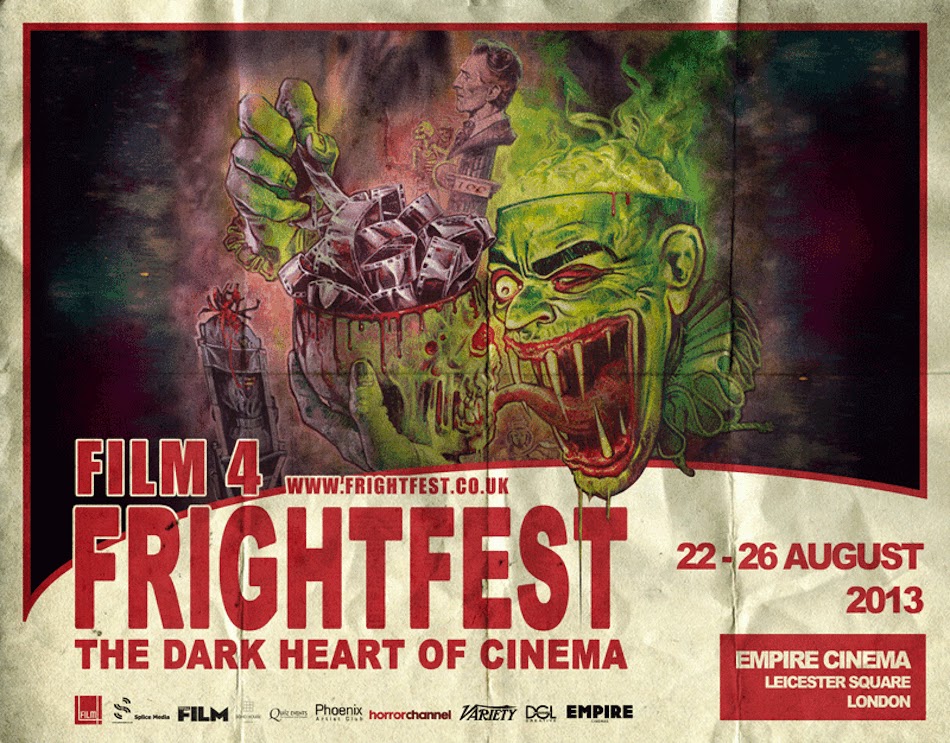
FRIGHTFEST
2013: Post-mortem
I
figure “post-mortem” is the kind of thing that horror bloggers write.
Anyway,
I am not so sure that I am hard to please. “The Dead 2 India” works for me,
despite its flaws being more obvious than its predecessor. Hell, I even dug the
“Slumber Party Alien Abduction” episode from “V/H/S 2”, which was probably my
guiltiest pleasure of the festival. But on the other hand, the random logic and
smugness of “The Hypnotist” and “Odd Thomas” just made me picky and petty. If
it was the dominance of rape that marred last year’s selection, this year is
was simply tiresome illogical character-cam… but even then “The Conspiracy”
tried to do something new and, even more, “Willow Creek” showed how that
aesthetic should be done.
But,
in the end, it was a better collection of films than I anticipated because there
was nothing I was really, really jazzed up to see. Last year I was really eager
for “Maniac” and “Berbarian Sound Studio” (both of which were magnificent). But
I got plenty of surprises and happily have a handful of favourites.
In
no particular order:
·
Dark Tourist
·
Big Bad Wolves
·
Willow Creek
·
Cheap Thrills
…And worthy mentions:
·
100 Bloody Acres
·
No One Lives
·
You’re Next
I changed my mind about “You’re Next”. I
had heated discussions with my friend who didn’t take to “Cheap Thrills”. I
bitched about “The Hypnotist” and its logic. I thought the audience this year
was even more fun than last year and admired how full-on and appreciative we
all were throughout the long weekend.
Here is a list of my favourite things from the films I saw:
·
The
‘monster’ designs in “Frankenstein’s Army”.
·
That tent-based long,
long take in “Willow Creek”.
·
The
quality of performances throughout, even in exploitation fare such as “100
Bloody Acres”, but especially “Haunter”, “Willow Creek”, “Cheap Thrills” and “In
Fear”
·
Zombie-cam
in “V/H/S 2: A Ride in the Park”
·
That birth scene in “V/H/S
2: Safe Haven”
·
What
creeped me most: aliens in “V/H/S 2” episode “Slumber Party Alien Abduction”
because it seemed resembled much as I feared when I was a kid (even though it
probably isn’t especially good). Also:
·
Guiltiest
pleasure: “V/H/S 2” episode “Slumber Party Alien Abduction”
·
What
scared me the most: the noises of “Willow Creek”
·
What
scared me the most runner –up: the empty Irish lanes of “In Fear”
·
What
bothered me the most: “Dark Tourist” and “Big Bad Wolves”
·
Worst
monsters: “R.I.P.D2” and “Banshee Chapter”
Favourite visuals:
·
The
image of a man wearing a red bullhead (“The Conspiracy”).
·
The
hotel (“In Fear”).
·
The
avalanche in “The Dyatolov Pass Incident”
·
The
monsters of “Frankenstein’s Army”.
·
The
opening of “Big Bad Wolves”
Actually, I am not sure a “Favourite
Visuals” list is going very far, because there were so many good, individual moments
to enjoy. But those are five favourites anyhow. I mean, “V/H/S 2: Safe Haved”
was probably chock full of vivid
unsettling images in its short running time than any two or three of the other
films thrown together. But there was so much to chose from… the finger moment
from “Cheap Thrills”, Chucky inanimate and then the first time Chucky speaks,
the wandering dead of “The Dead 2: India”, that
moment in “No One Lives” when the killer infiltrates the gang’s hideout and
pops out from where he’s been hiding, the first telekinesis assault in “Dark
Touch”… and, yes, even the avalanche scene from “The Dyatlov Pass Incident”. I
think we were spoilt.
So long, Frightfest 2013. It was a pleasure.
Labels:
favourites,
Frightfest,
monster movies,
Sasquatch,
Willow Creek
Frightfest Day5
DAY 5: Frightfest 2013
On the last stretch now, but still
much to go. There have been ominous mentions that the big screen, with its
capacity of holding 1330 Frightfesters, is to be closed down; even though the
showrunners aren’t saying too much it would seem it is going to split into two separate
screens (at time of writing, official announcement by the Empire is pending).
Already I am thinking that Frightfest would be a slightly lesser experience for
loss of the big theatre… but that’s just the pessimist in me.
“Dark
Touch” has a fine grey Irish atmosphere in which its young
protagonist, maltreated and confused, discovers and explores her psychic
powers. At first her telekinetic powers are uncontrollable and she reads the
phenomenon around her as the house having a rage, but once she is taken in by
another family who try to draw her out of herself, Niamh soon works out what
she’s about and learns to focus her powers against the abuse and inanity of
adults. Marina Da Van’s film starts well
enough and there are a number of decent set pieces when Niamh’s power lets
loose, but the film struggles as it goes on: some of the adult behaviour seems
a bit daft and certainly there was unintentional humour causing audience
laughter; at other times, certain things do not quite seem clear enough. This
means that the birthday doll party scene ends up as unconvincing and
unintentionally funny because surely the adults would have had more sensitivity
than to let Niamh go to a doll party (after she experienced her infant
sibling’s death) and perhaps it is not quite vivid enough that she casts some
psychic influence over the other kids (otherwise their mutilation of the dolls
is ridiculous). Similarly, the finale is agreeably downbeat and striking some
resonance with the kids emulating the inanities and casual control of their
parents, but it also feels as if some footage making the sequence fully
coherent has been left on the cutting room floor. Full of promise, it
nevertheless ends up unsatisfying and feeling somewhat incomplete.
On the other hand, lair
Erickson’s “Banshee Chapter” – 3-D!
– has very little to offer at all except a bunch of tiresome clichés. It has
some found-footage/character-cam aesthetic, which means we reach the ridiculous
situation where found-footage is in 3-D. This gives way to the director’s camera,
but Erickson films with the same swirling and swinging camera as a
character-cam, so the entire film feels like “found footage”. It’s a mess. The
premise is that the American government experimented on people with
mind-altering drugs; Internet journalist Anne Roland investigates (and is badly
played by Katia Winter). Ted Levine steals the show as a burnt-out ex-beatnik dopehead
but to little avail. The Frightfest programme states that this is “Based on
real documents, actual test subject testimony and uncovered secrets about
testing run by the CIA”, but if true their main achievement was in summoning
post-“Ringu” spooks. Despite the “true story” angle, this is of very little
interest, tired and trivial.

“ODD
THOMAS” is one of those oh-so-cute supernatural-superhero wish-fullfillment
tales that have characters with first names like “Odd” and “Stormy”. Eponymous
Odd Thomas is a young man with the ability to do whatever the hell the script
needs him to do: he sees dead people and spends his time avenging their deaths
(wait, how many would he need to save in small town USA?); but he also sees
wraith-like death creatures that are never quite called demons, even though
devil worshiping turns up elsewhere; and then there is a guy who apparently
wants to be a serial killer even though he is actually plotting to be a mass
murderer (the script throws this all together). And then Odd Thomas can see
dead people except for when he is being haunted himself… er? The film can barely go five seconds without a special-effect of
some kind. It seems to be some teen-orientated adventure but with jokes about
Ed Gein’s belts made of nipples and a mall massacre: that weird, particularly
American mixing between the daft and the genuinely disturbing without an inch
of self-awareness leaves the whole thing a bit clueless and unfocused and a
hodgepodge of horror junk that just leaves it as a pile of various crap thrown
against the wall. “Odd Thomas” has found far more favour with others than from
myself, because diverting as it may possibly be, it just seems to me to be more
mainstream filmmakers waving various horror tropes and attributes at the
audience and ending up incoherent instead of genuinely and gleeful chaotic. There
is little sense it actually knows what it is doing except chucking a bunch of
stuff onscreen. It is based on the novel
by Dean R Koontz and directed by Stephen Sommers, and you can take those as
warnings.
Jorge Michel Grau’s “We Are What We Are/Somos lo que hay”(2010) was the very first film I ever saw at
Frightfest, years back. It was the only film I saw at Frightfest that year
(because they banned “A Serbian Film” at the last minute) and I thought it was
minor classic. Bill Sage’s American re-interpretation is moody, slick and
getting much praise, but it is elegant and stylised where Grau’s original is
dirty and desperate. The original is about a broken underclass beyond repair,
it’s about starvation and struggle where Sage’s remake is mostly about ritual
and bullying patriarchy. Sage doesn’t really get into the nasty stuff and the
very ritual that ought to show without qualm the exact gristle of the family’s
cannibalism is all off-stage, so that we get a sympathetic backstory about the
ceremony but not its truth. On its own terms it is a fine variation slice of American Gothic, but it is a far less
nourishing and angry affair.
Aharon
Keshales and Navot Papushado introduced their “Big Bad Wolves” as a kind of revenge upon their parents who
brought them up on Grimm’s fairy tales wherein the monsters are euphemisms and
allegories for paedophiles. “Big Bad Wolves” succeeds on that level and many
others: as a shocker, as a mystery (did he do it?), as black comedy and as a
scathing indictment of torture and men who want to be, in various ways, big bad
wolves. After a deceptively elegiac opening, inclining towards fairy-tale, the
brutality sets in: the police are beating up the prime suspect in the case of a
missing little girl but they aren’t careful and cause the investigation to tank
when their ‘interrogation’ is. Meanwhile, the girl’s father has his own plans
to make the prime suspect confess. All the clues are there but you may not notice
them the first time round for the film moves between black-humoured farce,
social commentary, very real horror and stark violence that you may not quite
see its greater game. A brilliantly
scripted and cruelly played condemnation of man’s inclination to violence as a
recourse and resource.
And so, "Big Bad Wolves" is the very last film to be screened at the Empire's major screen. Festival organiser says he cannot reveal too much but looks forward to something different and better. And why not? I for one will miss the gigantic auditorium.
But I will still be back next year for Frightfest.
Labels:
cannibals,
Frightfest,
ghosts,
horror,
we are what we are
Subscribe to:
Posts (Atom)


.png)