Showing posts with label coming-of-age. Show all posts

Saturday, 13 June 2026

Walkabout


WALKABOUT
Director ~ Nicolas Roeg
Writers ~ Edward Bond, Donald G. Payne, Nicolas Roeg
1971, United Kingdom-Australia-United States
Stars ~ Jenny Agutter, David Gulpilil, Luc Roeg

Nicolas Roeg’s first film ‘Performance’ was directed with Donald Cammell, but he was an established cinematographer beforehand (‘Fahrenheit 451’ and, notably, ‘The Masque of the Red Death’). Both Roeg and Cammel went on to exhibit exemplary powers and skill with editing, although only the former crossed over. Roeg carried this on with a succession of classics from ‘Walkabout’, his debut as a solo director, ‘Don’t Look Now’, ‘The Man Who Fell to Earth’ and ‘Bad Timing’: a stunning run. Even later, lesser films such as ‘Eureka’, ‘Insignificance’, ‘Track 29’ and ‘The Witches’ had a lot to offer with his oddball sensibility.

The novel ‘Walkabout’ by James Vance Marshall, published in 1959 originally as ‘The Children’, is a slender affair with a slim story and a travelogue sensibility, showcasing indigenous tricks of survival, the outback scenery and wildlife. James Vance Marshll was a pseudonym for Donald G. Payne, the former being a man who lived in the outback that Payne knew.  The plot: two American children – a young American boy and his adolescent sister – are the sole survivors of a plane crash in the outback and only survive by stumbling upon an Aboriginal youth on “walkabout”, the indigenous rite-of-passage ritual of survival in Australia’s unforgiving wild. The culture clash is both sweet and ultimately tragic and Marshall leaves much unspoken.

Roeg’s ‘Walkabout’ announces his fierce translation of a young adult novel with shock tactics, unpredictable yet fluid cross-cutting editing that moves across time, memory, space and place, held together with the drift of John Barry’s luscious score and reaching a replication of experience rarely achieved in film. Certainly, it does not feel like a children’s benign odyssey anymore, however much the book has been marketed as such. It does this by marooning the children not with a plane crash, but their father’s breakdown (presumably caused by the modern world), murder attempt and suicide. This is a smart narrative change, saving budget but also announces a world of danger and unanswered questions. Your class privilege won’t save you, is not even a safe place ~ and in this adaptation, it is a particular English class privilege.

Like the prose, Roeg’s vision never loses sight of the wildlife simply carrying on while these two alien interlopers of civilisation try to survive. There are many startling shots of scenery and wildlife throughout the film: with a tiny crew of six people, Roeg created a phantasmagoria of improvised beauty and brutality. Always, his editing conveys layers that never lose sight of a bigger picture: they sleep and the dissolves convey their dreaming; as they wrestle with what to do next, the radio talks of mankind’s evolution to a “perpetual succession of comfortable shopkeepers”; or the sun and moon sounding like radio transmitters, or collecting memories on the airwaves. The adage goes that if you don’t notice the editing then the editor is doing their job, but with Roeg the editing is a character, acting like an omnipotent observer, like the universe or fate or Greek Gods playing around with the protagonists. Always a wider and comparative view is communicated: when the white kids are playing in a tree, it is juxtaposed with Aboriginals playing with the burn-out husk of the car; carving up a wallaby is intercut with a butcher’s shop. James Barry’s lush score and the sound design are integral to this, even lapsing into diegetic pop at moments (there is almost always the radio as a symbol of society broadcasting both its inanities, white culture and music). 


Roeg had apparently planned to adapt this book for years, for so long that he had co-directed ‘Performance’, his eldest son had grown too old for the part that his youngest took and Agutter had grown a few years into the much more suitable sixteen-seventeen. Agutter’s cut-glass Englishness and professionalism is perfect for a girl that can’t quite adapt from her bubble of civilisation, berating her younger brother for not caring for his uniform in perilous conditions, who thinks that the indigenous boy should know what English if she just talks more forcefully. Hers is a cultural superiority that cannot see or break out of its narrow-mindedness and her persistence in keeping a stiff upper lip are alternately heroic and annoying. She is almost the antagonist in her stubborn resolve not to integrate. Young Luc’s young performance is all young roughness, and it cannot be understated how effective his natural disarming nature is. Gulpilil’s natural grace and openness is warm and fascinating. These make for contrasting yet complimentary performances.

Agutter speaks fondly of David Gulpilil, who obviously made a strong impression on her, and warmly of Roeg. Gulpilil – whose name is misspelt as Gumpilil in the credits – went on to have an acting career for the rest of his life. Lucian Roeg (credited as Lucien John for the film) also speaks of the filming as a fondly remembered time with his whole family. He went on to be a producer ofmany noteworthy indie films (including for the Tom Waits live film ‘Big Time’) but has no further acting credits.

In the book, the white foreigners bring germs and a lack of understanding that brings about the death of the Aboriginal boy; it is his nakedness that the girl can’t get over; indeed, nudity itself proves almost insurmountable for her. In the film it is more sexual awakening mixed with this lack and fear of understanding. The film conveys sexual tension through suggestive close-ups and glances. She becomes increasingly frustrating in her boneheaded adherence to civilisation, although this surely stems also from fear.

At one point, the girl assumes that they are the first white people the youth has seen, but Roeg also shows how busy things are as the children roam oblivious. There are also weather balloons, hunting and what appears to be the exploitation of the locals. There is a great sadness when the youth becomes serious with his advances rejected by the girl who doesn’t understand, and a realisation that this civilisation that is portrayed as unfriendly and crude will reject and destroy his culture. But this is not to say the film is sentimental about the opposing Aborigine culture, making killing as much an ancestral artform, hanging corpses in trees, surrounded by flies. He also does not possess the imagination to think beyond his culture to communicate more than survival tips. The girl realises too late the Eden she experienced. These are the tragedy.

‘Walkabout’ may possess a simple and slender premise, but it is thematically rich: coming-of-age, culture-clash, class, survival, existence and nature, as Roger Ebert says, “the mystery of communication”.   Its use of editing, imagery and symbolism are unmatched in unlocking these wider contemplations on culture, memory and experience, and ultimately it is enchanting and very, very moving.


Monday, 20 April 2026

DJ Ahmet

DJ AHMET
Writer & Director ~ Georgi M. Unkovski
2025, North Macedonia-Czech Republic-Serbia-Croatia
Stars ~ Arif Jakup, Agush Agushev, Dora Akan Zlatanova


One of those minor bildungsroman that leaves you life-affirmed and takes up a small corner in your affection whilst the mainstream is mostly bombast and performative emotions. Its worth is in showing a small far away community and highlighting that the emotional simularities between cultures aren’t so conflicted at core. Ahmet is a typical fifteen year-old, a Yuruk teen from a remote Macedonian village, trying to cope with the loss of his mother and a difficult father who takes him out of school to work sheperding, as well as looking out for a younger brother that hasn’t spoken since their loss. Ahmet isn’t even really an odd-one-out, an outsider, just coping with domestic and social circumstance and first love. The pink sheep may symbolise otherwise, but it just needs time to find its way back.  

What is perhaps enlightening is the portrayal of how the contemporary TikTok age reaches such a relatively isolated and traditional community. Indeed, if anything, it is almost conventional for these stories that the enemy here is tradition and the patriarchy. While the mosque is broadcasting prayers from a PC (some of the film’s best laughs come from this), the men are still trying to marry off teenage daughters to their adult sons. The location offers many, many gorgeous vistas, making this, as Daniel Eagan says, “both wildly exotic and completely down to earth.”  He also says that

Jakup, who's in almost every scene as Ahmet, gives a solid if occasionally stiff performance. He can be charming, especially with his younger brother, but his character is too withdrawn and hesitant for much of the movie.

Jakup’s performance offers an unpolished natural niceness and sudden expressions that charm in their spontaneity. But not everyone is a go-getter or fiery or a traumatised lover, and if there’s anything the coming-of-age genre is good at it is showing how the ordinary is extraordinary to someone, how dilemmas are melodrama. And how limitation inspires invention: with the right motivation – music and love – Ahmet turns his tractor into a sound-system, for example. There’s a maintained sense that he is just on the verge: of being music-obsessed, of defying his father, of falling in love. Incidentally, Arid Jakup comes from that very village. 

It is Dora Akan Zlatanova as Aya that steals the show, rightfully so to knock Ahmet off his feet, sparkling with a worldiness that this town has little idea about. Yes, there are secret festivals happening just outside, but the patriarch aren’t truly aware or consenting, so they are not about to agree to her dance routine with which she hopes to sabotage her arranged marriage. The music itself appropriately goes from EDM to traditional, bursting out and blurring in but never quite dominating the set-pieces until it needs to.

It is not a film that feels angry or unsympathetic to any of its characters, but one that broadcasts empathy and the generational struggle between what is coming and what is already happening. If its simple message is to be brave, that’s powerful enough for a little funny film. We know he’ll be okay.


Thursday, 2 January 2025

Film Comments 2024: Man Bits


Film Comments 2024: MAN BITS

Toxic masculinity, then:

The other body horror concerned with gender, Steven Boyle’s ‘The Demon Disorder’ will in no way knock ‘The Substance’ off its perch of the moment but it boasts equally impressive effects, however briefly by comparison. The disorder is unhappy masculinity, and the demon is mental illness. Three contentious brothers must come together to battle both. With rough-edged machismo and a tone of melancholy and tragedy, and with a nod at farce (Shit! The cops are at the door!), it may have better characters than ‘The Substance’ but it’s nowhere near as memorable or striking. As enjoyably minor as it is, there is a sense it could have achieved much more.

It was up to Sean Durkin’s ‘The Iron Claw’ to really give the kicker to the fraternal tragedy. By the ending’s heartbreaker lines, Zac Efron’s performance had shown itself to be stealthily accumulating some impressive work. And when you have this kind of repeat heartbreak, it’s a pattern not a tragedy. 


A toxic scenario rather than fraternity in Isaac Ezban’s ‘Parvulos’. Three brothers trying to survive a zombie apocalypse on their own: the young actors give it all; the aesthetic is so washed out it’s often black and white; there’s some nice casual build-up, but it’s all increasingly a little bitty. You can tell it is heartfelt, which seems to make for a blindspot to its deficiencies, but it meanders along long enough for the audience to notice.  The aesthetic and the central horror of potential starvation do a lot to make this memorable, but if you’re bored of zombies this won’t change your mind.

Edward Berger’s ‘Conclave’ centred on a toxic brotherhood of priests, concerned only with infighting and the political machinations of becoming the next pope. Berger pulled back on the pyrotechnics of ‘All Quiet on the Western Front’ but the set design, framing and editing were no less impressive, getting out of the way of a bunch of superlative old guard actors. It was a film that accented age by allowing a lot of acting with nasal breathing on the sound design, along with a lot of small gestures and enjoyable conniving. The lockdown claustrophobia of the conclave acted as a decent metaphor for the insular nature of religious heads as they bickered over something that would define entire populations’ Faith whilst not knowing the outside world. Brilliant casting too: all Isabella Rosellini has to do is lurk with a few devastating lines up her sleeve to steal the show.

Scott Beck and Bryan Woods’ ‘Heretic’ tapped into a quite zeitgeisty horror of mansplaining. Great performances all round, a little genre play and never losing its suspense although very talky.

Todd Phillips’ ‘Joker: Folie à Deux’ came across as a response to the toxic fanboys that his preceding ‘Joker’ attracted. You waited throughout the film for Arthur Fleck (Joaquin Phoenix – a very canny actor) to find his anarchic-terrorist, villainous, anti-hero self, but the film thwarts at every turn, leaving him just a broken man. Hell, Phillips stokes up the desire to see him let loose and teach those abusive guards a lesson. It’s the introduction of starfucker Lee Quinzel (Lady Gaga) that lights the touchpaper, but the prison set is paramount and I inescapable, and Fleck is trapped by his own reputation and mental health issues. When I first heard this was to be a musical, I thought the numbers were to be an extension of Joker’s unpredictable craziness, but Phillips has a different agenda, making them melancholic expressions of Fleck and Quinzel’s romantic delusion. And the end stroke only clarifies the distance between the real and superhero world for such a perpetrator in, the coda of the reality of aspiring to be such a character or in his cult. A much hated film, it seems, but it withstands post-mortem dissection. But then the original was not so interested in being what you expected either, however misinterpreted it was by some. ‘Joker: Folie à Deux’ is a film that will surely grow in reputation and reconsideration over time.

When it came to straightforward action heroics and super-violence, Dev Patel’s ‘Monkey man’ mashed-up ‘John Wick’ with ‘Slumdog Millionaire’ with very enjoyable results. A little social conscience, melancholy and a style went a long way.

For more mindless excess, Nikhil Nagesh Bhat’s ‘Kill’ was a riot, starting with ten minutes of cliché before getting to the train and setting things off; and then dropping the title midway and saying You thought that was brutal before? The distinguishing feature that set it apart was that this train-bound actioner delivered all its brutality whilst humanising its bad guys and dehumanising its hero, all with Bollywood sentiment distracting.

Competing for the most despondent film of the year were ‘All of Us Strangers’, and ‘I Saw the TV Glow’. Both had moods and vibes to get lost in, both overcome by their own sadness and melancholy.

With ‘All of Us Strangers’, Andrew Haigh repurposes the novel ‘The Strangers’ by Taichi Yamada (adapted previous by Nobuhiko Ôbayashi’s as‘The Discarnates’) to plunge deeply into one man’s isolation. Adam (Andrew Scott) is a writer, so he has lots of time to be lonely in an apartment block which is apparently occupied only by another lonely man. It’s all about unresolved grief and trauma: it would seem that Adam hasn’t truly been able to move on from losing his parents as a bullied gay child, and he spends his time between ghosts and romancing Harry (Paul Mescal). ("It's okay, it happened a long time ago." "Yeah, I don't think that matters.") Andrew Scott is the kind of actor where you can see the cogs working when he’s alone, but the interactions he has with his parents’ ghosts are excellent. Scott, Clare Foy, Jamie Bell and Mescal are all up to investing the premise with the emotional possibilities that only the fantastical can reach. It builds a lot of affecting resonance, has a lush ambience and ultimately leaves him more alone in the universe than ever. And no matter how much Frankie Goes to Hollywood might try to cover it up, there’s the feeling that cruel moves have been made with a resolution that might stick in the craw.

Jane Schoenbrun’s ‘I Saw the TV Glow’ is a similarly ruthless-melancholic portrayal of one man’s forlornness, achingly sympathetic, dressed up in neon and a killer indie rock-pop soundtrack. Like Schoenbrun’s ‘We’re All Going to the World’s Fair’, it’s been thrown in with the horror pot and yet it’s far more amorphous than that, despite having some decidedly Lynchian moments. Our protagonist Owen (Justice Smith, covering a wide range of ages) barely even starts in life, barely recognises his own repression, is adrift. As a kid, his only friend is an older girl obviously going through her own identity struggle. The film is good at the brightness, rootlessness and uncanniness of adolescence, of showing how fandom grounds you, guides you as you discover yourself. It also takes a moment to show how those things we loved as youths probably weren’t as good and poignant as remembered. In this too, there’s a tragedy as we are left with Owen incessantly apologising to an inattentive world of inane distractions. It’s a raw conclusion that speaks of truth and empathy rather than cruelty, and the accumulative effect is an unusual gut-punch. If the film works only on its own wavelength, it’s defiantly obvious that is what it wants.

Hirokazu Koreeda’s ‘Monster’ was a far less abstract evocation of troubled coming-of-age, benefitting from shuffled narrative perspectives. Koreeda is a master of empathy, of emotional minutiae, revealing and changing as it unparcels itself. If the ending seems a little overly-contrived and, yes, cruel, that is nevertheless in keeping with the far more openly weepy ambitions. Surely a result of Yûji Sakamoto’s script, for Koreeda’s own endings tend to hinge on far more subtlety, although he filters here through ambiguity. It’s almost outdated in its conclusion. It’s beautifully told, has much to reveal without histrionics and maintains Koreeda’s reputation as a major and reliable dramatist.

Sean Wang’s ‘Didi’ was a more straightforward bildungsroman, but as a tale of one boy’s baby steps to maturity, there was plenty to painfully relate to. 

Matteo Garrone’s ‘Io Capitano’ ostensibly posited a warning about the dangers of striking out on your own, even about following your dreams – its Senegalese teenagers only want to leave Dakar for the pop life of Europe and run away for a mythical Italy. But the dangers and peril of migration start more-or-less as soon as they venture out, defying the warnings of their family. It is not as heartbreaking as ‘The Golden Dream’, and indeed Garrone presentation is a little too smooth, even allowing for a little flight of fantasy, but heartbreak is not the aim of this migration drama. Rather is it centred on the resilience and maturing of our protagonist Seydou, the goal being his trials from dreaming adolescence to scarred development through the horrors of migration and a predatory adult world. It is the performance of non-profession Seydou Starr that holds the film together, fluctuation between vulnerability and growing assurance. The final shot is about his self-realisation that he can accomplish what’s necessary against the odds. Even if there are to be new trials and horrors in the machinery of Italian migration, the film says, let’s just allow him his moment.

Warwick Thornton’s ‘The New Boy’ was awash with pretty outback visuals, the kind to get lost in. The new boy (Aswan Read) is an aboriginal nine-year-old, taken to an orphanage where the native ways are being “educated” out of the other boys by a renegade but well-meaning nun. He’s quite happy acting on his own interpretation of the symbols he sees, of being an outsider. Read is as comfortably insular as Cate Blanchett is brittle and frantically improvising to keep her autonomy and the safety of the boys, even as her Faith is undermining their identity. There are even moments where her desperation complements farce. After a striking opening with some violence, a calm, sunbaked ambience set is, dissolving the throughline of mysticism and the anxiety of Faith. It makes a somewhat sudden bid for thematic exclamation and tragedy for the end – the more insidious harm caused by colonialism and religion – but it is the ethereal nature that will stay strongest in the memory.

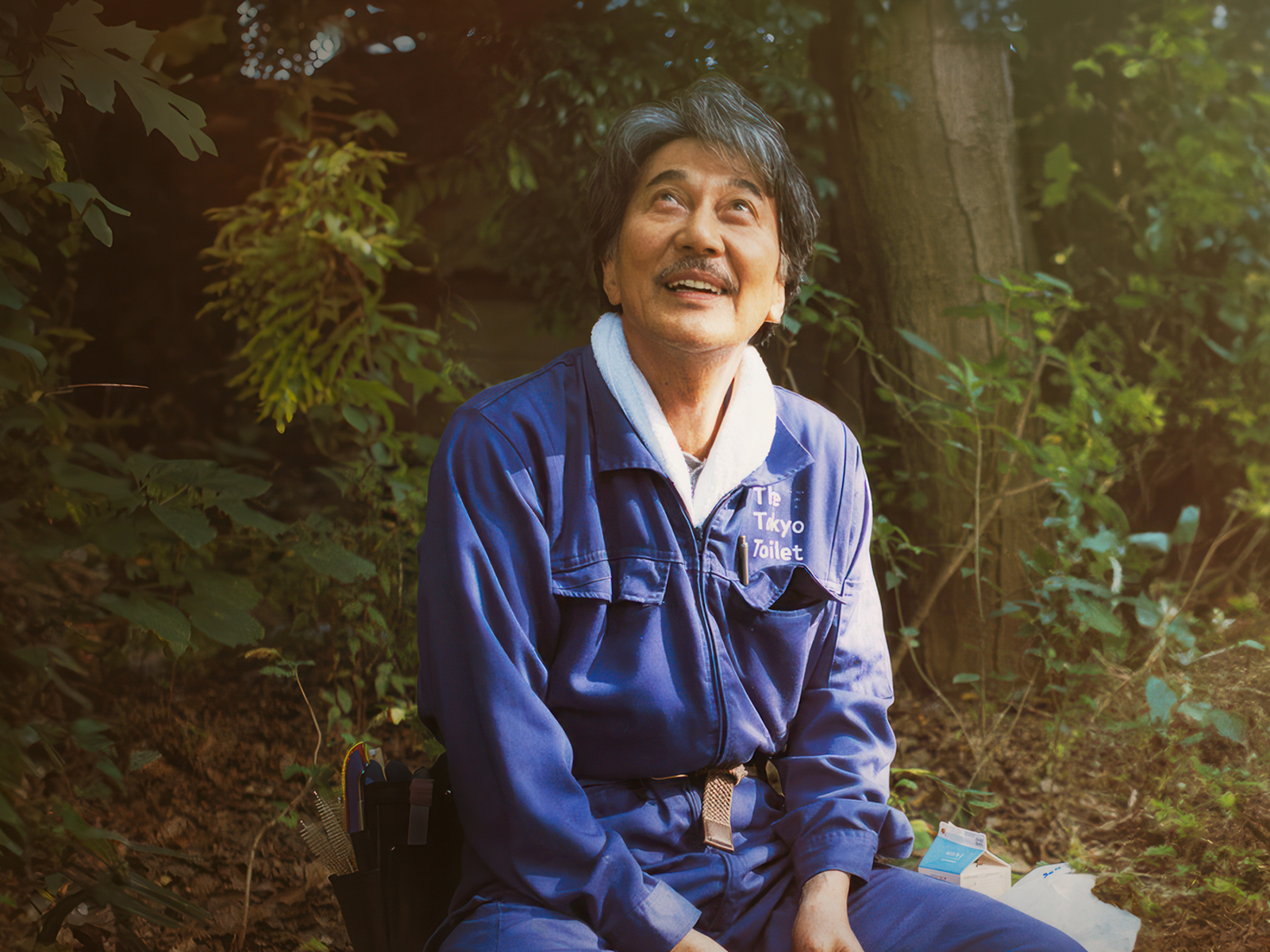
And from people struggling with identity and growing up to a character that is fully accepting of his lot, that chooses peaceful routine. Wim Wender’s ‘Perfect Days’ is one of those films that feels decidedly minor and wholly life-affirming at the same time, the kind of low-key ambience that puts your entire existence in perspective just by advocating for tiny moments. Hirayama spends his time between cleaning impressive Tokyo toilets, listening to rock classics and smiling to himself. Kôji Yakusho as Hirayama is delicious, happy to spend the film not talking and just soaking it all in – it’s a long time before we even know if he can talk. Even when some drama disturbs this calm, there’s no trauma; there may be tears but there’s no devastation. Whatever his past – and perhaps the brief interaction with his sister implies something difficult – he has reached a place where he is consistently kind and at the edges, just as he like it. It is a film about living life rather than a story, and much like Jarmusch’s ‘Paterson’, the apparent lack of Big Drama should not be mistaken for insignificance or inconsequence. We may conjecture what brought Hirayama to this place – maybe nothing at all – but there is no doubt it is exactly where he wants to be. Magnificent music taste, too.

To men that were far more discontent:

Alexander Payne’s ‘The Holdovers’ was far more narratively conventional. As a recreation of beloved films from the Seventies, it was every bit astute as homage as a Ti West horror. Kudos to the trailer for capturing that exact spirit. So you knew what you were getting, but the performances and writing were uniformly assured – after all, you have Paul Giamatti and Da'Vine Joy Randolph –and it proved a nice warm and comforting drama.

Cord Jefferson’s ‘American Fiction’ also housed many excellent performances – Sterling K. Browning stood out as the estranged brother – but was far more tonally unbalanced between its impressive family drama and a far broader satire on the publishing industry. The moment where Jeffrey Wright spoke to his characters as he was writing them was a highlight, but the film is never quite as inventive again.