Monday, 17 December 2018

Spider-man: Into the Spider-Verse


Bob Persichetti & Peter Ramsey 
& Rodney Rothman, 2018, USA

As much as I liked ‘Spider-man: Homecoming’, I still had issues with the use of Marvel’s Mile Morales’ Spider-Man high-school premise. I did feel ‘Homecoming’ got around appropriating a mixed-raced teen’s story by having notable diversity around him, but it seemed however much the comics world was now used to Miles, the cinematic world wasn’t quite ready for a Spider-person of colour. But Marvel’s use of an animated film to introduce Miles to a wider audience seems a smart and canny move: it means they have been able to do whatever they want. From the ‘Spider-verse’ trailer, I also thought Miles was going to be drowned out by too many spider-people – even Peter Porker! – but this also proves not to be the case. 

Blitzing through the multiple origin stories with montages and quips, we quickly get to Miles who looks different here to the comics and is more breezy, confident and less angsty. It’s true we’ve had a lot of Spider-Man angst to go around over the decades, so this really isn’t missed (and why the aww-shucks upbeat Tom Holland Spider-man is so winning). There’s a crowd of huge bad guys – perhaps Kingpin is a little too big in design, just a black hole crowding the frame (but maybe I’ve been spoilt by the wonderfully textured Vincent D’Onofrio Wilson Fisk from the up-and-down ‘Daredevil’ NetFlix series?) – which the script doesn’t care to give backstories to, just relying on fan recognition to fill in the blanks (again, this has to be an advantage of being an animated feature – hey isn’t that Tombstone?). The voice cast do a great job, of course, with Nicolas Cage as Spider-Man Noir being an amusing easter egg. (A list of other easter eggs at Den of Geek.)

It’s fast and always kinetic in a way that animation allows that can be tiresome and in live-action, but held together by a script that doesn’t come to a stop when the emotional bits happen or becomes indecipherable when the action kicks in. Phil Lord and Rodney Rothman’s screenplay is almost as scatological as ‘Deadpool’, with the logistics surely on par with ‘Avengers: Infinity War’. Or, as comics writer Scott Snyder tweeted:

Scott Snyder‏ @Ssnyder1835 

As a writer, #Spiderverse is a deeply inspiring movie. The challenge of that script - in-troducing a new spidey, a new universe, then 4 more new spideys, making it all feel true, exciting, heartbreaking... that math is next level hard and the movie was incredibly good
15/12/18


On top of this, there’s a wealth of varying animation styles – various universes and all that – and a trippy finale that matches anything from ‘Dr. Strange’… and even a good Rubik’s Cube gag. There’s a strain of animation that is hyperactive and often nonsensical, but ‘Into the Spider-verse’, as chock full of stuff and diversion as it is, never loses focus. As over-crowded as this is, it is steered by Spider-people's outsider qualities: the other Spideys are like future options for this brand new one, whether dead, gone -to-seed, moody-noir, silly-ham or heroic young Gwen: but it's not like he has to choose - he's just starting out and finding his bravery.

And it even defiantly saves the Miles Morales subplot of his roommate knowing he’s Spider-man in the back pocket for the next time, regardless of ‘Homecoming’ already pilfering it. Miles’ debut couldn’t have ended up being more striking. Fun, furious, gung-ho, ludicrous and highly entertaining. If this is your kind of thing, it’s the kind of film that you know will reward a repeat viewing even as you watch, a big surprise of exuberance and the joys of the genre and animation.


Saturday, 15 December 2018

Harlequin


Simon Wincer, 1980, Australia

Screenplay by Everett de Roche, a reliable genre writer, This hodgepodge oddity is one of those films that, as a kid, I could throw in with psychic power films and stuff like ‘The Medusa Touch’, ‘The Fury’, ‘Carrie’ or even ‘The Omen’ and 'The Gate', where anything seemed possible, where an unseen logic dictated strange occurrences. Where a stain on the floor turns into a face, for example. Like superheroes, such abilities appeal greatly to power fantasies and ‘Harlequin’ certainly appeals to a male fantasy of mysterious powers as well as those of martyrdom.

It’s a rendering of the Rasputin story where a mysterious stranger called Gregory Wolfe (how’s that for allusion?) ingratiates himself into the political Rast family by seemingly curing the terminally ill son. Wolfe’s ultimate plan is to show the ambitious politician Rast (David Hemmings – and don’t forget to spell “Rast” backwards) how he is being manipulated by devious superiors, but it’s not clear how he plans to do this by spending months talking and smirking cryptically, turning up in hilarious garb and bedding Rast’s trophy wife (Carmen Duncan).

Robert Powell as Gregory is just short of the full-on camp of ‘Rocky Horror’s Tim Curry, but it’s campness of the inadvertent kind: he spouts French for flirting, acts like a dick to the women, holds the child over cliff-edges for some lesson about the closeness of Death. Occasionally he indulges in parlour tricks, spangly eyebrows and – when exercising true magic which everyone seems to just accept as illusions – charmingly dodgy effects. It still appeals for being offbeat, a mishmash of political and horror-fantasy that makes it winningly offbeat and always intriguing. When potentially anything goes, there’s always anticipation for being surprised. But no, it doesn’t quite go full-on bonkers, although Powell does wear a Harlequin outfit (which he must have hired from the same place he got the clown outfit).

‘Harlequin’ turns up in discussions of the run of Ozploitation films of the 70s and 80s, a slick and offbeat inclusion. It smudges its Australian origins by importing British leads and dubbing characters in American, but Powell’s frosty charm and Hemming’s slightly hangdog blustering raise the bar even as Duncan is constantly throwing herself at Gregory’s feet. Richard Kuipers gives a good rundown of how this is “the most ‘internationalised’ of [Australian] genre pictures”, and notes that upon release,

“Australian critics and audiences may have been cool but the story overseas was very different. Harlequin won awards at the prestigious Sitges and Paris Fantasy Film Festivals, received theatrical release in the US and UK and was a sizeable hit in several Latin American territories.”

It’s datedness, its unintended campness and the fact that it’s determinedly unspecific on many details all add to its fascination. If it doesn’t quite make sense at the end, if there’s a sense that the audience has always been kept at a slight distance throughout by intention or lacuna, that all becomes part of the mystery.


* I also note that the recent 88 Films blu-ray release also features a epilogue where the corpse is found by boys fishing, which is different to how I saw it end originally and makes more sense of Wolfe’s actions. 


Saturday, 1 December 2018

Valerian and the City of a Thousand Planets


Luc Besson, 2017, 
France-China-Belgium-Germany-United Arab Emirates-USA

Despite the title, the scope is a handful of planets at best and the implied awe of the title is captured by an over-saturation of CGI. But it’s the weightless kind of CGI, the kind that thinks quantity dazzles itself out from the nodding requirements of realism or physics. There’s so much of it and it’s filmed with such a giddy plunging camera that it really doesn’t leave too much of a mark. There’s a stillness to ‘Blade Runner 2049’ that allows time for its CGI vistas to unlock your wonder, for example; there is even a pace to ‘Black Panther’ that allows Wakanda to make an impression with its utopian vision. Or ‘Solo’ is a decent example of a faux-realism, a credibility to give matter to the FX bonanza.Look to 'Avengers Infinity War' to see how such a saturation of fakery needs an alert script to capture interest as well as imagination. Luc Besson is very much style over substance but here, there’s the blight of inconsequentiality that comes with too much reliance on digital effects. 

But worse than this, although based on a long-running and influential pulp French comic series – even though I have not read ‘Valérian and Laureline’ by Pierre Christin and Jean-Claude Mézières, going since the Sixties – the film feels like nothing but a superficial rendering with dialogue set around ‘Star Wars’ level but with less interesting characters. The bickering between Valerian  (Dane  DeHaan)and his lover Laureline (Cara Delevingne) is of the puerile and tedious kind – he is trying to make up for being a rat by marrying her why she is playing the difficult ice maiden that will give into his dubious charms eventually – so there isn’t much to take from that.

There’s the Rhianna impression showreel (reminiscent of Besson parading Natalie Portman in a variety of pop-culture personas in ‘Leon’, except with more shape-shifting), Clive Owen doing his best swishing villain, and Ethan Hawke, Rutger Hauer and Herbie Hancock cameos, but as Peter Bradshaw says, “- no actor is given much to work with in the Google Translate script.” Yes, there interesting details and incidents to distract but they ultimately add up to very little more than a cascade of diversions (the fishing episode, for example). When it uses Bowie’s ‘Space Oddity’ to win favour, it’s a little too close to Zack Snyder’s grab-bag mess, ‘Sucker Punch’. Worse, some of the aliens verge on the Jar Jar Binks side.

It often plays like a thin framework for the cut scenes of a console game you are watching someone else playing.The thin drama of a comic space opera is usually more evident in the transition to film and this does not have the same wit as, say, ‘Flash Gordon’ or ‘Barbarella’ to be much more than a vaguely pretty spectacle. 

Thursday, 22 November 2018

Peterloo


Mike Leigh, 2018, UK

With The evidence of ‘Mr Turner’ preceding this, it turns out that Mike Leigh has emerged as one of the premier artists of period cinema. 'Peterloo' follows the lineage of Bertolucci’s ‘1900’ or the work of the Taviani brothers. With almost every shot, it resembles classical portraits brought to life, people moving and living in those portraits on walls of national galleries. As with ‘Mr Turner’, occasionally there will be a vista of landscape to take the breath away, but it is never quite prolonged to give the jaw time to fall all the way ajar. In this way, the editing is fluid and never showy, never intruding on the acting or story or the impressive set design. And no matter how immersive the aesthetic, it is always secondary to the exemplary ensemble cast. But the opening is the notable exception. 

From the opening shot, Leigh seizes the attention with the long take of Joseph (David Moorst) in the middle of the Battle of Waterloo, bemused, looking around at the carnage and explosions, trying to do his job as bugler even as it’s a wonder he isn’t killed. It is the one time the camera feels deliberately aware and subjective, circling him as if closing off any escape route. Here is a man being traumatised. 

When he gets home to Manchester, it’s to vivid poverty and disenfranchisement. Indeed, the endless meetings seem like class war counsels. The locals are attending pro-democracy meetings and getting all fired up over trying to get the vote. This is an era where only 2% of the population had the vote and the new corn laws were causing starvation. And so cue the rich sitting at a banquet whilst the impoverished suffer and struggle to have agency. 

As Peter Bradshaw summarises:

On 16 August 1819, at what we would now call a pro-democracy demonstration in St Peter’s Field, Manchester, an excitable band of cavalry and yeomanry – whose commander had airily absented himself for a day at the races – charged with sabres drawn into a crowd of 100,000 unarmed people, many of whom were unable to escape the enclosed space. The troops killed 18 and injured hundreds more.


The dichotomy is distinctly between the cruel and paranoid authorities and the down-to-earth working class poor united by righteousness. The dissenting argument is that the authorities are coloured too broadly, as caricatures, but this is surely endemic in polemical commentary. In George Cruikshank’s satirical ‘The Massacre at St. Peters, or Britons Strike Home’ (1819) the yeomanry are all plump and rosy-cheeked, flush with outrage and righteousness as they cut down the unfortunate protesters. This is even a feature of Richard Carlile’s more austere painting representing the scene (1819). Indeed, the yeomanry were often freeholders and tenant farmers themselves (having funds to buy uniforms, etc.). 

On horseback, armed with sabres and clubs, many were familiar with, and had old scores to settle with, the leading protesters. (In one instance, spotting a reporter from the radical Manchester Observer, a Yeomanry officer called out "There's Saxton, damn him, run him through.") 
http://www.peterloomassacre.org/history.html

This can be nothing else but anecdotal but is an illustration that broad and partisan have always defined the event. Since we know that the magistrates did indeed order the soldiers to let loose on the crowd, it is hard to imagine any portrayal that would not portray them as outright villains (well, not without going down a ‘Birth of a Nation’ route). Here, they act in arrogance, anger and chaos; conniving and sure of their superiority. The more moderate and mitigating magistrate voices are shouted down and side-lined for the rush to blustering authoritarianism. 

When so many of our contemporary political figures seem cartoonish or behave like caricatures – just look around – it is perhaps a little limited to just dismiss Leigh’s characters as caricatures: the massacre is historical fact and it is quite believable that the boorishness and callousness of the authoritarians were to blame. The villainy is in their actions, regardless of their portrayal. When the massacre happens, it is shown as much the result of chaos and shouting as brutality. But yes, there is no doubt there is a good and bad side, with the latter scheming and misconstruing for fear of the workers and selfishness. Whether politics and political action has progressed is for debate.

‘Peterloo’s  uniformly impressive ensemble cast populates this vast tapestry of period recreation and polemic. It’s cleanly and beautifully shot by Dick Pope and there is much detail to wallow in; but the constant talk and rhetoric may put some off and occasionally falls into exposition of history notes. Perhaps this is inevitable given the nature of the project, Leigh’s intent to give as much perspective as possible and how this has been a lesser known historical massacre. There are subplots of PTSD, disillusionment with one’s heroes, agent provocoteurs, the role of the media supplementing the bigger themes of the political scheming, infighting and class war, all funnelling into the final tragedy. 

Perhaps there is a little repetition and a meeting or two too many, but Leigh lays down as many ramifications as he can so that when the massacre begins – the joyous and open feeling of the protesters in contrast to the outraged and bickering magistrates – all the details culminate to produce the appropriate horror. This final sequence does not use the rapid editing utilised to induce the facsimile of excitement as typical of action sequences, but rather speeds up its straightforward observations to clearly show the confusion and awkwardness of the atrocity on all sides. Hoards of extras run around as the horses and sabres crash in and all the groundwork laid beforehand is rewarded and crucial as the ramifications and the small stories and, most importantly, the individuals are not lost in the grand scale of the terror. 

Such a film can be seen not only as a rendering of things gone by, but a direct warning of what is still possible in our current age where the political climate is so volatile and contentious, there’s an apparent ever-widening divide between the rich and poor and protest marches are regular and bigger than ever. As a film, it’s a brilliant piece of politicised drama where Leigh’s textured but unfussy vision offers a history lesson of outrage and empathy to those still struggling against inequality and oppression. 

Sunday, 18 November 2018

Avengers: Infinity War


Anthony & Joe Russo, 2018, USA

The most impressive aspect of ‘Avengers: Infinity War’ is how Christopher Markus and Stephen McFeely’s script manages to juggle so many characters on such a massive scale without losing a sense of the small moments. Of course, this can be seen as a culmination of decades of experience and refining the Marvel film formula: for example the Ditko Dr. Strange interdimensional razzle-dazzle; the Black Pather Wakanda future tech; and there is no way this would work on so many levels if Marvel hadn’t been shown with ‘Guardians of the Galaxy’ that light humour and wit should be a winning leading factor, a route they now pursue with much vigour and success (recently this has revitalised the Spider-Man and Thor franchises). Having established so many characters in many previous films, ‘Infinity War’ happily dispenses with much set-up and gets down to the business of Thanos (Josh Brolin) trying to obtain as much power as possible by collecting the Infinity Stones.

It’s just packed with stuff: Spider-man’s pop-culture familiarity providing him with the means of vanquishing an enemy, as well his ongoing father-figure relationship with a tetchy Tony Stark; the bickering of the Guardians; the Avengers conflict with the government; the women being equally kickass; Thor carrying over some of the goofiness from ‘Thor: Ragnorok’; Groot being a typical surly teenager; etc. A fight and a throw-down is never far away, but so are the many good one-liners that feel organic, rising from character interaction instead of shoehorned in to fill a laugh quota.


There’s sci-fi and spaceships, and the fantasy quest leanings of Thor and, back on Earth, the usual punching superpowered people through skyscrapers and devastation of urban streets. But it’s not a mess because the Marvel Universe has laid the groundwork over so many films that these divergent elements never seem in conflict. This is where long-running contracts ensuing the same actors play the same characters pays off: we know who they are immediately, never having to take a moment to realign recognition and acceptance. It’s probably best if you have some passing familiarity with some of the Marvel Universe for this to work, but perhaps the effects, fights, archetypes and wisecracking is enough even for the newcomer. 

More than anything that has preceded it, ‘Infinity War’ captures the scope and varied stories of the Marvel comics. The set-pieces flow into one to another and even if this is a long film, it never feels like it is pausing. Except, perhaps, for the ruminations of Thanos.

The film’s biggest success and surprise is that it’s guided by a soulful genocidal abomination which provides focus when so much of everything else CGI is going on. In the comics, Thanos is motivated by a love of Death but here, arguably, Thanos is a far more recognisable and relevant villain for our times when his genocide is motivated by delusion: he believes that he is doing a good, ultimately benevolent act; that only he is making the toughest of decisions. And although there is never a question that he will finally be vanquished (next film) there is even space in the film to wonder if one or two major characters are actually dead.

Perhaps if super-heroes bore you, even this won’t do the trick, but as an accumulation of all that’s gone before, it’s delirious on its own grandeur whilst keeping a lot of that there humanity. Maybe pushing the “save that one person and I’ll give you means to obliterate half the universe” thing a few times is meant to be part of this humanity, but in the circumstances it just seems the heroes can’t see past themselves, or is at least a flaw. But moreso, it’s one disappointment is that the good guys almost have the upper hand but are let down by a character’s lack of emotional control at the crucial point. But Marvel characters are nothing if not over-emotional.

Oh, and it also captures  a lot of the beauty of a comic strip panel come to life. When super-hero films first made their appearance, something on this cross-over scale was only in the fantasies of the fans. But here it is and most of all it’s fun with the pretence to life-and-death dramatics that hark back to cultural legends to give it some gravitas.


Tuesday, 6 November 2018

FrightFest Halloween All-dayer 2018

I’ve never been to the FrightFest Halloween all-dayer before and I wondered to myself why-ever not? Of course, being a FrightFest veteran and in the age of binge-watching, an all-dayer isn’t much so much of a challenge. The weather stayed fine and Leicester Square itself is all closed up whilst they construct the Christmas fair, but that didn’t put off the street performers. 

• Ian Ratnay (FrightFest organiser) told us that actually the Empire Leicester Square had forgotten to book the superscreen for the event earlier that week. 
• Issa López – the delightful director if ‘Tigers are not Afraid’ was there to help with introductions - sat in front of me and I could see her nodding vigorously when Julia Ducournau’s ‘Raw’ was mentioned onstage as part of the recent golden of horror. 
• Craig Conway’s young son was there and in the Q&A for ‘Mara’ asked “Why do you always make my dad kill himself?”
• There was a robot in the foyer. 


REBORN


Julian Richards, USA, 2018

I don’t think I can do better than the FrightFest synopsis: “A stillborn baby girl is abducted by a deranged morgue attendant and brought back to life by electro-kinetic power. On her sixteenth birthday, traumatized Tess escapes captivity and sets out to find her birth mother leaving a trail of horrifying violent destruction and chilling chaos behind her.” Well, first electro-kinetic power brings back the stillborn baby and then she’s abducted, but who’s quibbling? Despite the warmth and appeal of Barbara Crampton and Michael Paré – she’s the mother who hasn’t recovered from the stillbirth while he’s the detective that seems to be sent to every odd murder that’s going, but smart enough to work out what’s going on seemingly with a Google search – this is standard fare with negligible dialogue, chills and acting. Refer to Richards’ ‘Summer Scars’ instead.


DEEP CLEAN
Matt Harlock, 2018, UK

A short film about a troubled teen joining an estranged uncle – the always charismatic Paul Kaye - for work experience on a road crew only to find that this is cover for battling portal monsters. This is a prime example of how to deliver enough characterisation and ideas in the short format so that you can easily see it leading to a bigger project. An highly agreeable horror short.  


PARALLEL 
Isaac Ezban, 2018, Canada

A group of friends discover a portal to other dimensions in their basement and use its temporal shifts to gain the edge in their respective careers. With ‘The Similars’ Ezban showed that he was fascinated with and quite a dab hand at alternative realities, although this was written by Scott Blaszak. This starts with the premise that when faced with a time-bending advantage, a group of average friends will only use it for self-service. And there’s always one that will cause trouble and ruin it all. When the rules are established, it isn’t hard to see where it will go, but there are enough twists and turns to always keep it lively. Thoroughly enjoyable if undemanding, sci-fi concept drama.


MARA

Clive Tonge, 2018, UK

Criminal psychologist Kate (Olga Kurylenko), investigating a seemingly cut-and-dried case of a woman murdering her husband, doesn’t quite believe it and becomes convinced it’s all to do with the sleep demon called Mara. Then follows a series of frights with an obvious Asian horror influence, but earlier on many of these scares are edited so quickly or darkly lit that there’s a blare of music and you might be wondering what you’re meant to be jumping at. It’s all centred around sleep paralysis, but the truly terrifying nature of that condition isn’t really captured by this formulaic horror: all it does here is evoke a captive audience without any other insights or true inventiveness.

Craig Conway injects life into proceedings, being an actor who can play frightening hardmen whilst projecting their insecurity, fear and lost decency: it’s easy to image he’s stumbled in from a more genuinely pained horror. Kate seems to solve things by defying orders, going where she shouldn’t and generally carrying on in tired film-trope maverick style, suffering many warnings from the disapproving and gruff Detective (Lance E Nichols); luckily she doesn’t seem to have a caseload to distract her. 

By the time Mara appears in full, she’s memorable enough but nothing new to lift this from the routine.


The Predicament

Three people on a supply-run in a zombie apocalypse find themselves trapped in a car surrounded by the undead and with no keys. It’s the kind of drama that plays out all the time in a post-‘Walking Dead’ world but doesn’t really amount to much more than an aside that’s too long.


PERIPHERAL

Paul Hyett, 2018, UK

Bobbi Johnson (Hannah Alterton) is the author of a zeitgeist-defining novel sitting down to write a second, but she has writer’s block. The passive-aggressive publisher strongarms her into using a super-PC to write, but as the deadline looms, things become more unreal. 

Bobbi is constantly set at snark and pissed off, so she quickly establishes herself as mostly one-note and irritating, although as things plunge into oddness more Alterton is able to show more range. Yet we never get a sense of what makes Bobbie tick, not really; we never leave the flat so who knows where she gets her inspiration? We don’t truly know what this book is, or what the first novel was. Not matter what else happens in the film, perhaps what is most fantastical is that her writing has caused defiant riots:* so the reality starts from the unlikely. She is stalked by an unstable fan that delivers self-harm videos through the letterbox – in Haneke ‘Caché’ style, by VHS. Which doesn’t really make sense, although it feeds into the fetishising old technology and forms. For example, Bobbi’s a fangirl of the classics because it seems those were pure where nothing else matches. She is harassed by the unfeeling publisher whose artificial nature is symbolised by her plastic surgery. Subtle it isn’t, but it does have a few decent gags: one of the best jokes is that the futuristic writing programme changes the gender of her protagonist from “she” to “he” without Bobbbi’s consent. 

It’s like a lower-key version of Aronovsky’s ‘mother!’ with its wide brush-marks of symbolism and claustrophobia, but not quite so successful in detail (an audience member in the Q&A asked what the meaning of the blackening of her fingers meant, perhaps not quite aware of its association with ink stains (I guess), which sits awkwardly with the neon high-tech keyboard imagery). This is a world where your favourite famous author pays a housecall (“Gilmore Trent!!”, Bobbie greets). But it's a piece that oddly looks back, thinking the past is the era of authenticity.

It’s critical of the industry and technology killing creativity but all it leaves us with is a typewriter and Bobbi’s history as an ex-squatter junkie as badges of authenticity (the fucked up are always more authentic). And what will she do with a typed manuscript? Does she intend to let it go unread, wallowing in the poetic tragedy of its unacknowledgement? But if she is going to publish, she is going to have to engage with the industry and/or technology eventually, with editors if not editing software. I mean, this absurd technology doesn’t actually stop her from writing something good, it seems. The film is dismissive of the huge unwieldly software without quite addressing the advantages of technology: more artists than ever are creating, present and out there with apps that help and with many self-publishing platforms (like Lulu for writing and SoundCloud for music, for example). More bedroom artists are being seen and heard than ever. (I prefer to be more positive than to gripe.)

But I liked it the more gonzo it went, following its polemic into the ridiculous. Peter Taylor’s cinematography and Peter Hyett successfully keep Bobbie’s flat colourful and interesting and it never falls into the dourness that would make this claustrophobic. But ultimately I couldn’t shake the feeling that it’s moaning in its bubble without fully addressing the full range of possibilities. In this way, it comes across like one of those unfulfilled unsigned artist rants on social media against the system that often lapses into ALL CAPS. 

• * This reminds me of Ian McEwan’s ‘Saturday’ where a recital of a poem stops a home invasion, which made me laugh out loud.


THE UNTHINKABLE 
– Den blomstertid nu kommer

Victor Danell/Crazy Pictures, 2018, Sweden

Here is one of those films where it is advisable to go in knowing nothing. I’ll just say this was the best film of the day and you should forsake this review now and try for yourself.

The first half is a slow build-up detailing hapless Alex (Christoffer Nordenrot) and his fraught homelife when growing up with a volatile and damaged father. His only reprieve is in his crush on Anna (Lisa Henni). There is the measured pace and slightly dreamy visuals to make this seem like a typical bildungsroman. Alex grows up into a pretty unlikeable and damaged guy himself and then, halfway through, it reveals itself as a disaster film where Sweden faces a mostly abstract attack. Indeed, if you are luckily enough not to know how things will be, when cars start crashing and piling up on the bridge, the gradual feeling of Holy shit! rewards all the patience of the sombre build-up. Of course, any trailer is going to give something away with the one I saw tried to be as coy as possible, but I also saw a poster that had “Disaster movie!” broadcast as loudly as possible; so this is another case where I am so glad I saw this at FrightFest when I had no idea what was coming so that I could experience the reveals and gradual realisation along with the characters. If you are primed to expect a disaster movie, the effect is likely to wondering when things are going to get going. Let’s just say there nothing earlier on to hint there will be exploding helicopters, or that the chainsaw gift will come into play later. If it all ties up a little to neatly on the sentimental side, there’s enough Swedish dourness and surprising action to make this a full course of entertainment. 


ABRAKADBRA

Carlos and Nicolás Onetti, 2018, Argentina-New Zealand

There’s a trend of 80s homages now (and as tiresome as this has become, there are many good evocations), but the Onetti brothers instead make a film that harks back to and feels like the second tier gialli of the 70s. The blaring colours and grainy edge, the continuous recourse to eye close-ups, a slightly choral and funky score, the detached dubbing always seemingly heard a yard in front of what’s seen: it’s all here. It’s a commendable mock-up and looks like the real thing. It’s the wackily rendered tale of a magician seemingly stalked by a murderer and a man that always smokes. Notably much of the twist plays out around the end credits. It’s bizarre and colourful enough to always be intriguing but never quite transcends its pastiche.


And so in retrospect: 
• If I seem to be harsher of ‘Peripheral’ than others, that’s because there’s more there to argue with. 
• It’s true that I felt much else was standard and noted the lazy writer’s technique of good people trespassing where they shouldn’t and stealing and breaking-in just to keep the plot points coming. 
• I probably enjoyed ‘Abrakadabra’ more upon reflection as an aesthetic piece even if I have little nostalgia for what it pastiches. 
• When I realised that ‘The Unthinkable’ was turning into WTF?! much of the second half went on my scenes-and-sequences-of-the year list. When the hairs on the back of my neck slowly started to rise as the pile-up piled on, I put it immediately on that list.


Friday, 2 November 2018

Mandy


Panos Cosmatos, 2018, USA-Belgium-UK


Anyone who had seen Panos Cosmatos' ‘Beyond the Black Rainbow’ would have known to expect ‘Mandy’s primary colours and filters, stifling and measured immersive mood and hallucinogenic vibe. ‘Rainbow’ (2010) was faux-80s before that was even a trend, convincingly capturing the spirit of trippy 80s straight-to-video cult favourites, and – if judging from social media reactions – Cosmatos has certainly made an instant genre classic with the revenge excess of ‘Mandy’. Of course, he has Nicolas Cage to boast of here and Cage’s participation for sure means this will immediately have crossover appeal, reaching many that would not otherwise have known they would enjoy such an exploitation homage seemingly wrapped up in candyfloss, just as it’s being melted.

It starts off mellow enough with that just-coming-from-the-hippy-Seventies vibe that coloured early 80s genre. Red (Cage) is living an idealised away-from-corrupt-civilisation life with his wife Mandy (Andrea Riseborough) in a nice secluded house in the horror trees and a Timotei commercial.  Even here, the rooms of the house seem to change and swim alive with colour and shadow changes. Then, as Mandy is asserting her feminine freedom with a roadside walk, she catches the eye of a deranged cult leader passing by in a van and disaster is then sure to happen. The cult pay the dreamy couple a deranged visit that intends to leave both of them dead. But Red survives and then embarks to a rampage of vengeance that incorporates porn, chainsaws and (alien? demon?) bondage bikers.
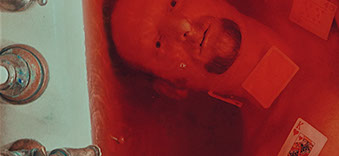
Those who come for the “Nicolas Cage: he so nuts!” will not be disappointed; not least of all when he goes bonkers in a bathroom that looks like a set from Anna Biller’s ‘The Love Witch’. But it’s Linus Roache as Jeremiah Sand who surely takes the biscuit and initially muddies the waters between outrageous hamming and fearless acting. The men gleefully overact and the women look beatific and dreamy. There’s certainly a theme of machismo and ego in here beneath the filters: Sands’ homicidal rage is triggered by having his power, supremacy and sexuality laughed at; there’s a spike-penis; oh look, his chainsaw is bigger than Red’s chainsaw (but it’s all down to how you use it); and, of course, all that pink and red. It’s a ridiculous parody of male potency in action films.

There perhaps seems a little calculation in the clunky dialogue seemingly deliberately aimed to trigger laughter (“That was my favourite shirt!”; “You’re a vicious… snowflake.”) or seemingly fanboy-pleasing moments like a chainsaw duel, but there is so much genuine oddity on display that it’s easy to just enjoy the excess. It’s certainly a riot. Also, the craziness dials up after Red’s escape, so that there could be a reading that this is all just the revenge dream of a dying man (the stab in the ribs is totally forgotten); but the trippiness and lunacy has long been established beforehand and seems to refute this. Each shot is designed to add to this otherworldliness, no matter if the scene is pretty scenery or chainsaw battles. And yet it’s all filtered through a melancholia that both grounds and accentuates the outrageousness. 

…And then Red is doing a spot of ironmongering, making an axe that looks like a ‘Flash Gordon’ prop. Well, of course.

It’s a somewhat tired trope now, but the 80s aesthetic is thoroughly convincing from the hammy dialogue and the question of how generous should you be to the acting, to the intertitles coming in type of fonts that used to grace the covers of bargain bin horror paperbacks; and every now and again, there are animated dreams, sci-fi interludes, a quick vision of cars buried in a wasteland like a detour from ‘Mad Max’, or a melting face (a nod to a excised effect from ‘Rainbow’?). And of course, with ‘Beyond the Black Rainbow’ Cosmatos can be said to have been doing this throwback agenda in earnest earlier than others, but the narrative and novelties of ‘Mandy’ will probably prove more accessible for those that found ‘Rainbow’ too thin and slow. 

Some films excel on aesthetic alone – Argento’s ‘Suspiria’ immediately comes to mind – and Cosmatos delivers such a heady phantasmagoria of homicidal hippydom and Heavy Metal revenge fantasy that a viewer can just sit back to be happily submerged. Benjamin Loeb’s cinematography and the editing by Brett W. Bachman and Paul Painter are joys in themselves, creating an overwhelming mood that seems at odds with the straightforward revenge narrative. Oh, and the soundtrack by the late Jóhann Jóhannsson is a treat, all retro-synths and prog-rock thickening the mood. Rarely does this kind of story get this kind of lavish visual treatment and that’s at the root of it’s fascinating kaleidoscopic appeal. It’s a riot in all kinds of ways.


Sunday, 28 October 2018

Halloween (2018)


David Gordon Green, 2018, USA

Without being remarkable, David Gordon Green’s continuation of the vast ongoing franchise has a little to please everyone. Although this leaves it open to accusations of being baggy and overstuffed, this is probably a canny move as - as is usually the case with these franchises – it seems an audience doesn’t really want something so different: regard the greatly maligned Myers-less ‘Halloween III’ and the much hated Rob Zombie ‘Halloween’* which, if nothing else, were truly taking a different tact. Green’s entry – written with Danny McBride and Jeff Fradley – leapfrogs over the other sequels and versions and gleefully dismisses the sibling twist of ‘Halloween II’, starting with as clean a slate as possible. Producer Jason Blum prefers the term “reinvention” rather than “reboot”, but contorting over semantics is unlikely to really fool anyone. Endorsed by the return of Jamie Lee Curtis and John Carpenter himself – executive producing and reprising his seminal score – and coming with a distinguished indie director, this certainly comes with as much creator approval as possible for a decades-old product. 

So it’s clean and bright and a little shaggy around the edges, as typical of American indies; meaning it replaces the precision tooling of Carpenter’s original – which, of course, is a genre masterpiece – with a more loose-limbed vibe. This means that there isn’t the sustained stress, suspense and squeeze Myer’s first appearance, but it would surely be foolish to expect to imitate that. Even so, the sequence where in more-or-less one take Michael strolls around the suburbs, wandering into houses and slaughtering residents is a set-piece that comes close. The many call backs to the first film mean fans can have fun spotting Easter eggs, but these are often more than just homages: the Michael-Goes-About-His-Business sequence also mirrors the lurking p.o.v. from the original; and when Laurie is shown mirroring Michael’s poses from the first ‘Halloween’, it goes to indicate how much she is claiming that story as a survivor. She’s been preparing to fight back this time. 

Laurie Strode** has been busy training and arming herself for Michael’s return at the expense of healthy relationships with her family. But this is far from only Laurie’s story: there’s a lot of subplots and a lot of characters where it seems this time Michael’s story is trying to cover as much slasher ground as possible. There are three generations of women to deal with: Laurie, her estranged daughter and her granddaughter. As with most slashers right now, it comes loaded with post-modern self-awareness of Clover’s Final Girl which leads the action by the nose and means to get maximum play. Curtis has certainly been on the promotional circuit highlighting this as a film very much attuned to the #MeToo movement and relishing the kickback, making this very much a film of the moment. But although he was always a threat of male violence, unlike many of the slasher sub-genre he helped inspire, Michael was surely a symbol of The Unstoppable Killer Out There rather than of rampant misogyny (he has always been indiscriminate with his kills). But there is no doubt that this one stems more from revenge fantasies than fear of the bogeyman.

The film begins with a couple of obnoxious podcasters that come to provoke Myers, the kind of critique of a mercenary media that ‘Natural Born Killers’ traded in; then there’s a somewhat off-centre subplot with Dr Sartain (Haluk Bilginer) which certainly fulfils the Gothic protestations that Dr Loomis brought to the original. But mostly what will stand out from this grab-bag of pleasures and diversions is the humour. This is the kind of casual humour that has run through much of Green’s work, not least his work on the amiable series ‘Red Oaks’. The scene where the boy complains to his father that he’d rather really be at dance class than going hunting is a nice nod to how far expectations of gender roles have moved on since the original was unleashed; and it’s not the only humorous moment that then segues into horror that means business. Many audience criticisms I have read seem to object to this, but slashers and horror have always run close to humour, just perhaps not so overt comedy: the criticism is that the humour undercuts the horror, but perhaps the only ill-judged moment is when the smart-mouth of the babysat kid undermines the horror of the closet scene (which is a great scare that is spoilt anyway by being in the trailers).  

There’s a moment when a youth shrugs that Michael’s original kill count isn’t so remarkable in an age when horrific mass killings seems like a monthly event (fortnightly? weekly?); the hoopla around Myers seems like hyperbole. In the original ‘Halloween’ he newly represented the fears that Something Unspeakable was out there threatening the cosy suburbs; indeed, he was bred in the suburbs. But this ‘Halloween’ forgoes the supernatural slant of the original, the move into The Shape: here, he is the returning trauma that must be confronted. It’s entertaining, if not particularly scary, but with enough of a nasty streak and kills to be occasionally unsettling and with humour to keep things on their toes elsewhere. Ultimately, it heads for what, in this scenario, ends up being a happy and triumphant ending. This is the age where getting your own back is in vogue, and that’s always been as prevalent in horror as bad luck. But, of course, there is a just a little ambiguity… there's a franchise to think of, after all.


• * ‘Halloween III: Season of the Witch’ has received a lot of reappraisal over time and is certainly regarded more highly now. I have always liked it and the laser-in-the-face and the masks still remain two favourite horror scares. I also have a lot of time for Zombie’s ‘Halloween’, although I doubt that would win me any friends.
• ** John Kenneth Muir painstakingly decodes Laurie Strodes name to argue that she was always going to be a winner.