Showing posts with label reboots. Show all posts

Tuesday, 23 July 2019

Child's Play (2019)


Lars Klevberg, 2019 
Canada-USA

Creator Don Mancini apparently objects to this reboot but updating Chucky for the Bluetooth generation is a smart move.  Slight thematic differences stop this from being a dull retread of the original. Dismissing the whole “possessed doll” origin makes Chucky less wisecracking but more troubling as the threat of modern technology gone awry. More ‘Westworld’ and ‘Black Mirror’ than ‘Annabel’. It also eschews the smugness that dominates the later Chucky films. 

Andy (Gabriel Bateman) feels like a decidedly modern kid, both happy to cry it out and to kick-ass, a reasonably full range of character. And the casual way he’s partially deaf, which barely plays a part in the drama or his friendships, is a detail which is positively normalised by being happily trivialised. His mother (Aubrey Plaza) is a young woman who had Andy too early and sometimes feels more like a big sister. Yes, many other characters come from the B-Movie Catalogue of Archetypes – the bad boyfriend that deserves all he gets; Andy’s new slightly obnoxious friend – which is expected, cliché and undemanding but the film doesn’t quite rub it in and is grounded by the central relationship. Uncle Lancifer doesn’t quite accept the middle section where Andy has to deal with the grim gift Chucky has left him – like a cat leaving a dead mouse for its owner – and this is indeed the most awkward sequence which runs like horror farce and relies on no follow-up questions to get resolved; but it’s not quite out of tone. It has that b-movie scruffiness where a further polish on the script wouldn’t have gone amiss to nudge it up a little. If there is the sense of feeling a little surprised that this is fair rather than bad, that was the dominant take-away. And then it just runs into a standard showdown third act. Oh, and Mark Hamill now voices Chucky.

‘Child’s Play’s most interesting feature is its brush with the themes of nature and nurture. Chucky has had his “violence inhibitors” turned off by a factory work pushed too far so that he fixates on loyalty to Andy but doesn’t know how to process certain input appropriately. Andy is a little old for a “doll”, but he’s new in the area and lonely and this is a fascinating super high-tech appliance. So it’s creepy when Chucky is staring at you when you are trying to sleep, but, hey, every appliance has it’s annoyances. Chucky’s mistaking a toilet roll for science book is just a glitch in it’s trying to be a real friend. These are moments of humour.

Most interestingly, whilst the tweens are laughing at the silly super-violence of ‘The Texas Chainsaw Massacre 2’, Chucky is taking in tips for killing. This isn’t a film to take on such a weighty topic as the responsibility of art’s portrayal of violence, the ‘Chainsaw 2’ moment being a set up for the film’s grisliest moments and for farce, but it’s intriguing that a main source of empathy is Chucky’s clumsy desire to do good and misunderstanding cues happening around him. The kids are laughing – like any innate horror fan, they know the genre is a good source of comedy – but  there is something fundamentally amiss with Chucky and he takes it all wrong. His insistence and faux paus are readable as the behaviour of somebody who is cognitive atypical and therefore deserving of empathy. Until he kills, of course. But then, his homicidal behaviour comes across more as he-knows-no-better than intentionally malevolent, as the violent reactions of a stalker or spurned lover. Which makes him no less scary.
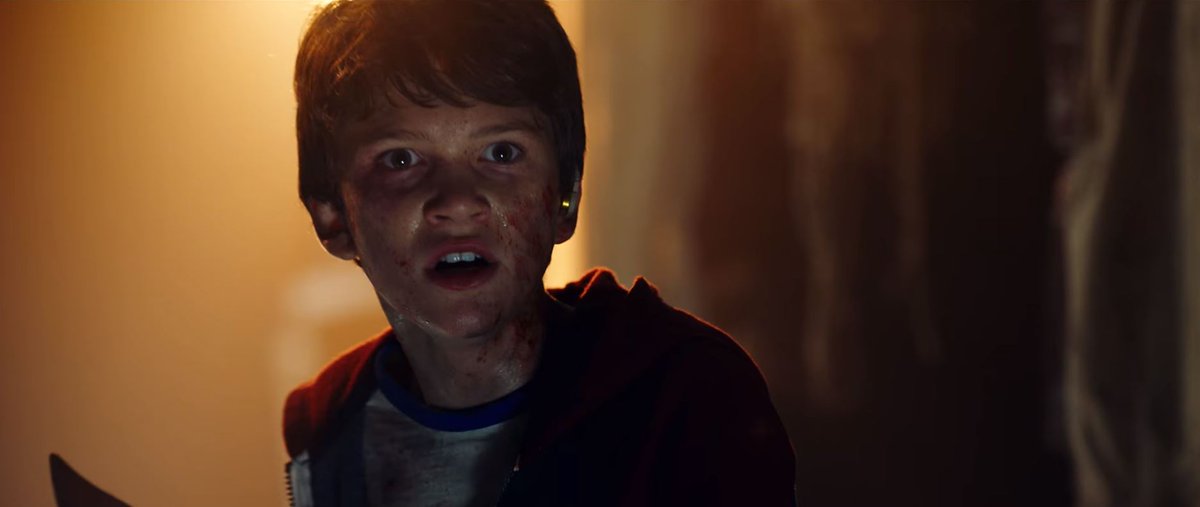
It’s not ground-breaking, but it meets demands with Tyler Burton Smith’s script tweaking a bit here and there to lift it above the in-joke that the original series has become.

Thursday, 19 April 2018

Shin Godzilla - stomping through politics


Hideaki Anno & Shinji Jiguchi, 
2016, Japan

A reboot of Godzilla by Toho Studios – directed by Hideaki Anno and Shinji Jiguchi – that focuses on the political turmoil caused by a super-monster stomping through Tokyo. That means lots of talk about military action, evacuations and international relations. From time to time, Godzilla impressively unleashes sheer destruction. He’s been upgraded to motion capture and CGI but they haven’t even used the latter to make the eyes blink and his arms never move so it’s feel is very much man-in-a-suit. More importantly, the long-shots of Gojira ploughing through the suburbs and the city are bright, spectacular, clear and the best yet seen, surely.* The film steers a very tricksy line between the appearance of seemingly clunky old-fashioned effects and state-of-the-art techniques, pleasingly and sometimes surprisingly.


But the film is mostly cutting between various political, scientific and military departments trying to deal with the crisis. Much is made of Japan’s international relations dealing with the giant monster crisis: boardrooms become the central location of the drama as a satire of government bewilderment and bureaucracy ensues. If Gojira was born from the Atomic bomb, here the monster more represents nuclear and natural disasters: he’s there to embody all the terrible tragedies that befall Japan it seems (most obviously here it’s Fukushima Daiichi and Tōhoko, but remember he also fought the smog monster Hedorah). There’s a sly acknowledgement to the origins of Godzilla by having America name the beast and Japan then adopting it. America is represented by an ineffective aerial assault – just one of many – and a Japanese-American liaison (Satomi Ishihara) who bears the most difficult English accent of the cast; she has a penchant for acting sassy and flipping her hair like she’s learnt her moves from perfume commercials and seems to have stepped in from one of the earlier tackier films in the franchise (there’s also a somewhat baffling subplot about her becoming president eventually?). But it ends up being France that proves Japan’s political ally.

There are so many characters and groups being introduced all the time that it’s probably forgivable if you don’t quite keep track (the IMDB page gives the flavour of this). But mostly we follow Cabinet Secretary Yaguchi (Hiroki Hasegawa) as he angsts over Gojira and his political ambitions. Directors Hideaki Anno and Shinji Jiguchi try to keep all this boardroom and control centre action exciting by gliding the camera through offices and having sheets of paper deployed in quick cuts like karate blows, or more strikingly through a portable device’s screen’s POV of the people looking at it, but there’s no doubt that this gets in the way of giant monster action and that the film could have been shorn of much of this. Most of the dialogue is made of instructions and exposition so it’s certainly better than many Godzilla films, but the line that stuck out for me was also the most enjoyably ridiculous: “Deploy all train bombs!” Of course, if you want to up the cheesiness, just play the dubbed version.**

The monster genre is typified and marred by the sense that the drama is almost always weaker than the rampage, but here it’s more that the politics starts to get in the way of the Kaiju. The seriousness is commendable and it’s all very slick and less silly than most Gojira flicks, but as admirable as it is to return Godzilla to Toho studios, there’s the sense that it’s longer and less fun than it should be.


· Gareth Edwards much maligned 2014 ‘Godzilla’ had some spectacular showpieces but failed to film its monsters in a way that left the audience satisfied. Even if it’s a man in a suit, an audience likes its kaiju anti-hero bright and clearly seen.
·        It’s “Send in all the train bombs” in the subtitles and “Freeze the bugger!” becomes “Freeze the bastard!” in the dub. It’s the little things… But this has been a review of the subtitled version because dubbing makes everything less serious.