Showing posts with label second watch. Show all posts

Saturday, 17 July 2021

Fried Barry

Ryan Kruger

2020, South Africa

Story by: Ryan Kruger & James C Williamson


I first saw this at Grimmfest and had no idea what it was going to be. Let's just say I wasn't expecting much and then ... well, I always recommend its scattalogical barminess, but on a second watch I was more taken with how Haezer's score and the editing evokes so much with mood and temporal displacement.

Brash, rude and crude and random, and that’s even before general junkie scumbag Barry is abducted by aliens. From then on, the narrative is based upon, as Barry has now been possessed by an alien passenger, how the more sordid end of Cape Town reacts to his goggle-eyed stare and silence. Along the way, Barry encounters thugs, druggies, prostitutes and sex hungry supermarket staff, serial killers and policemen, etc. Without true narrative dictates, there’s nothing fencing in the WTF possibilities of the story. Barry is mostly passive, the amusement coming from how he just stumbles into and reacts to crazed vignettes, oblivious, occasionally showing signs of extra-terrestrial powers. The whole thing is held together by Gary Green’s consistently oddball performance, jerking and walking like a malfunctioning terminator, innocent, scary, bug-eyed, gurning. It even has time for an intermission when Barry is knocked out.
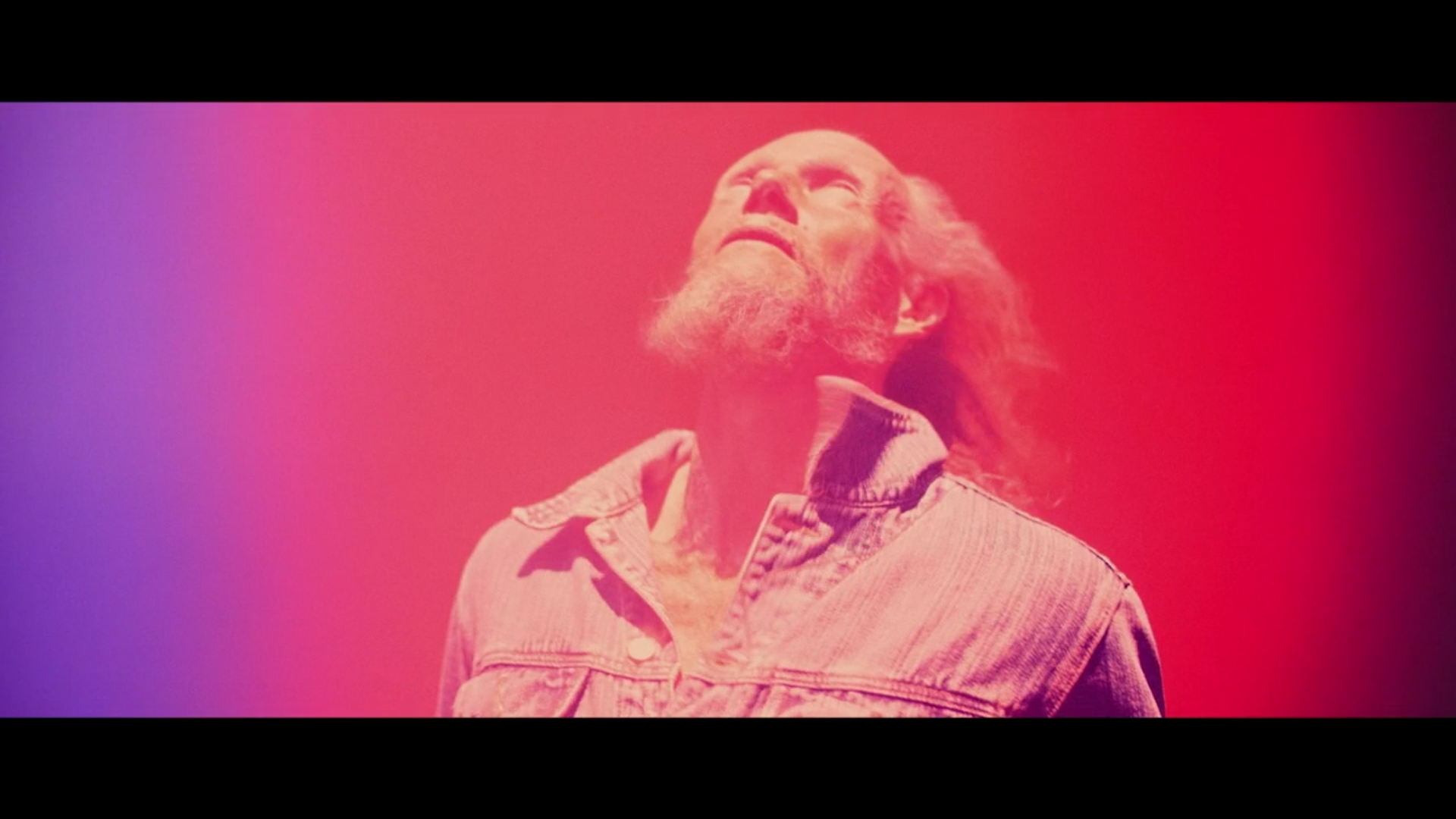
The skits are predominantly there to amuse, but it’s also a longform riff on feeling disconnected, always feeling the outsider with things just happening to you. An analogy for time-lapses and bafflement of drug addiction, it’s like natural extension of a Barry bender taken to extremes. Unlike ‘Under the Skin’ or ‘The Man Who Fell to Earth’, this alien visitor doesn’t have any apparent motivation other than just to experience; perhaps to gather information; maybe it’s just a hedonistic holiday? What the alien gets is a crash-course in digressive exploitation cult cinema. It’s an offbeat tour of a seedy side of urban humankind, although Barry intuits enough to save someone from a heart attack or to engage with a chainsaw fight with a serial killer to save children. 

“Green has the reckless abandon that makes for unhinged performances, but "Fried Barry" can't decide if he's a joke, or a zonked-out Christ figure.”

So says Nick Allen, who seems to think Kruger is reaching for some kind of commentary rather than just amusement and entertainment. After all, Kruger says this is more of a "thing" than a film, mphasising experiece over narrative. But Barry is a fully zonked-out Christ figure joke – complete with resurrection – not one or the other. The point is that Barry is often just a blank slate to project upon for those he runs into, revealing more about themselves than him; and this is an extra satirical edge if that’s what you want. 

It is fluid with vibrant colours and lighting and Haezer’s excellent electronic score contributes otherworldly or pumping vibes where necessary. 'Fried Barry's superpower, apart from Barry/Green himself, is its consistent, restless search for inventiveness. This picaresque, episodic joyride with full on non sequiturs won’t be for everyone, of course, but it’s triumph of low-budget anarchy over the dictates of story. 

Sunday, 29 March 2020

John Wick: chapter 3 – parabellum ... revisited: I came for the set-pieces


Chad Stahelski, 2019, 
English-Russian-Japanese-Italian


So I watched ‘John Wick 3’ again just to see what I felt about it on a second watch. It’s not the usual thing that leaves a mark on me, and certainly the first two hadn’t, and it’s the kind of film I watch just to keep with trends and the mainstream.

What I first noted was that it seemed to me that the opening credits were the kind of montage and design that front TV action series. It’s a world of sicky green, velvety purple, smouldering orange and vivid red, despite a digression into the bronze of the dessert. It’s beautifully filmed by Dan Lausten, giving a little slick class. It owes a debt to ‘The Villainess’ with its ballet-and-wrestling-school-for-assassins, as well as it’s bike chase. The actors all ham it up shamelessly and I am inclined to treat it as a comedy, so silly and over-the-top and narcissistic are its narrative and character outbursts (and I’m still leaning towards Laurence Fishbourne as bad here). Halle Berry’s plays it straighter than the others, as if she’s come in from a more serious film and gives a little gravitas to proceedings. She proves a good foil for Reeves, who delivers his one-liners with his slacker drawl that undercuts some of the silliness in a way that a more lip-smacking performer wouldn’t.

But none of that drew me back in. It was those first twenty minutes that I couldn’t shake. The library fight, the museum fight and – quoting Reeves here – the horse-fu are three knock-out set-pieces in succession that still retained their effect on me. The fight choreography gave me the same buzz that I got from ‘The Raid’  films: fight scenes are as pleasing as dance-offs with the dubious punctuation of violence. It provides the same rush as good pop or rock music. But it was even more notable this time at how well the editing facilitated the action.

With the library scene: oh, that’s how you use a heavy book to fight? There’s the moment when you realise they have found a way to make books lethal, to give you that oh! gratification.

And then there’s that moment when, having been shooting and brawling, both Wick and his adversary take a second, look around the weapon museum around them, and think “Wait, we have an arsenal here!” and start smashing into the knife displays with desperate abandon. Then are the closing knife-in-the-eye and axe-to-the-head gags that are framed for maximum effect, both for squirm-inducement and humour (because there’s humour in outrageousness).

It's the same humour in outrageousness that gratifies when, pursued into a stable, Wick starts to use the horses as weapons – gloriously over-the-top. And when you think of the logistics of horse and bikes and crashes, all in the same take, the film-making skill is evident.

These are each great set-pieces that would have been peaks in other films. And then it gets bogged down in plot and world-building and the silliness takes over. But upon a second watch I enjoyed the shoot-out-with-attack dogs more than before because this time I could see the skilful editing, timing and framing. And boy, so many headshots. It’s a very violent film.

Sometimes I can take a film for it’s set-pieces: I have a friend that felt the uneven nature of ‘Ad Astra’  showed that James Gray failed at narrative, and that may be so, but again that film’s sci-fi set-pieces won me over despite the unevenness (well, that and Hoyte Van Hoytema’s cinematography wowed me). Tarantino’s films are often a sequence of grandiose set-pieces. Jodorowsky’s odysseys are built on moments and vision rather than coherence. If there’s inventiveness, skill and pleasing aesthetic, that alone can impress. But there are many superficial pleasures to be had and quite often the overall vision can compensate for narrative weaknesses.

So, those opening set-pieces of ‘John Wick 3’ still strike me as worthy and impressive in their talent, inventiveness and execution, and that half hour alone will still gain marks from me, although I may find it easy to b thee indifferent to the rest of it.


Sunday, 17 June 2018

Batman vs Superman: Dawn of Justice - second watch

Batman vs Superman: Dawn of Justice
Zack Snyder, 2016, USA

A second watch of 'Batman vs Superman' and the first twenty minutes are fine. There’s the unnecessary recap of Batman’s origin in nightmare form with Snyder’s particular “opening credits” editing style that was so effective with the ‘Watchmen’ opening credits – but even that can’t liven up this well-worn origin – and some action and some spy-like shenanigans and that’s all good enough. It still seems to have promise. And then Jesse Eisenberg does his impression of Lex Luther as The Joker and it’s pretty insufferable – why conceive Luther that way? Go straight to Vincent D’Onofrio in the ‘Daredevil’ TV series. The films takes a true nosedive them, but it’s never badly made. It’s a mess and overloaded and the rivalry between the two heroes never really convinces, although it’s mostly based on Bruce Wayne being an uncompromising asshole. Jeremy Irons makes for a cranky and quite unlikeable Alfred instead of wry and dryly super-efficient. There’s a dream sequence that seems to be there just to allow Batman the fantasy of a different suit and using a gun and owing down bad guys; and make no mistake, he make not actually wield a gun but there’s so many explosions and physical violence that he obviously kills many by proxy. There’s a confusing appearance from The Flash in a vision of sorts. There’s nothing really wrong with Henry Cavil but this Superman … well, although we’re meant to be convinced that he’s conflicted and angst-ridden, it’s not truly convincing as colouring him in and perhaps going with the Good Guy God approach would have been more interesting, done right (like Peter Parker is better for being naïve and gung-ho). He’s not quite 2D in a way that captures the imagination. But a second watch shows that Gal Godot does much with little and that Doomsday is pretty cool for a CGI creation, if it would only linger a little. Oh, and there’s something about other superheroes too. And why leave a Kryptonite spear underwater where any bad-guy could trace it? And superheroes bonding over mummy resolves conflicts... But by then, true interest has been pummeled away by overstuffing the turkey with CGI, protesting too much forgetting to be fun.

But ‘Batman vs Superman’ does have one stand-out scene with Batman’s hand-to-hand combat with a gang of bad guys in a warehouse. That remains and is the one moment when it all comes alive.