Saturday, 29 June 2019

Brightburn


David Yarovesky, 2019, USA
Writers: Brian Gunn & Mark Gunn

The ‘Superman’ and the Evil Child premise mash-up in another dissection of the superhero. This one is a family occasion, written by Brian and Mark Gunn and produced by genre favourite James Gunn. 

Childless couple Tori and Kyle (Elizabeth Banks and David Denman) adopt a baby from space that falls outside their homestead. The boy Brandon (Jackson A. Dunn) is mild and smart and, it seems, mostly ostracised/bullied by peers. We know how this goes. But when he hits puberty, the spaceship hidden in the barn starts calling to him and his burgeoning powers make him dangerous and unhinged.

There is solid work from the main actors and a no-fuss modern feel to the characters: for example, there’s a nice mature sexual warmth to Tori and Kyle’s relationship and they have no hang-ups about adoption at all. ‘Brightburn’ looks good and the script skips over the points it already assumes we know from many, many superhero and supervillain backstories (which isn’t quite the same as the underwriting I accuse it of later). This stops things from tripping up with the familiar but sometimes it just leaves lacunas. 

Director David Yarovesky’s 2014 film ‘The Hive’ was an initially intriguing idea but was quickly weighed down with genre cliché. That film’s assurance and play with colour is also evident here, giving ‘Brightburn’ vivid and memorable images – it gets a lot of mileage from Brandon’s red cape and eyes against darkness – but there are just as many techniques that easily veer on the cliché: moving through flapping hanging laundry; recourse to repetitive fading to black or strobe effects: tiresome horror devices done to death by the likes of ‘Insidious’. 

And although brevity serves to speed things along, there’s a suspicion that other points are underwritten. For example, when Brandon actually cuts himself it looks quite bad: wouldn’t he need stitches, and wouldn’t that mean a trip to the ER where more about his invulnerability would be revealed? And everything comes to a head before we can fully explore his burgeoning sexuality, as creepy and frightening as that might be: the sub-plot with his stalking of the girl is just dropped and there feels an important chasm between his last visit to her bedroom and the naked disembowelled woman in the barn. What about that lawnmower? Then there was the threat of a conversation with the Sheriff in the morning… but I guess the car crash put paid to that. Still, there seems a neglect in the writing of some of the finer details. 

And then it launches into something like music video satire for the end credits, skipping ahead to add more story, with a tonally ill-fitting song (Billie Eilish’s wicked rendition of 'Bad Guy' - is that meant to be ironic? Celebratory?). Perhaps this is a parody of the end credits that typify modern franchises, but it’s also a mood-killer … and I don’t think so. It is also what we are now used to for indicating a franchise. It is as if at the end it isn’t self-aware of its barbed subtext.


I don’t know if “Brightburn” will be the start of a franchise, but I kind of hope so. Not that I’m necessarily rooting for this humorless little dude with a knit mask and a dumb logo to grow big muscles, acquire sidekicks and all the rest. It’s about time that someone understood superheroism as a dangerous pathology. What I mean is: It’s much too late. 


Where ‘Brightburn’ is most interesting is in its intersection of superhero power fantasies with (white male?) privilege and toxic masculinity. Brandon’s constantly being told he’s "special", a dogma that seems of a particularly American flavour that trumps the individual over the collective. Commercials and brands are always hammering the message that the world centres around you and your choice. Of course, Brandon’s parents are only trying to make him feel worthy, which is admirable, but with the onset of adulthood his interpretation of “special” seems to be the privilege to do whatever he wants, which ultimately means he feels a right to kill others as he pleases. In an American context where currently school shootings seem be a monthly tragedy, where mass murder is the end-result of aggrievement and entitlement (not only, but they’re key elements), where these are means to potency and infamy, this feels like a sharp cultural criticism of the very fanbase wallowing in and taking the wrong message from the MCU and DCU (no, it’s not about how you can “Take the world” or how cool or lethal your power makes you: it’s about how you use that power to help others). It joins ‘Chronicle’ as a bad guy origin.

It’s not as obviously sharp as James Gunn’s ‘Super’, which gets engaged with the limits of power fantasies when carried over to the real world, and perhaps ‘Brightburn’ resembles the contemporary superhero format too closely for its critique to resonate clearly, but it’s there. Dunn’s performance as Brandon is sweet enough and mild at first and then, when the sociopathy sets in with the onset of puberty, he’s opaque and cold and lying, but tinged with confusion and still saying he wants to be good – maybe more accurate for a sociopath than the smirks of Kevin in ‘We Need to Talk About Kevin’. Certainly recognisable teenage behaviour. Of course, some may just put it down to shaky acting.

In the end ‘Brightburn’ falls short of the mark. Yet as a scaled-down curiosity with some nice visuals, middling action, some cliché mixed with a little genre and social criticism, as well as some lingering jaw-gore you won’t forget, it entertains.

Saturday, 15 June 2019

Booksmart


Booksmart

Olivia Butler, 2019, USA

Written by: Emily Halpern, Sarah Haskins, 
Susanna Fogel & Katie Silberman

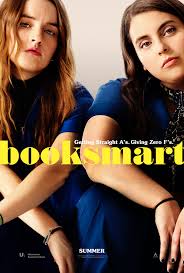
Count ‘Booksmart’ as another film ill-served by its trailer. It’s not a just a ‘Superbad’ for girls, a gender-reversal on the standard hormonal (possibly obnoxious) young men gross-out comedy, although it is that too. It’s the tale of two girls at their last day of school realising that in having made the choice to forfeit fun for a more academic approach, they have been missing out. After all, their peers who apparently have just been goofing around are still going to good universities. So, they embark upon an odyssey to go to a party one last time to make up for what they’ve lost out on. Because partying defines young America.

It’s directed in a no-fuss style by Olivia Wilde that allows Beanie Feldstein and Kaitlyn Dever to fully indulge in evoking a believable friendship between the two nerds, Molly and Amy. The screenplay is funny all the way through with a couple of surprises thrown in. The fact that Molly isn’t a Barbie doll is never mentioned. The fact that Amy is gay is just an excuse for more risqué gags and for offbeat crushes: no angst here. Even when the girls have a falling out, music mutes the argument and the camera strays to look around, because although the argument matters, ‘Booksmart’ doesn’t dwindle so that it drags the comedy into dull dramatic cliché (although Pat Brown sees this as a misstep). There a real let’s have fun! philosophy at work here.

The cast fully embrace the broad strokes of their archetypes (everyone wants to be in ‘The Breakfast Club’) and, of course, over the course of the film their deeper layers are revealed: Hey, jocks like ‘Harry Potter’! Insufferable dweebs are just trying too hard and are actually sweet and interesting! The seemingly dumbass guy who has re-taken years is going onto coding! Hey, do you think maybe those guys are gay? etc. As Molly and Amy are defined in more complex and believable ways – for example, their ritual of praising each other to high heaven when dressing up is both endearing and cringe-worthy – this does leave a gulf of characterisation between them and others, but the sense of all-inclusivity wins out. There’s a benign agenda of acceptance that eschews, say, the tougher terrain of ‘Eighth Grade’ for an agreeably positive outlook. It’s more like ‘The Edge of Seventeen’ in its message for “get over yourself and have a good time” and “this is just a phase”. They are presented as a very self-aware generation but not with the tiresome privileged and narcissism of ‘Assassination Nation’. Untypically, peers aren’t vehemently nasty or bullying: indeed, these girls are generally welcome wherever they go. It becomes clear they’ve been their own worst enemies when it comes to socialising, that actually it’s they who have been indulging in snobbery. And then, as the genre demands, over one night they learn their lesson and it’s all good. This generosity of spirit makes ‘Booksmart’ highly likeable and uplifting. 

Butler and team wanted to make the kind of teen comedy they loved as adolescents, but ‘Booksmart’ is better than John Hughes candyfloss because it’s less prone to platitudes. It’s not above the broad humour of falling into claymation for a drug rip, but even this turns out to be a jab at the Barbie Doll fantasy. It benefits from updating the perspectives of its influences. It all makes for highly agreeable, slightly edgy and consistently funny light entertainment. 

Sunday, 9 June 2019

Godzila: King of the Monsters


Michael Doherty, 2019, USA

So, I recently gave ‘Kong: Skull Island’ another whirl, thinking I may have been too hard on it previously, but a second watch didn’t sway me. There was still something in the drama that aggravated me (and I didn’t change my mind that Samuel L Jackson is just tiresome in it, coasting along as if aggressively bored, as if he is determined not to have fun with the rest in a giant ape movie). But in retrospect it had good monster fights and had a nicely tropical feel.

By contrast, ‘Godzilla: King of Monsters’ insists on being dark and drained and moody, even in the daytime. It often follows on from Gareth Edward’s 2014 ‘Godzilla’ in having the monsters so glumly lit and in the fog of battle that on occasion you wonder if you are actually watching monsters at all. When the screen is lit up, it with the orangey hue of dying cinders. Sure, there’s a large chunk of the city caving in but: monsters? In ‘Kong: Skull Island’, it was brightly lit in dazzling sun so you could see it all. So, you know, there isn’t the excuse for underlighting for hiding any defects of CGI. And digital effects have some so far now that the monsters are magnificent: see the way Godzilla falls into a gorilla’s mannerisms Actually, King Ghidorah probably steals the show.  And maybe that’s also the thing: CGI is so awesome sauce all the time now that it’s hard to be dazzled just by one computer-generated marvel punching down on another. But when you have men in suits or models, there’s charm and mortality that CGI just doesn’t have. There’s a need for more narrative invention for the monsters and to the fights.

For example: Edwards’ ‘Godzilla’ had the parachute jump which nearly transcended the format for a moment: and when Godzilla lights up and gives an impressive light display, all the chiaroscuro made sense. ‘Kong: Skull Island’ gives Kong two great entrances: twice, Kong emerges as other narratives are playing out so that his appearance is unexpected and thrilling. Kong versus the helicopters is a peak for monster battles. It would seem there’s now a studio directive that the monster must appear in the first act so as not to lose the attention-span deficient, but in ‘Godzilla: King of Monsters’ in his introduction he’s just there, demolishing the city; it’s an introduction that’s barely trying. Later, there is maybe one notable fight with Rodan versus the jets: if there is one transcendent image I take from the film it is Rodan spinning in flight to destroy the fighter planes. Oh, and King Ghidoran atop a volcano with a cross in the foreground like a painting of the devil by an old master (and from this you could theorise the film is drawing a line from these ancient titans to the development of religion… but that doesn’t lead too far). But, yeah, we see the tremendously impossible all the time now. Michael Doherty’s previous films ‘Trick’r’Treat’ and ‘Krampus’ were far more alive with attention to detail and quirkiness. 

So: secret organisation Monarch is hiding and monitoring these titans/Kaijū and bad government folk are interfering with things they don’t understand, and then a rogue eco-terrorist group (*raise eyebrow*) frees the titans to risk the world of the plague that is mankind. But they too are messing with things they don’t understand. King Ghidorah takes centre stage and impresses. Rodan gets his moment. Mothra too. The other monsters… not so much. And all this is to now cast Godzilla as a good guy, an apex predator that keeps the others in line. He often appears (tiresomely) just in the nick of time, then King Ghidorah kicks his arse… in fact Godzilla has to be revived a couple of times to continue the fight until he’s a deus ex machina. It’s enough to make you doubt his awesomeness.

But what is most unforgiveable is that when a monster fight is going down between Godzilla and King Ghidorah, we focus on the humans and are supposed to care about the family reunion of the perfunctory human interest. And they aren’t that interesting. It’s a waste of a decent cast. Yes, big monsters are fighting just like mommy and daddy, and now mommy and daddy are making a truce for the daughter - but we’d rather watch the monsters. That’s what we’ve paid money to see. Any splendid stuff just dries up. I mean, even 'Shin Godzilla' made me fairly interested in the politics of it all, so there's no reason for being rudimentary. 

Unkle Lancifer at Kindertrauma gives all the positives but I was left with a feeling of being underwhelmed. Of course, the argument is that aside from the seminal original, all the Godzilla films suffer from silliness and negligible human representation, and that’s undeniably true; but there’s a sense when I go to see a new gorilla-whale film with lots of money and skill behind it, I am thinking maybe this time, it will truly raise the bar more than being half decent. I don’t want to see a mega-budget film with the same flaws because then it just comes across as not caring enough and doesn’t have the same charm. 

There’s a sense these films are just coasting. But there will be some interest is seeing how the tropical colours of Kong conflict with Godzilla’s drained look in the inevitable ‘Godzilla vs Kong’. 

Sunday, 26 May 2019

John Wick: Chapter 3 - Parabellum


John Wick 3: Chapter 3 - Parabellum 

Chad Stahelski, 2019, English-Russian-Japanese-Italian

Well you know what you came for with ‘John Wick’ so it’s a little redundant to chip at flaws when it’s big dumb excess and entertainment. The IQ is low – someone will explain the title, don’t worry – but that doesn’t stop it from trying to open up the Wick-world. Franchises are everything these days. Quietly, ‘John Wick’ seems have snuck in and taken some of the glory from ‘The Raid’ (chalk that up to being non-English, but the people that matter seem to know: after ‘The Raid’, I saw fight scenes everywhere realised they had to up the ante, not least in the ‘Daredevil’ NetFlix series).
   
It starts with the murderous properties of library books, sets a fight in a museum of antique weapons and then delivers a little horse-fu (as Keanu has called it). So, for me, this first act is the strongest sequence of action scenes, funny and outrageous in its excess and excellently executed. This is where director Chad Stahleski’s experience as a stuntman and his history with Keanu Reeves (they go back to ‘The Matrix’) is a major asset: you never feel that the editing is doing all the hard work and every now and again there’s a camera angle that really lands the punchline (eye-piercing, anyone? But the whole antique weapon’s fight contains knowing angles).

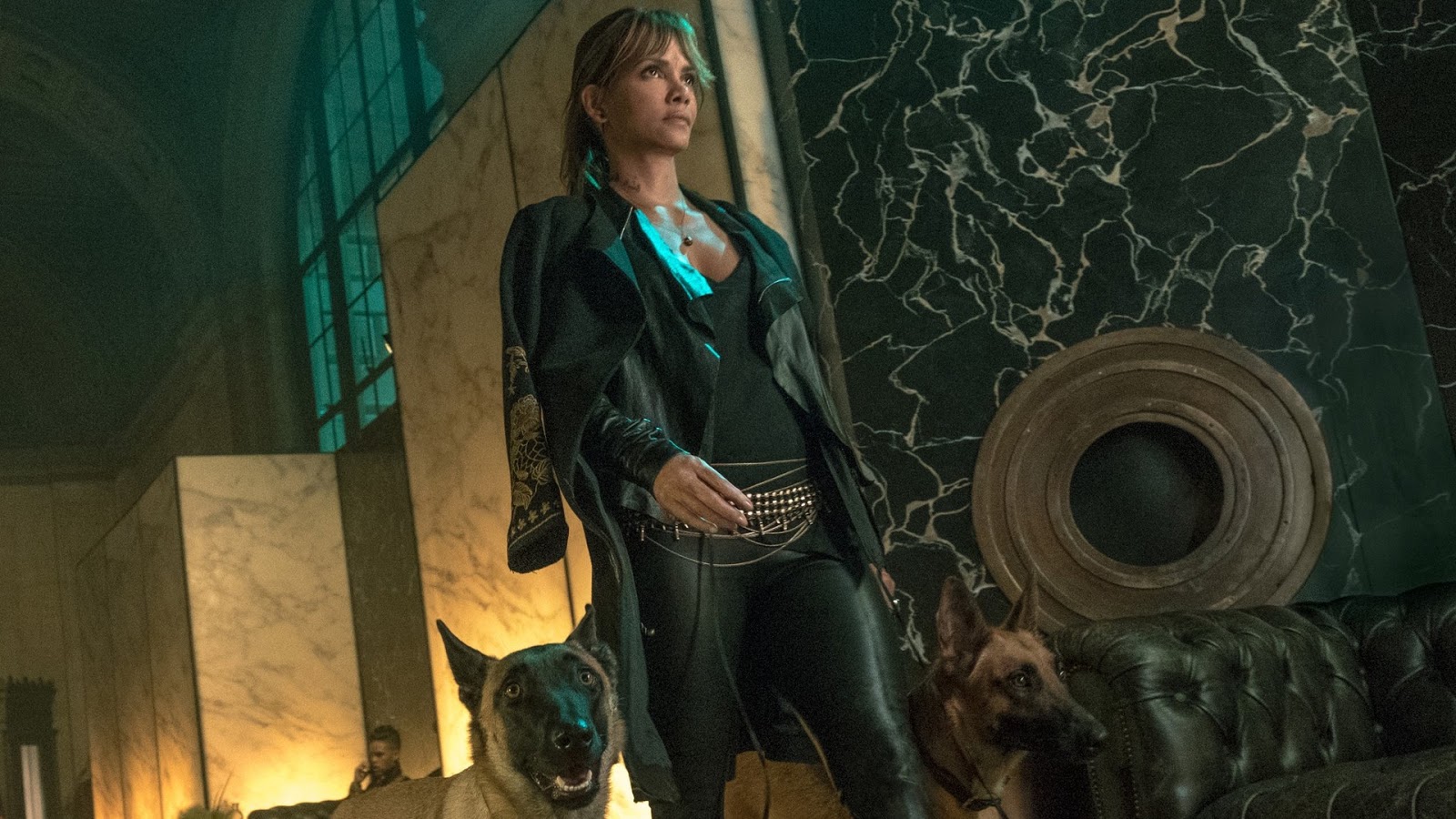
It seems to be that different people have different preferences: some think the opening act is weakest, some the middle and some the end. It’s true that when the guns come out, there is less visible invention because the film is not required to be so imaginative in its arsenal. However, Halle Berry and her attack dogs have proven a high point for many (ref. social media).
But then some seem to think ‘John Wick 2’ is better/inferior, so it seems a series more open to flexible audience’s preferences than most. It’s all fights, so maybe repetition fatigue sets in at different points for different people.

But to back-track: this takes off where the previous film finishes with Wick (Keanu Reeves) on the run with a humungous bounty on his head. This time, it’s not vengeance motivating him but simply going to one person and cameo to the next to get to the head honcho of the High Table, which controls this league of assassins. What this really does is take Wick from one fight to the next. It gets a little ‘Black Swan’ at one point and then cod-mystical (in the desert?), but it’s in obvious high debt to ‘The Villainess’, especially with that bike-and-horse fight. So, it’s derivative and undemanding and daft, yes, but it has a nice sheen and colour-scheme – filmed with a clear commercial gloss by Dan Laustsen – and the fights are exceptionally choreographed, filmed coherently without the edits getting in the way. And this is where it truly delivers. 

And it helps that Reeves is more hangdog in demeanour (sad puppy, maybe?) undermining the potential machismo. It follows a trick from ‘The Raid’ in that he is a protagonist reacting in a Why-are-you-all-making-me-be-such-a-bad-ass? way, which allows him to be both persecuted and to show how lethal he is. A film about his being an assassin would have been very different. Still, he still applies so many headshots to make sure potential threats are dead – no one-shot kills all here – that the “15” rating seems ridiculous. Reeves has little dialogue and a couple of one-liners and he’s probably no one’s idea of an exemplary actor (but stories of how nice he is are as legendary as Wick’s kill list) but when he has to show his skill as a physical actor, he doesn’t disappoint in the action scenes. Fighting on a horse is pretty impressive. And when his dourness can’t quite keep things sparking, there’s Halle Berry and ‘The Raid’ guys and Mark Dacascos (an assassin barely able to repress his hero-worship) to keep the momentum up. But it should be noted that this is not a youth-dominated word: the cast is notably mature and happily showing the youngsters how immature ultra-violence is done.

It’s a movie-movie world where seemingly everyone knows Wick by sight and no innocents really get hurt; hell, you can kill henchmen in a busy train station and no one will notice (and the film really isn’t the kind to posit this as social commentary). It’s an assassin’s world and we just live in it. They spread the full class spectrum too, from the glitz of The Continental hotel – a safe-ground for assassins until Wick decided otherwise at the end of ‘Wick 2’ – and the street homeless, weaponised by The Bowery King (Lawrence Fishburne… whose performance is perfectly in keeping with shenanigans, but is probably less embarrassing here than in ‘Wick 2’). In this Hard Man Fantasy, the whole world is against you but, thankfully, your skills and cool can overcome. And it helps that characters have no qualms about referring to Wick as “legendary” or “mythic”: they know their place.

If ‘The Raid’s detractors bemoaned its lack of narrative, its level-up games structure (“Yes, and?” responded director Gareth Evans), its skeletal structure seemed to me to be stripped of artifice, by way of Walter Hill or early John Carpenter. ‘John Wick 3’ by comparison has that pretention to cinematic narrative and world-and-franchise-building that games now have, that can often get in the way of gameplay. But Stahleski gets the balance right here. One can’t blame him for thinking that “Hey, we’re on number three here: shouldn’t we fill in a little background?” But it never gets in the way of the jaw-dropping body-count. 

Maybe this is the best entry for me because I came in knowing
what this would be and just focused on the mayhem. (And, again: such a body-count for a 15 rating.) I was perhaps lukewarm on the previous instalments, but the set-pieces of this third chapter did their work once it did the death-by-library-book. It’s undemanding, but there’s no denying I enjoyed the skill of the action. 

Friday, 17 May 2019

My second appearance on the You Total Cult podcast

I am on the final episode of the You Total Cult podcast where we get together to watch one those so-bad-it's-good films, 'The Children of Ravensback', or just 'The Children', if you prefer. 

In the 1990s, when films were still banned, I used to go to a film fair where you could get all those illicit VHS copies. I bought a rough fourth or fifth generation tape of 'The Texas Chainsaw Massacre' from there, for example. Anyway, I bought 'The Children' mistaking it for 'Children Shouldn't Play With Dead Things' and was most disappointed when I watched it. But then, I showed it to my friend James in outrage and he fell about laughing. So I showed it to others and then we had about two or three parties where a gang of us got together to watch it and laugh. 

I hadn't seen it for decades, but it was released last year by Troma and so it was time to revisit. It is a film where the effects highlights are fingernails turning black and the funniest child dismemberment ever.


Wednesday, 8 May 2019

Tekkonkinkreet


Tekkonkinkreet 
Tekkon kinkurîto 
鉄コン筋クリート

Taiyō Matsumoto, 1994

In Taiyō Matsumoto’s Manga, two boys named Kuro and Shiro – “Black” and “White” - live in Treasure Town, under the delusion that they “rule” it as a delinquent duo called “The Cats”. However, the Yakuza have designs on converting this part of town into a theme park where money can be made. Whilst White’s babbling seems to be getting worse, Black takes on the Yakuza who unleash superhuman assassins and causes all kinds of trouble.

Of course, Black and White are Yin and Yang: White says numerous times that he has the screws that Black doesn’t have and vice versa. White is seemingly mentally challenged, digesting the world as a toddler who has just discovered he can count and make up songs even though he is about ten. Typically, this subjectivity is equated with innocence in a crazy world, but as these brothers are rendered through symbolism and archetypes, this is less reductive than it might have been. Their friend, the old man on the street, says that he doubts White would have survived if it wasn’t for Black. For Black’s part, he is old beyond his years, bloodthirsty and fearless to the point of foolishness. There is the typical philosophising that runs through Manga, but ‘Tekkonkinkreet’ stops short of the mawkishness that often mars Manga narratives and drags it into tedium; or rather it doesn’t dwell on its sentimentality so much that it gets in way of the action (indeed, each chapter is called a “skirmish”). 

‘Tekkonkonkreet’ is a mispronunciation of the Japanese word for concrete. Its superficial look is all-smiling and hectic, but this is misleading: the tone is despairing and downbeat and Kuro/Black really isn’t a smiley kid, being the dark half of the duo: violent, dour, psychotic: his smile is closer to the psychosis of Snake, the ever-grinning bad guy. Matsumoto’s artwork is often giddy, full of the upper regions and taking a bird’s eye view of the city of Takaramachi – “Treasure Town” – since The Cats seem to be able to defy gravity somewhat and constantly perch and live on rooftops. It’s often overcrowded, angular and slightly off-kilter from realism. Several characters – not least the central boys themselves – come with a streak of the surreal and superpowers, offset by the sad-sack slouch of many adults.

The mash-up of slightly Chosen One kids adventure and surreal Yakuza yarn give this an originality that the story would lack if these elements were independent of each other. Black and White are immediately arresting characters and the relatively straightforward telling means it’s direct and compelling right from the start whilst the art is packed full of dynamism. A. E. Sparrow writes:

"Indeed, it's the blending of traditional Japanese manga, European art-stylings and an indie-comic sensibility that push this book into a realm all its own."

It’s fierce and sentimental in equal measure, but it reaches a balance of surrealism and Manga nihilism that always fascinates. And the collection of the serial, ‘Tekkonkinkreet: Black & White’ is gorgeous.


Tekkonkinkreet

Michael Arias, 2006, Japan

Michael Arias’ film adaptation of ‘Tekkonkinkreet’ does the source full justice. The animation is often breath-taking, keeping the vertiginous perspective of Matsumoto’s original art. For example, the introductory longshot through the city alone is stunning. And likewise, although the design of the faces is cartoonish, the detail of the backgrounds is so chock-full that it surely would mostly prove impossible to take it all in. It often emulates elaborate crane-shots or follows the characters through the streets in a chase sequence, mimicking beats from the action genre and giving the film a more cinematic quality, opening up and getting intimate with the city. 

One of the reasons it succeeds is that it doesn’t mess with the story so much. There’s no need. However, it starts with The Cat’s the conflict with Dusk and Dawn which strikes as a wise choice, starting with a conflict that plays a future part in the plot instead of a random skirmish, but otherwise it hardly deviates. 

It’s an essential companion piece to Matsumoto’s graphic novel. The tone is downbeat but there’s joyful delirium in the art and Arias’ adaptation maintains that. ‘Tekkonkinkreet’ is familiar in its tropes but filtered through an oddness that makes it quite unique and hanging around the upper echelons of its peers. 


Sunday, 5 May 2019

Amusements

Darks Corners' excellent essay on the horror films of FW Murnau.


Talk Talk live in Montreaux, 1986.


Rob Doyle on Philip K Dick's "Valis"

The art of 

Piotr Jabłoński


Lunar Engine live

A collection of live recordings and a demo from Lunar Engine from years ago. Free download.

Wednesday, 24 April 2019

Piercing


PIERCING

Nicolas Pesce, 2018, USA

Nicolas Pesce’s follow up to ‘The Eyes of my Mother’ is another oddball affair and likely to prove unequivocally divisive. But if it’s one thing that seems clear just from these two features is that Pesce is following his own agenda and doesn’t mind being an acquired taste. His explorations into horror are the ingrowing kind, thoroughly opposed to the mainstream. 

“Can we eat first?”

‘Piercing’ begins with a striking montage of building miniatures. Like the Onetti brothers’ ‘Abrakadabra’, its aesthetic is clearly a homage to the ‘70s giallo, another growing genre trend after the wealth of ‘80s reverences. This means it also reuses music from ‘The Red Queen Kills Seven Times’ and ‘Tenebrae’: I guess that maybe we can thank Quentin Tarantino for making reusing the soundtracks from other films a trend – sometimes incongruously.* 

And then it becomes instantly queasy arthouse horror with a twitchy man hovering over a toddler with a knife. He doesn’t do it, but the urge is strong, so he rents a hotel room with the intention of murdering a prostitute. Like performance art, he mimes the murder for practise.  But then Mia Wasikowska turns up at the door and… things don’t go as planned. 

Christopher Abbot seems about to deliver a consummate performance of the meek-seeming killer, but Wasikowska then introduces something more playful and equally dangerous. If not dangerous, then unpredictable. The actors relish turning the tables on one-another within Naomi Munro’s sumptuous, slightly unreal art design. And all the time, the tone of Seventies giallo frames it all, the bold colours, the simultaneous perversion and flippancy.

Based on Ryū Murakami’s novel, ‘Piercing’ plays with assumptions until the audience is in the submissive role of wondering just who’s in charge. Rarely has S&M been played so openly and brazenly with the viewer as Pesce artfully removes one block after another from underneath until we are left as uncertain as can be. This is sly, adult material and very stylish. Steve Abrams is frustrated by 'Piercing' and that's as it should be, surely.  Of course, the ending will be the decider in dividing opinion, but it is completely in keeping with the S&M agenda and leaves the audience teetering on the edge of satisfaction. 


• Yes, I am aware that Cattet and Forzani’s ‘Amer’ utilises the music of other films but that feels more in the service of giallo mash-up that ‘Amer’ is and not in the service of their vinyl collection.

Tuesday, 23 April 2019

10 Shocks & Scares

Here are 10 of my favourite shocks & scares, both drawn out and skin-jumpers.


1. SHOCK 
(Mario Bava, 1977): 
Boy-into-man jump-scare.
So simple but so effective.

2. WILLOW CREEK 
(Bobcat Goldthwait, 2013): 
In the tent.
When I saw this at FrightFest, a woman screamed and usually this might encourage a chuckle from others, but by that time the tension had us wound so thoroughly that nobody murmured a thing.

3. The OTHERS
 (Pedro Amenabar, 2001)
The curtain.
Just a little thing, but thoroughly chilling.

4. TERRIFIED 
(Damien Rugna, 2017)
The man under the bed and/or the corpse at the table.
A truly effective and fun dispenser of fright scenes.

5. JAWS 
(Stephen Spielberg, 1975)
Shark reveal.
Well, not seeing Bruce has been pretty damned scary up until that point, and then...

6. AN AMERICAN WEREWOLF IN LONDON 
(John Landis, 1981)
Home invasion dream.
Never fails to unnerve me and scared me shitless as a boy. I mean, I was already freaked out by the moors scene, but then...

7. Dr WHO: The Talons of Weng-Chiang 
(David Mahoney, 1977)
Mr.Sin.
Old-school scary puppet. Terrified me as a kid and once Mr. Sin’s true nature is revealed – something to do with being a pig-creature – as an adult I found something viscerally repulsive in him too.

8. The HAUNTING
(Robert Wise,1963) 
Whose hand? 
Well, the whole thing really, but this one moment is a classic.

5. THE HOUSE ON HAUNTED HILL 
(Mike Flanagan, 2018, NetFlix series)
The car jump-scare.
This is a jump-scare in the tradition of “Boo!” that the ‘Insidious’ and ‘The Conjuring’ franchises pedal, but this one actually caught me out. And that’s because it seemingly comes as a reaction to sibling squabbling and thereby also has resonance. It’s headlong to disappointment from then on and therefore far inferior to the other entries here. But it gets a mention because it fully worked on me and I jumped mile. 

10. SUNDAY’S CHILDREN

(Daniel Bergman, 1992)
The swinging ghost.
Directed by his son, but written by Ingmar Bergman whose work has always seemed just a shadow away from horror. These moments often come without warning in otherwise perfectly realistic domestic dramas, and they’re all the more shocking and scary for being unexpected. 


Sunday, 14 April 2019

Pet Sematary


Pet Sematary

Kevin Kölsch and Dennis Wydmyer, 
2019, USA


A generic loving family buy a huuugge piece of Stephen King real estate, which means their land also includes an old Indian Burial Ground that brings the dead back to life. Within minutes, they’re experiencing jump-scares – a passing foreshadowing truck – and are quickly alerted to the “Pet Sematary” when a procession of horror kids marches through their land for a burial. It seems the estate agent missed out mentioning the “semetary”. These horror kids wear creepy masks and are all over the trailer, but actually, once they have proven their worthiness as memes and Halloween dress code, they disappear from proceedings. The burial ground has a wall of fallen trees that looks just as fake as the “scary tree” from ‘The Conjuring’, and beyond this is where the true zombie-making dirt lies, in the immense misty swamp and Native Land beyond.


Another remake (surely “reboots” are for reviving old franchises?) of a middling favourite, but it seems redundant to complain when Horror has always been the most cannibalistic genre, constantly reviving and regurgitating old titles. The trailer is, in fact, one of those that tells you everything and kind of misleads at the same time. We know it’s not Gabe as the zombie-kid this time because of the trailer and the poster, so the fake-out in the film that puts him peril is made somewhat redundant. In fact, there’s an underlying feeling that the whole enterprise seems to be ticking points off instead of getting under the skin. It’s a fair distance from the condescension of the aforementioned ‘The Conjuring’, but it’s on the same post code. The theme of grieving-leading-to-horror doesn’t feel more than a trope being perfunctorily marked so we can get on with the horror set-pieces. The only truly chilling moment is the bath-time corpse staples, and that’s in the trailer anyhow. Oh, and also the final moment and its implication, even though any chills are subsequently blared out with a cover of The Ramones' ‘Pet Sematary’.

With a little more emphasis on theme the horror would have been deepened. This is how films like ‘Hereditary’ and ‘A Hole in the Ground’ create more resonance and praise. For example, the death of a student and Amy Seimetz’s flashbacks and visions of her dead sister are almost affecting but give way to just being horror jump-scares. Being brought back from the beyond apparently makes the dead – who are seemingly an interconnected resentful mass – metaphysical and homicidal and therefore potentially intriguing, but this avenue also gets stunted. For a spook-kid given a low horror-voice to angrily lament and goad, there is the sense that Jeté Lawrence is capable of far more and therefore underserved: Jeff Buhler’s screenplay seems to be giving her generic horror kid dialogue but Lawrence’s performance seems far more soulful and insidious. The adults are solid but unremarkable. (But Peter Bradshaw is more positive.)

Kölsch and Wyndmeer’s previous film, ‘Starry Eyes’, is far more convincing in its psychology and, of course, there’s plenty of room to argue if Mary Lambert’s 1989 ‘Pet Sematary’ is better. There is a sense that a more troubling and vivid film is trying to emerge. And, just like King’s novel, it bails on truly expanding on the consequences of all this (it’s nasty but where does it go?).


Thursday, 11 April 2019

Kin


KIN

Josh and Jonathan Baker, 2018, USA 

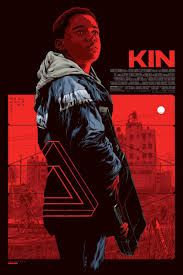
Against a backdrop of low-income struggle and a scenery of deserted buildings, black teenager Eli goes scrapping and finds an alien rifle. Meanwhile, his white brother returns from prison to a tetchy father’s homecoming but still has issues with local and lethal lowlife. 

A Tough Love father, a wayward but fun older brother and a stripper with a heart-of-gold. A hint of “chosen one” syndrome. And a ray-gun. With all these elements, the Baker brothers’ ‘Kin’ acts as a full-blooded young male adult fantasy. In this sense, it’s best evaluated as young adult fiction that still has a lot of maturing and self-reflecting to do.

Besides this, the problem seems to be for many commentators that it’s also made up of a blend of genres and the argument is that it satisfies none. Part indie crime drama, part road journey, part sci-fi, part coming-of-age family drama. But such a mash-up is fine by me and keeps things on its toes. It reminds me of such eighties favourites as ‘Tron’, ‘The Last Starfighter’ and ‘Flight of the Navigator’ where a slightly dull and tatty real world gives way to special-effects and Chosen One excitement. I’m far more likely to raise an eyebrow buying into the idea that a ragtag group of bad guys would attack a police station; or that it probably stays too long in the nudity free strip-club where Jimmy (Jack Reynor) acts like an asshole and gets them into trouble. But the genre-blending that might not quite gel and yet marks it out as likable entertainment is surely a central pleasure of genre b-movies: the lack of genre mainstream conformity often redeems the failings and rough edges.

I’m amused at ‘Kin’ acquiring a “not present” grade on commonsensemedia for “consumerism” as we spend a long time in a strip club (but no actual stripping): surely the selling of objectified women qualifies? And then, of course, the central theme of “a magic gun makes boy heroic” is greatly problematic. The film is weak in self-reflection in these areas and leads Glenn Kenny to see it as “insufferable, self-seriously combining shut-in nerdiness with wannabe macho pyrotechnics.  It’s Bro Cinema in all the worst imaginable senses of the term.” Well, I wouldn’t say insufferable, more that it has b-movie charm despite these obvious flaws. I certainly found it less obnoxious than McG’s ‘The Babysitter’ (2017, NetFlix), another male teen fantasy (again, ‘Kin’ reminds me of those eighties young adult flicks). I also probably find it a less stupid male teen fantasy than ‘John Wick’. It helps that it is boosted by the inclusion of two veterans that know this turf well with Dennis Quaid and Jesse Franco, but it’s the unassuming appeal of Myles Truitt as young Eli that grounds the freewheeling drama.

Even with its streak of immaturity, ‘Kin’ still contains comic fun and charm, even if it is distinctly less than its promise.