Showing posts with label film noir. Show all posts

Thursday, 12 March 2026

In a Lonely Place

In a Lonely Place

Novel~ Dorothy B. Hughes, 1947


Director ~Nicholas Ray

Writers ~ Andrew Solt, Edmund H. North

1950, USA

Stars ~ Humphrey Bogart, Gloria Grahame, Frank Lovejoy


Dorothy B. Hughes’ novel is the tale of a serial killer shamming his way from place to place, a psychological study with noir garb. As a female writer, she convincingly traces Dixon Steele’s infatuation with women, through jealousy and misogyny to barely checked anger and murderous intent. Steele is not quite as arrogant as Lou Ford in ‘The Killer Inside Me’, but similarly convinced he has others fooled, that he’s untouchable. It is Los Angeles, post-World War II and there’s a strangler on the loose, murdering women. Dix is pretending to be a writer and ingratiates himself with an old friend working on the case. The eponymous place is one of misogyny and anger which cannot help but flare up in Dix. He is a damaged man, a monster emerging from that fog of the first pages, prowling the streets at night. 

A prolific and award-winning novelist, Hughes’ book is ahead of its time in focusing on a serial killer’s mindset and toxic masculinity, it exudes noir suspense where the battleground is between the sexes and psychologies rather than criminality. One of its best moments is where the two very different women of his infatuation rub up against each other in his lounge. Sensationalism and sleaziness aren’t the agenda: indeed, the kills happen “off screen”, as it were. To get it out of the way: Dixon Steele is a name worthy of 'Carry On'. Dix’s descent/escalation into murderous sexism is repellent and Hughes isn’t interested in making him charm the reader, although we can see how he might be perceived to have charm to the other characters: we’re too privileged with an awareness to his inner workings and jealousy. One can almost sense it as a woman’s writing experiment in speculating about violent men, although there is a hardboiled attitude that fits it in untroubled with the thriller genre.


Developed by Humphry Bogart’s own independent Santana Productions, the film has come to feature on several “best of” lists, including from ‘Slant’ and Robert Ebert. It is obvious given the censorship at the time that was no doubt impossible for Bogart to be cast as an irredeemable serial killer, no matter how audiences were used to him being an anti-hero, which makes Hugh’s book a strange choice. The adaption is quite an altered beast from the novel, although general details remain. Here, Dix is a screenwriter rather than a faux author which opens the film’s major addition as a commentary of the Hollywood of the time. Nicholas Ray’s fifth film, ‘In a Lonely Place’ is often mentioned along with ‘Sunset Boulevard’ as insider barbs and sour criticisms of the system. Indeed, one of the more impressive meta-moments is the scene where Steele describes that just an everyday scene in the kitchen can relay that they’re in love.

Dix’s ambiguity is the film’s own: we start with his looking in a rearview mirror, giving a zinger that he never watches his own films, almost losing his cool at a roadside altercation and left framed alone against the stop stencilled in the road. It’s a neat summary of his dilemma: reflection, intelligence, temper, warning, loneliness. Such is the ambiguity of his wryness and nihilism that we aren’t sure if he’s guilty of killing the hat check girl. Although the era was averse to criticism of the military, the suggestion of PTSD is there in both book and movie, but it also riffs on Bogart’s own temperament. Louise Brooks’ wrote in Sight and Sound that,


‘In a Lonely Place’ gave him a role that he could play with complexity because the character's pride in his art, his selfishness, his drunkenness, his lack of energy stabbed with lightning strokes of violence, were shared equally by the real Bogart.

(Brooks, Louise. Sight and Sound, Winter 1966/67,

Volume 36 Number 1, "Humphrey and Bogey.")


And if Dix’s character tapped into brawly Bogart’s own, the disillusion with the studio system comes from all the filmmakers. The screenplay is credited to  an authorship that is contested but includes Ray’s penchant for improvisation. Ray takes credit for rewriting the book’s ending which arguably elevates this story into a maturity that genre pictures rarely manage.

Once we have the measure of Dix, the film subtly slips to his love interest Laurel Grey. It is a much-lauded performance by Gloria Graeme, sensual, sleek, vulnerable, smart, in some ways just as elusive and slippery as Dix. It would seem that Dix also acts as Ray’s avatar, a chance to express his own difficulties with his reckless and sensitive self and the marriage to Graeme.

She was forced to sign a contract that agreed that she would not nag him, would always defer to the instructions without putting forward ideas of her own, that kind of disagreeably sexist stuff. But she did sign and in fact the shoot, despite the difficulties star and director may have been going through, apparently went smoothly. Indeed, despite the contract it plays very much as Graeme’s revenge on aggressive and possessive men. Graeme and Ray’s separation during production was kept a secret with Ray essentially living on set for a while. It is a wonder that the film doesn’t implode with all the background baggage, but rather it seems to hone so much focus and surely provided a more devastating and less tropey finale. It is an obvious passion- and passionate project.

There are plenty of quotable and sardonic lines (“What a grip. Comes from counting all that money.”), Bernett Guffey’s cinematography that delves into more grey than typical black-and-white high contrast, a memorable courtyard set between their apartments (based upon one of Ray’s actual addresses), a bedrock of strong side characters and Hadda Brooks singing to add to the jazzy heartbreak feel. Its strength is in focusing on fleeting happiness (“I was born when she kissed me…”, etc.), how people aren’t what we want them to be despite the romance, on how our key flaws ruin everything, how anger destroys what chance there may have been. How we leave ourselves in that lonely place. There’s a whole adult feel to the film that elevates it from mere genre delights to speaking of the simple tragedy of being who you are.


 

Sunday, 17 April 2022

Cross the Line

Cross the Line

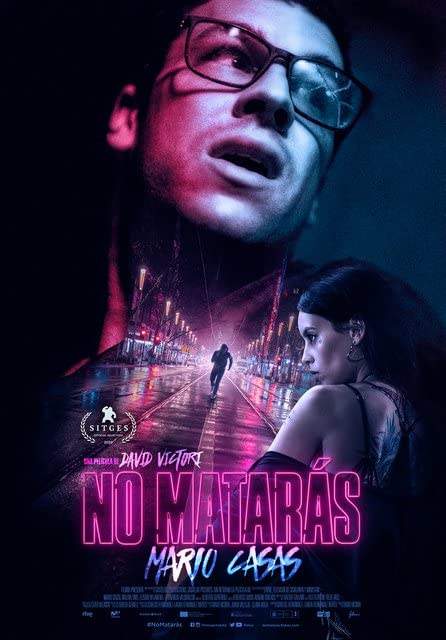
No matarás

Director – David Victori

Writers – Jordi Vallejo, David Victori, Clara Viola

Stars – Mario Casas, Milena Smit, Elisabeth Larena


At online Grimmfest Easter.


Mild-Mannered people-pleaser Dani (Mario Casas) has devoted his recent life to caring for his father, but now it’s time to move on and start anew. And he’s on the verge when he crosses paths with the kind of domineering good time girl that you know is going to be trouble. The film makes exceptional use of music as it goes from dad’s unremarkable dying room to neon nightmare as Dani finds that straying from his caution only gets him deeper and deeper into trouble and desperation.


Victori is obviously going for something more poignant here with the title (online translator says the original Spanish translate as “You will not Kill”?), but the fun is following how things, pretty realistically, spiral out of control, forcing increasingly desperate and extreme reactions. Like ‘Victoria’, there’s a sense of playing out in real-time across the city, the handheld camera staying close to the protagonist– in this case, across Barcelona. It won’t win any friends with portraying the threat as a wild side female, in noir style or a nineties “yuppie peril” scenario, but Smit’s performance is compelling. However, it’s Casas’ portrayal of a man being altered for life by one night, the toll taken showing increasingly on his face, that really grounds the film. Perhaps the film ultimately overreaches for sadness rather than closure, but it’s a vivid and entertaining thriller with lots of panache.


linktree Buck

Sunday, 17 October 2021

GRIMMFEST digital: 'Midnight', 'Faceless'. 'We're all going to the World's Fair', 'The Free Fall'. 'The 3rd Day'


Midnight

Writer & Director - Oh-Seung Kwon

Stars – Wi Ha-Joon, Park Hoon, Ki-joo Jin

2021, South Korea


A hearing-impaired daughter and mother get mixed up with a devious serial killer. Well, it should be profoundly deaf, because the sound design makes it clear they can’t hear a thing. This allows sound monitors of various kinds all over the place (they must have spent all their money on them?) which aren’t quite used inventively enough. However, the portrayal of Kyung Mi (Jun Ki-joo) is mostly sympathetic although her hearing impairment is, of course, just a conceit to rack up tension and misunderstanding. It’s no mistake that the killer’s ability to talk himself out of situations is the counterpoint to her desperation to be understood; he represents the constant threat of the verbose on her impairment. Wi Ha-Joon makes for a handsome and slick killer


It pummels along, but it relies on everyone being a super-runner and the fumbling and stupidity of police and a little convenience-contrivance to keep things going. And going. Perhaps it’s twenty minutes too long because all the way through, the balance swings towards suspense and then rolling your eyes or shouting at characters (you may do this from the first scene) and it’s a little tiresome come the last act (No! Don’t turn your back on the killer! etc). There is a little of the debate about citizens responsibility to one another, a fine melee in a police station and a fine solution to stop him talking his way out all the time.


Faceless

Director - Marcel Sarmiento

Writers - Ed Dougherty, Marcel Sarmiento, Freddie Villacci

2021, USA

Stars - Brendan Sexton III, Alex Essoe, Terry Serpico


A small time trouble-maker wakes up with someone's else's face and a case of amnesia: uncovering the mystery ensues. Shadowy alleys and bars and murkier medical experiments are all there. Sexton III puts in a vulnerable performance as he experiences existential angst and identity crises, trying to piece together what happened.


A film of face trauma and a plot that is both conspiracy and film noir convolution. Uncomfortable throughout for the constant face abuse, packed full of too many questions (Sarmiento says this himself, but one shouldn’t fault a little over-ambition) but ultimately satisfying for the body horror and plotting in a slightly confused and confusing noir manner.


We’re All Going to the World’s Fair

Writer & director - Jane Schoenbrun

2021, USA

Stars - Anna Cobb, Holly Anne Frink, Michael J Rogers


With another remarkable young performance from Anna Cobb, this is something like ‘Eighth Grade’ and ‘Wild Tigers I Have Known’ for horror girls. Friendless video teen Casey (Cobb) plays The World’s Fair, an internet horror game that is meant to possess you. The vibe is American slacker suburbia - but more shoegaze ‘Wild Tigers’ than the metal of ‘Gummo’ – with the protagonist creating her own world online, although she may be talking to no one. But then she is contacted by the dubious MJR, and afterwards she becomes increasingly unstable.


The pace is slow and immersive, utilising long takes and a modern teen’s ease with being on camera. Details like the colourful interior of Casey’s room are vivid and diegetic sound of rain on the roof and traffic passing becoming increasingly create unsettling ambience. It creates a convincing depiction of experience through online videos (expect your screen to buffer frequently) but, like ‘Eighth Grade’, it sides with the kids in that they know exactly how to navigate the artificial and performative world online. Empathetic and weirdly creepy as we seem to be watching a girl’s loneliness turn to mental instability, it maintains its elusiveness to the very end. A character study of teenage malaise and escapism.


The Free Fall

Director - Adam Stilwell

Writer - Kent Harper

Stars - Andrea Londo, Shawn Ashmore, Jane Badler


Slick but prosaic with obvious scares and gaslighting, starts all Gothic ‘Rebecca’ before a touch of ‘The Shining’ and ‘The Conjuring’ universe and ‘The Exorcist’. Possibly camp fun? It didn’t strike me the way Grimmfest’s synopsis did as “a chilling commentary on the seductiveness of Hollywood's dreams of dark romance.”


On the 3rd Day  -  Al Tercer Día

Director - Daniel de la Vega

Writers - Alberto Fasce, Gonzalo Ventura

2021, Argentina

Stars - Mariana Anghileri, Arturo Bonín, Diego Cremonesi


Like de la Vega’s previous ‘The White Coffin’, this too features a woman running around in the middle of something supernatural with a child’s life at stake. The influences and homages to Seventies films are evident (red and yellow raincoats, anyone?), but de la Vega makes the somewhat choppy pacing and nightmare logic of giallo into a pell-mell ride through tropes and mystery. There’s nothing you wouldn’t guess here, but de la Vega’s style always feels like it can’t stop to be obvious, always throwing into hints of something else that implies it could go off in any direction (the silhouette of a man wielding a crowbar in front of a house is straight out of a slasher, for example). This makes for a fun and artful ride through genre, heading for a classic last image before the credits. But there’s also more after the scrapbook credits.


Normally film stills in credits and post-credit codas aren’t something I like, but there is something “everything in!” about da la Vega’s style that I go even with this.


And the very entertaining 'Night Drive' also featured in Grimmfest today.

Saturday, 13 March 2021

I Care A Lot


Writer & director: J Blakeson

2020, UK-USA

Starts with one of those narrations where the protagonist-villain is spouting that sociopathic bullshit about people being one of two types, predators or victims. Yeah. She’s a “shark”. But it’s unnecessary, as so many narrations are, because we can see immediately what kind of woman Marla Grayson (Rosamand Pike is). She’s scamming the legal system into putting elderly people into her care homes, enabling her to fleece them of their homes and money.

But then she plays her trick on the wrong old timer (a game but somewhat side-lined Dianne Wiest), whose son (a constantly stewing Peter Dinklage) is also a reprehensible gangland criminal. Mark Kermode says that the film plays with allegiances, but never once did I root for Grayson. What we are left with is knowing that, whatever happens, the bad guys will win. And they do.

The stipulation that a fiction’s protagonist should be “likeable” is, of course, absurd. What they must be is interesting and even, you know, complex. ‘I Care a Lot’ truly pushes that to its limit, because there really isn’t anyone to root for. Of course, it helps that there’s Rosamind Pike whose superficial smile is the stuff of nightmares, giving a sexy authority to her moral vacuity. And there’s Peter Dinklage, where you can feel the gears grinding beneath the surface. Both are brilliant turns. But what you need is an interesting plot if are at odds with the characters, dialogue and twists and turns, and the film has that enough. But what we also have is a plot that hinges upon henchmen not checking their victim has drowned and being unaware that they are being obviously tailed all night, it seems.

But the fact that ‘I Care a Lot’ doesn’t ask for your empathy for its protagonists no doubt contributes to the strength of negative reactions on Amazon commets: “Stupid movie” and “Waste of talent”, that kind of thing. But ‘I Care a Lot’ isn’t that, of course: Blakeson does what he sets out to do, and it’s stylish, well written and paced and always interesting. It’s certainly divisive and frutsrating. The second half moves into a thriller scenario and there is also a hint of the heightened reality here, so perhaps the bleakness and cruelty obscures the playfulness. It feels like it’s in the same semi-absurdist world as, say, Soderberg’s ‘Unsane’. For example, the credibility of Grayson’s scam might be an issue, if you know how courtrooms work, etc. It’s Grayon’s girlfriend (Eiza Gonzáles) who provides a hint of vulnerability and humanity, although this isn’t the would-be tragic tale of how she got swept away by a sociopath. Grayson is such a towering larger-than-life presence that it almost obfuscates the culpability of her enablers.

The final narrative note is a balm because the bad guys triumphing so big is perhaps too much to take for an audience, and films are there to see comeuppance given. But we know bad guys get away with it all the time, heading corporations, corruption, dodgy pasts, becoming president, etc. So that is perhaps the message that hangs: that we are run by crooks. And anyway, she philosophically wins because she had already stated fiercely, under duress, what she thinks of this outcome.

Tuesday, 19 January 2021

The Sweet Smell of Success


  The Sweet Smell of Success

Alexander Mackendrick, 1957, USA

Screenplay: Clifford Odets and Ernest Lehman

Coming from Ealing, Mackendrick went to America and made this vehement attack on the noxious shwbiz gossip journalism scene. Moving stateside, the wit is less satirical and more acidic. Full of memorable put-downs and one-liners that are just desperate to punch you. The pace is at an authoritative stride and you’d best keep up. 

Elmer Bernsteins’s score keeps up the jazz dizziness and cool, never overpowering the dialogue but always paralleling the sense of characters constantly riffing. And with that heavy-hitting script and actors at their best, with that agile camera following and gliding through James Wong Howe’s wonderful black-and-white photography, it’s definitely a film where everyone is at the top of their game.


The screenplay is by Ernest Lehman and Clifford Odets from Lehman’s novel, and it’s a legendary script. It’s film noir with the nihilism and wisecracks transported to column writers rather than private dicks. And even if there is the implied gloss of the entertainment industry and we’re visiting high end clubs and restaurants, we’re firmly in the gutter and underbelly here. Tony Curtis practically sweats self-loathing as Sidney Falco, the press agent trying to simultaneously suck up to and siphon some power from columnist J.J. Hunsecker. Burt Lancaster as Hunsecker seems to turn the very air around him to cruelty. And boy, Lancaster and Curtis know just how to deliver those zingers. The former’s sleaziness and the latter’s ever-present ominous threat are palpable essences. Falco avoids the conscience-pricking of his secretary whilst Hunsecker connives to destroy his sister’s romance (Susan Harrison) to the decency of a jazz musician (Martin Milner). That’s the plot that barely hints at the poisonous flow of character and scheming, the hints of the incestuous and moral vacuity. All for the sake of personal weakness, cynicism and show business.

And of course, these men would never think they might be beaten at their own game.

A cold classic.

Sunday, 5 November 2017

Blade Runner 2049 (just a first watch)

Denis Villeneuve, 2017, 
USA-UK-Canada

I know it’s going to take second watch to fully determine what I think of Villeneuve’s continuation of Ridley Scott’s classic. I like Villeneuve ever since I thought the direction of ‘Sicario’ proved exceptional, but I felt ‘Arrival’ had major problems that dented my appraisal of him (although that was more the material than his execution). From the trailer, I thought ‘Blade Runner 2049’ was going to be a more action-filtered rendition of the premise, hyped-up with adrenalin for a modern audience, so I was pleased and surprised that the tone proved to be measured and faintly abstract. In fact, it’s so wilfully – and in my opinion appropriately – languid and conceptual that this seems to obscure its storyline: it has been accused of lacking story, but the storyline seems to me to offer plenty to chew on. A replicant (an artificial human) with an identity/midlife crisis is going about his job of killing other replicants when he is given reason to follow up on his heritage; this leads him to a revelation that makes him think he is special as well as to the narrative of the previous film, but in a nice snub to The Chosen One trope that is so dominant in fiction, he finds he is mistaken. Rather, he sacrifices himself for the greater good. This seems plenty to be getting your teeth into and perhaps it is the overwhelming art-design and mood that leads people to believe the narrative is smothered and lesser than it is. 

And this is a gorgeous film. Many times, I found myself marvelling at the visuals, with Roger Deakins’ cinematography accentuating the glare of the opening, the perpetual neon night of Los Angeles and the art design of Jared Leto’s domain. The film is almost overwhelming with visual wonder – many of the urban vistas are breathtaking – but it also abundant with details to sift through: Pan Am adverts left over from the original; 'Peter and the Wolf' as a ringtone; the idea that a personality is just memory on a data stick (an idea completely in tune with Philip K Dick’s agenda); etc. Surely it is a veritable wealth of Easter Eggs that it is impossible to parse on a single watch. On top of that, the holo-Vegas fight and the final battle in a flood are exemplary action pieces.

“K” (Ryan Gosling) has a personality built upon artificially implanted memories, but when he gets home, all he wants is a traditional set-up where a devoted wife-figure serves him dinner and dotes. Is such an old-fashioned domestic desire programmed into him? Indeed, are we to deduce such desires can be credited to his programming or a more independent personality, growing from the programming, and that this vision of an idealised lifestyle is derived from the surrounding patriarchal/misogynistic culture? Nature or nurture? And are we to assume in this future setting that gender-politics haven’t gathered any nuance in the past hundred years, at least? It’s easy to take issue with such details but it remains steadfastly ambiguous and that is surely a strength and a nod to the unresolved questions of the original, questions it snakes around answering and mostly leaves open-ended.

We can maybe attribute “K”’s heterosexuality (and that is presumably programmed too) as triggering the objectified female holograms, but we don’t see any parallel and balancing experiences from the women character’s perspective so it leaves the film wide open for accusations of misogyny. This is mitigated by having Robin Wright as “K’”s boss, even taking advantage of her power by making a pass at him; also by shading Luv (Sylvia Hoeks) by having her seem increasingly saddened during her actions, as if she is asking herself Is this all I am: a murderous replicant? Mark Kermode makes a solid argument that actually it is the women of ‘Blade Runner 2049’ that hold all the power and that it is the patriarchal mindset of the male characters that hinders them in seeing things clearly. More than once, characters are told their attractions are programmed and then the film continues to maintain the air of ambiguity. Perhaps it is human vanity that we wish the replicant characters to be human? But the original surely took a jab at this by having Roy Blatty (Rutger Hauer) in the original be the most soulful character, despite the humans?

Indeed, it is surely the female characters that actually have more to do and show. The men come from the stoic, underplayed side of things, and one of the main frictions is waiting to see if Ryan Gosling will break out of his reserve. When Harrison Ford turns up, he effortlessly shows that you don’t need so much to exude a broken, grizzled machismo. Jared Leto has come in for attack for its high mannerisms, but that is surely a piece with the original replicants. But no, it’s the women that get to show more layers, more evident intelligence and range; and with the female prostititute and assassin replicants, they express a barely subsumed tiredness at working within patriarchal culture is expressed. It’s this that muddies the waters of criticisms for ‘Blade Runner 2049’s gender politics: it’s not that they don’t have some grounding but that it’s working on a more complex terrain than might be originally thought.

The thematic heft of ‘Blade Runner 2049’ is surely stronger than the original, which benefited and may be seen as superior from having a simple film noir narrative and a romantic intention that were instantaneously familiar as a guide through the tremendous art design. That Villeneuve with Michael Green and Hampton Fancher’s screenplay manages to capture and continue much of the ambiguity and abstract tone, smothered in state-of-the-art effects and set design, is surely a remarkable and stubborn achievement (although it might be seen by detractors as just pilfering and imitation). The fact that it is surely to be hotly grilled and debated in many studies to come – not least about its gender politics – is surely indication that, although already mostly warmly received, it’s true worth is yet to come. And even in that, it follows in its seminal original’s footsteps.