Film Comments 2024: Others + Horror
Jonathan Glazer ‘TheZone of Interest’ was remarkable anti-narrative
portrayal of total horror, presenting a perspective of the facilitators that
treat it as an extension of their cosy, privileged lives. A profound
achievement.
I may have been unconvinced that Alex Garland’s ‘Civil War’ gelled, but in a pending "President Trump Toxic Avenger 2" world, it’s vision of people at war with each other for who-knows-what?
reason certainly seemed to be onto something, somewhat prescient for those
perpetually doomscrolling.
To more conventional thrillers:
Joshua Erkman’s ‘A Desert’ was a solid, sunbaked
thriller. A photographer goes on a road trip, bearing a mid-life crisis, and
discovers – like so many horrors – that Some People Just Want To Fuck You Up.
Even if that’s predictable, there are full-blooded performances, grittiness,
beautiful cinematography, and enough inventiveness to make this memorable. A
film that will surely earn itself cult status.
Rather than the stylisation and staginess of his
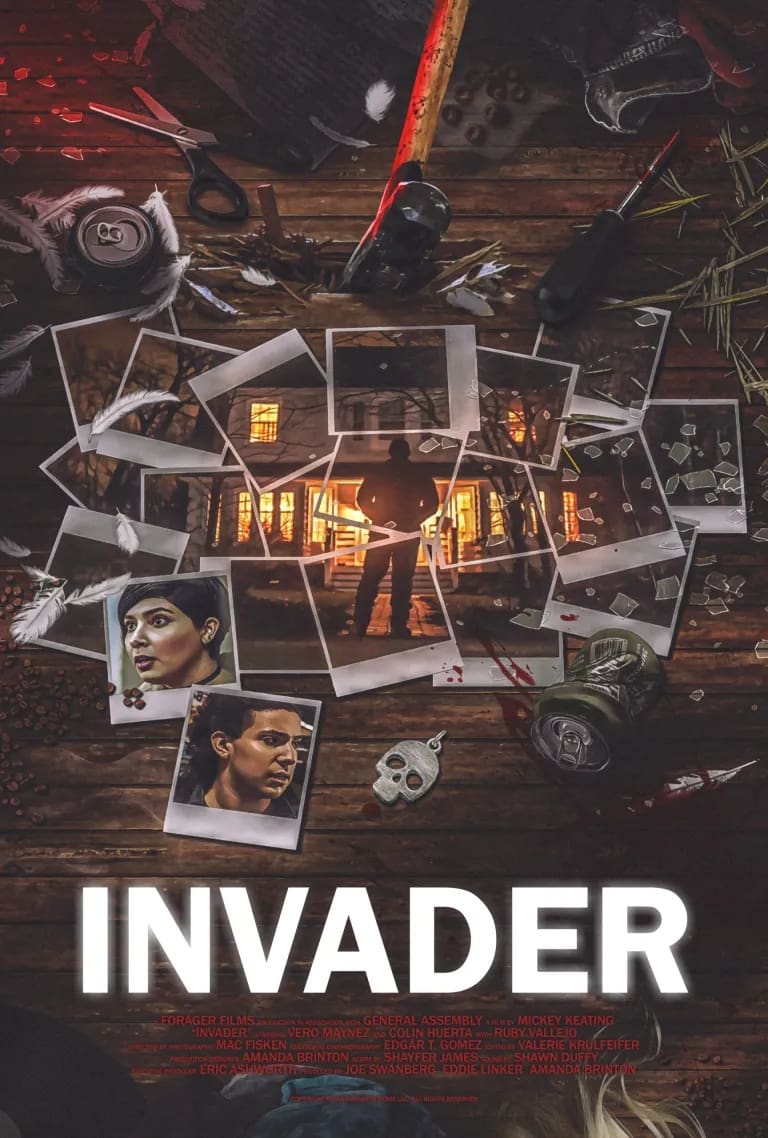
previous ‘Psychopaths’, Mickey Keating’s ‘Invader’
shouted a smash-and-grab intent. It’s a slender, brash and often intense home
invasion tale told in hand-held fashion that – in their stage introduction –
Keating and editor Valerie Krulfeifer warned we may have to look away and take
a break from at times. And yes, sometimes the shaky-cam is confusing – blocking
doesn’t seem to be a thing – but it is obviously deliberate rather than
artless. Keating talked of trends in the nineties for films about Americans
going abroad and getting fucked up, and how he wanted to invert that (and just
stopped short of saying outright “Why do people want to come to Chicago?”
Keating and Krulfeifer were light and breezy, likable and funny). And it’s true
that the America presented here is litter-strewn, unfriendly, threatening and
ultimately homicidal in a weirdo get-up. ‘Invader’ is a short and loud
burst of social anxiety with no room for relief.
For lighter entertainment:
Chris Renaud’s ‘Despicable
Me 4’ may have a plot, with Gru the main guy, but it’s the
minions we come for, surely. They are a brilliant comic creation and their
slapstick a constantly amusing occasionally hilarious delight. The franchise was
always based in satirising the superhero/villainy genre and this time round,
the minions get their own superhero group, with their going around erroneously
do-gooding a highlight.
Kelsey Mann’s ‘Inside
Out 2’ proved a solid, inventive primer for teenagers
negotiating emotions. Well actually, ‘The Numskulls’ allegory is a good foundation for thinking about behaviour at any age. New
Teenage Emotions gatecrash the equilibrium of our growing protagonist Riley’s
character, and it’s their interplay that is the film’s core delight. Goofy
designs, bright and colourful, mono-motivated and often at odds yet all aiming
on the same goal. It’s a smart and mindful screenplay and execution with plenty
of poignancy (Embarrassment helps and covers for Sadness). Definitely in the
quietly brilliant camp.
The defiantly oddball ‘Hundreds of Beavers’ by Mike Cheslik was
deliriously inventive, always funny, quite unique and spiked with nastiness as
much as cartoon slapstick and craziness. That it gives people dressed up as
animals romping around a forest such consistent focus and technical ingenuity –
just a 19th century bear-trapper trying to kill as many animals as
he can to impress a hard-to-get girl with furs – on small budget and a load of
creativity was impressive; that’s it’s just plain smart-stupid-funny and
entertaining even more. Now you know what Guy Maddin rebooting Looney Tunes
looks like.
Pablo Berger’s ‘Robot Dreams’ was as
much about loneliness as ‘All of Us Strangers’ and ‘I Saw the TV
Glow’, and had a sneakily sombre tone, but colourful and benign. The
anthropomorphising is absolute from our protagonist DOG to the Robot he buys
for a friend. It taps into pet love sentiment and so will inevitably reach
deep, although it perhaps doesn’t go as you might think. Its ultimate message
about the depth and perhaps brevity of a best friendship coming up positive and
life-affirming. Full of lovely details such as comedy pigeons, or a
street-drumming octopus and snow on a beach, one of those benevolent, all-ages
animations with proper emotional resonance. And in that way, a small treasure.
To franchises:
All I know is that I watched Denis Villeneuve’s ‘Dune part 2’ in a state of awe.
His slightly detached manner of storytelling is not for some, but from the
post-credits voice blaring out to the subsequent soldiers silently gliding up
dunes, I was beguiled. It is typically a second viewing that reveals the
linearity. Launching from the set-up of its predecessor, this sequel consummates
a world-building of stunning cinematic breadth and technical achievement. That
it is a anti-chosen-one narrative is a buried under a sandcastle, but Paul
Atreides refusing and then fully embracing the White Messiah complex is nicely
accentuated by foregrounding Chani: I found Zendaya a weakness of the first
part, but not so here. The palaces, the spaceships, the battles, the pomposity:
this is science-fiction size on screen to compete with what was in your head
when you read a book. Totally immersive.
Wes Ball’s ‘Kingdom
of the Planet of the Apes’ came trading in the goodwill of the franchise
that has lasted decades. It came with a somewhat unwieldy name that implied we
might get an ‘Outhouse of the Planet of the Apes’ at some future point. The
opening is a little like consul gameplay challenge with the apes trying to get
far-flung eggs, and because it was world-building for another trilogy, the
pacing issues were achingly obvious, almost recovering from them when
Proximus’s prison-Utopia becomes the focus. But Mae the human is a flaw, being one
of those defiant characters who causes a much trouble when her only motivation
is defiance!, thinking that is strength, and the film seems to think so
too. Dreary and despondent rather than scary, energised doom mongering.
Shawn Levy’s ‘Deadpool
& Wolverine’: There are memories of the meta-stuff being
funny in the predecessor, but that has turned into in-jokes, no consequence and
a narrative built on audience applauding cameos. Yet, good for a few laughs.
Fede Álvarez ‘Alien:
Romulus’ does a lot
right, rehashing and rebooting, and there was a lot to enjoy when a bunch of
looters come up against xenomorphs. There was always a sense of thinking out
the set-pieces and problem solving, of returning to monster-movie roots. of the
aliens trying to reclaim their genuine scary nature. But then there’s a
call-back line so glaring, so wrong, that it undermines a lot of goodwill.
Nevertheless, consistently great set design, David Jonsson’s turn as Andy and
the standout shots of the spaceship in the planetary rings made this enjoyable.
Horror:
To get it out of the way: It’s doubtful that any
alternative adaptation could usurp the glorious 1979 series that traumatised a
generation, but if there ever was to be it was not Gary Dauberman’s ‘Salem’s Lot’. There was potential to
the drive-in finale, but it was not a film that found a way to condense the
sprawl of the material into something effective and unnerving, leaving it thin
and shruggable.
Damien Leone’s ‘Terrifier
Part 3’ was an obvious result of adolescent boys getting
together trying to think up the most outrageous and gory set pieces they can. But
there’s no doubt that Art the Clown is a great performance by David Howard
Thornton, and that Leone can direct, wallowing in cruelty without any point or
consequence. Like part 2: probably what non-horror fans think horror is: over
two hours of sadism and outrageous gore with a magic sword get-out clause. But
this time with added Christmas bullshit.
Films like Frédéric Jardin’s daft ‘Survive’ and even Pierre Tsigaridis’ daft and ikky ‘Traumatika’ were not-good-but-enjoyable-nonetheless.
Films like ‘The Invisible Raptor’
and ‘Alien Country’ were
far funnier and better than their one joke promise. Films like Clark Baker’s ‘Test Screening’,
Josh Forbes’ ‘Destroy all
Neighbours’ and the ‘V/H/S
Beyond’ did exactly what they promised on the tin, and enjoyable
if undemanding for that.
But then there was Cameron and Colin Cairns’ ‘Late night With the Devil’ that
managed to make its evident flaws irrelevant.
It proved to be the genre’s underground success, overcoming any imperfections
by its era recreation and just being greatly enjoyable.
Equally scruffy but memorable was Yusron Fuadi’s ‘The Draft!’, generically
stumbling along it’s tropes, when suddenly its title makes sense and opens up a
host of meta-gags. Even the score set to “overkill” and a gag reel make sense
in context. Surprisingly smart and amusing.
‘The Last Voyage
of the Demeter’: Troubled
by distribution delays, André Øvredal’s embellishment on one of ‘Dracula’s
best passages proved a solid big monster movie with some good characterisation
(ships were centres of diversity) and some great monster effects. Not at all
gruesome or scary, but impressively mounted and touched with a little nastiness
when it needs it. Lavish and slick if unremarkable Gothic horror entertainment
(and a light companion piece to Eggers ‘Nosferatu’).
Sébastien Vaniček
‘Infested’ had the socio-political horror down pat, where
the bigger threat was the police trying to keep the less fortunate in a
deathtrap, but the spider action was a little underwhelming.
In a post-pandemic world, David Moreau’s ‘MadS’ couldn’t help but have a
little more socio-political heft, but as a straightforward One-Take-Wonder
romp-and-dazzle on a familiar set-up, it delivered.
Alexandre Aja’s ‘Never
Let Go’ was on the verge of saying something relevant about
isolationism, delusion, nature/nature, but never quite made a point. Halle
Berry gave it earnestness – but was this just commitment or signalling the
mental illness of fundamentalism? And the child performances were impressive,
as was the tense atmosphere – Aja is a craftsman, there’s no doubt – but
there’s a fine line between ambiguity and being the feeling of being cheated
out of answers.
A far better folk horror was Daniel Kokotajlo’s ‘Starve Acre’. Unfolding as expected, although
distinguished by the rabbit action, but nevertheless hitting directly that
pleasure zone of British Seventies horror vibe. Oddball performances,
uncanniness, the sense that grief may lead you to dig up the past and into
ruination.
Also in this realm was Benjamin Barfoot’s ‘Daddy’s Head’, impressive for
having its internal logic all thought out and all the random uncanniness stem
from this, making ultimate sense once you put the pieces together (horrors
often feel like they’re the other way around). With a dread, slow burn
atmosphere and a modest itinerary on its ambition, its lack of Big Horror might
leave some cold, but it was far better than its bad, bad title.
Couples trouble was covered by Jason Yu’s creepy-fun ‘Sleep’ and Caye Casas’ ‘The Coffee Table’.
The former was ultimately a sad tale, despite its veneer of horror tropes, and the
latter funny until defined by the unbearable. In that sense, it was true
horror.
For other favoured horror-thrillers that weren’t ‘Strange
Darling’:
Kyle McConaghy and Joe DeBoer ‘Dead Mail’: Set firmly in a dour, washed-out
Eighties where most era homages look like cardboard cut-outs coloured in felt
tips. Deliberately low-fi aesthetic, all the cassettes, typewriters, rotary
phones and sleuthing mail departments surely puts this in a technological era
that will be totally alien to younger viewers. Superior attention to detail,
character and plotting makes this increasingly engrossing as an unusual
thriller based upon synthesizer geeks and mail offices that work more like
altruistic private detectives. There’s also bonus appreciation of the underappreciated
heroism of working people just doing their job and taking a care. Its context
feels so, so real with Fleck and Macer Jr’s performances infused with pathos
rather that movie thriller panic and motivation. And the devotion to analogue
synthesizer music on the soundtrack gives it that extra special element.
Any seasoned horror fan will get where this is going
from the opening credits collage. Teddy Grennan’s ‘Catch a Killer’ makes for a thriller whose
stylishness belies its B-genre concept, but it’s slick, entertaining, very
enjoyable and hosts a great central performance from Sam Brooks. And for once,
the romance feels worthwhile rather than performative. I for one appreciate the
swiftness of the ending as opposed to a originally conceived protracted
showdown that would have highlighted more problematic elements.
Perhaps Chris Nash’s
‘In a Violent Nature’ was not quite the slasher
deconstruction I first thought it to be, but, my word: what a difference pace
and camera placement makes. I was deeply amused that such a thing as an ambient
slasher existed, and I was fully hooked. It trudged along with in a slow burn
without a score to spark responses in a manner that I assumed to be antithetical to the Jason
Vorhees crowd. Often the plot and victims – I mean: we have seen it endless
times – was approached by the hulking undead killer from afar, deliberately,
non-excitedly; but every other kill was grandiose and gruesome. And the ending
wasn’t going to win anyone over either, but all this same-old-story-from-a-different-angle
was a winner for me.
And:
Disappointments 2024:
Drive-Away Dolls
Lady Frankenstein
MaXXXine
Never Let Go
Deadpool vs Wolverine
These were films I was genuinely excited for
but left underwhelmed.
I mean, I never expected ‘Salem’s Lot’
to impress, but I thought I might be pleasantly surprised.
A few favourite soundtracks/scores 2024
The Zone of Interest
I Saw the TV Glow
Strange Darling
Perfect Days


