Showing posts with label killer doll. Show all posts

Tuesday, 23 July 2019

Child's Play (2019)


Lars Klevberg, 2019 
Canada-USA

Creator Don Mancini apparently objects to this reboot but updating Chucky for the Bluetooth generation is a smart move.  Slight thematic differences stop this from being a dull retread of the original. Dismissing the whole “possessed doll” origin makes Chucky less wisecracking but more troubling as the threat of modern technology gone awry. More ‘Westworld’ and ‘Black Mirror’ than ‘Annabel’. It also eschews the smugness that dominates the later Chucky films. 

Andy (Gabriel Bateman) feels like a decidedly modern kid, both happy to cry it out and to kick-ass, a reasonably full range of character. And the casual way he’s partially deaf, which barely plays a part in the drama or his friendships, is a detail which is positively normalised by being happily trivialised. His mother (Aubrey Plaza) is a young woman who had Andy too early and sometimes feels more like a big sister. Yes, many other characters come from the B-Movie Catalogue of Archetypes – the bad boyfriend that deserves all he gets; Andy’s new slightly obnoxious friend – which is expected, cliché and undemanding but the film doesn’t quite rub it in and is grounded by the central relationship. Uncle Lancifer doesn’t quite accept the middle section where Andy has to deal with the grim gift Chucky has left him – like a cat leaving a dead mouse for its owner – and this is indeed the most awkward sequence which runs like horror farce and relies on no follow-up questions to get resolved; but it’s not quite out of tone. It has that b-movie scruffiness where a further polish on the script wouldn’t have gone amiss to nudge it up a little. If there is the sense of feeling a little surprised that this is fair rather than bad, that was the dominant take-away. And then it just runs into a standard showdown third act. Oh, and Mark Hamill now voices Chucky.

‘Child’s Play’s most interesting feature is its brush with the themes of nature and nurture. Chucky has had his “violence inhibitors” turned off by a factory work pushed too far so that he fixates on loyalty to Andy but doesn’t know how to process certain input appropriately. Andy is a little old for a “doll”, but he’s new in the area and lonely and this is a fascinating super high-tech appliance. So it’s creepy when Chucky is staring at you when you are trying to sleep, but, hey, every appliance has it’s annoyances. Chucky’s mistaking a toilet roll for science book is just a glitch in it’s trying to be a real friend. These are moments of humour.

Most interestingly, whilst the tweens are laughing at the silly super-violence of ‘The Texas Chainsaw Massacre 2’, Chucky is taking in tips for killing. This isn’t a film to take on such a weighty topic as the responsibility of art’s portrayal of violence, the ‘Chainsaw 2’ moment being a set up for the film’s grisliest moments and for farce, but it’s intriguing that a main source of empathy is Chucky’s clumsy desire to do good and misunderstanding cues happening around him. The kids are laughing – like any innate horror fan, they know the genre is a good source of comedy – but  there is something fundamentally amiss with Chucky and he takes it all wrong. His insistence and faux paus are readable as the behaviour of somebody who is cognitive atypical and therefore deserving of empathy. Until he kills, of course. But then, his homicidal behaviour comes across more as he-knows-no-better than intentionally malevolent, as the violent reactions of a stalker or spurned lover. Which makes him no less scary.
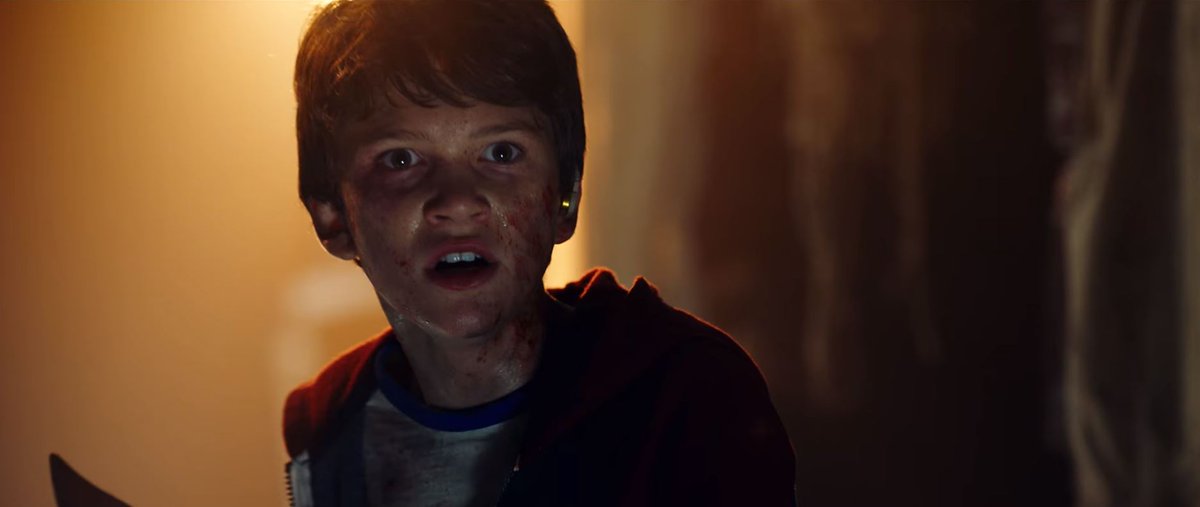
It’s not ground-breaking, but it meets demands with Tyler Burton Smith’s script tweaking a bit here and there to lift it above the in-joke that the original series has become.

Wednesday, 6 September 2017

FrightFest 2017 - Day 5

When I started coming to FrightFest, I remember it started off as an experience of maybe sitting through two or three films before a good one hit the mark. But over the last few years I see it as the reverse, as it being rare to have a truly bad film. I mean, there is usually one but I have to protest that, for all that I may appear picky, I really do enjoy the whole experience and I think a wealth of good-to-great films only make each other look better. In fact, it was last year that I realised that watching decent-to-brilliant films back-to-back was just as tiring as watching a host of bad films: there isn’t much time at a film festival to digest a good film before the next one is upon you. But this year, I found it much easier.

So on to the last day:


STILL/BORN
Brandon Christenson. 2017. Canada

Mary gives birth to twins but one is stillborn. A new spacious home and surroundings can’t quite hold off post-partum depression, especially when odd noises come from the baby monitor and she starts to believe that a witch-like spectre wants her other baby. Odd noises down a baby monitor are, of course, inherently scary and this may be the most creepy film on the FrightFest main screen this year. Christenson doesn’t really fall back on redundant jump-scares so much, but there is a lot of running to the nursery for the spookiness, and it then becomes evident that the film isn’t going to break free from convention. It all ends with a slightly sloppy party scene: (so she just runs to the party from the hospital? Was it just down the road? And she’s sitting there with a knife and they just impotently bang on the glass? Does nobody think to even try to break the glass door? And then he just opens the other door and runs in…? Wait, wasn’t the other door locked?). And then it has one of those it’s-not-over-really codas that really doesn’t resolve anything. So it’s an average scarer that does nothing insightful with such a loaded premise.


LOWLIFE
Ryan Prows. 2017. USA

Interweaving narratives about a series of characters living in the underbelly of Los Angeles. The most striking characters being El Monstruo, a disgraced Luchador who never takes off his mask and deludes himself with his own mythology, and Randy, fresh out of prison with a full-face Swastika. But there’s also Crystal, a recovering addict trying to achieve some kind of pride and morality in running a shabby motel; her estranged junkie daughter; a corrupt policeman; a thoroughly reprehensible hoodlum running an illegal organ donor scheme with the daughter in his sights… And it’s here we come in, starting with the business of Teddy the human trafficker. This opening is nasty and bloody and more in the vein of ‘Sicario’; it doesn’t hint at the black humour and amusements to come. 

The different stories are divided into chapters and play with time so that we gain a fuller picture when scenes are retold and then they converge for the last act. Of course, such a focus on temporal and perspective playfulness and criminal society will be compared to ‘Pulp Fiction’ as if such techniques were never done before, but Tarantino was never this humble in the face of people’s suffering. It probably leans more to indie crime drama than horror and it may be scruffy at the edges but ‘Lowlife’ is a great mixture of crime drama, offbeat characters, gore, amusement and social discourse. It may stem from different vignettes and have five writers, but Ryan Prows keeps it all fluid, bringing it all together by investing in the complexities of the characters, even if they initially seem cartoonish. Prows spoke at the screening of being a fan of luchador movies and trying to put that in a more realistic contexts, which he does to amusing effect as well as El Monstruo being a study in delusion. Then it successfully humanises a guy that’s a walking Swastika and delivers an exemplary performance from Nicki Micheaux. It doesn’t waste time in colouring in Teddy (Mark Burnham), but then it’s not really about humanising the bad guys as focusing on good peole doing bad things to survive. A stand-out curio.


BETTER WATCH OUT
Chris Peckover. 2017. Australia/USA

After his parents go out for Christmas (Virginia Madsen and Patrick Warburton delivering brief but great comic turns) 12 year-old Luke (a startling Levi Miller) is looking forward to being baby-sat for the last time by Ashley (Olivia DeJonge) for he has quite a crush on her and wants to declare his love. But then a home invasion interrupts his plans…

And here I really do want to stop you if you want to enjoy ‘Better Watch Out’ to the fullest. My blog is full of spoilers and I don’t usually pause to give more warning as my “About me” has a big one, but ‘Better Watch Out’ – originally ‘Safe Neighbourhood’ – deserves to be gone into unprepared for its twists. No, don’t even watch any trailers because they are sure to give away a little too much. Just take it that’s good and worth your time. Get the idea? Then I’ll continue, knowing that anything I hint at might give the game away.

During the height of the video nasty craze in the UK in the Nineties, I felt appalled that a film like ‘Home Alone’ was considered suitable for kids with its slapstick approach to using household implements to, for instance, set fire to a man’s head when ‘Reservoir Dogs’ was banned for an ear-slicing you didn’t see – remember one of the chief motivations of censorship was to cull films of bad behaviour that kids might imitate (hence the wholesale removal of nunchuks from ‘Teenage Ninja Turtles’ and so on). Something happens halfway through ‘Better Watch Out’ and it becomes a whole different film that seems to me to be a dismantling of all those precocious brat films and their slapstick violence. And you can even count in that ‘The Visit’ which also starred DeJonge and Ed Oxenbould (they were unbearable in that and excellent in this).  I still don’t like ‘Home Alone’, but when ‘Better Watch Out’ kicks into full gear, it gives the lie to all the films that use inappropriate horny behaviour from boys as funny (‘Crazy Stupid Love’ comes to mind) and the preciousness that defines character like Kevin from ‘Home Alone’ that apparently some find cute. 

Zack Kahn’s script – a writer for ‘Mad’, so that should be a clue – is peppered with details that seem innocuous and cutesy at first but are subsequently filled in later to fill in a more sinister back-story (like “sleepwalking”). Bloody-Disgusting thinks that “There is a period of time in the second act where Safe Neighborhood [‘Better Watch Out’] plays things a little too seriously”, but I was disturbed as soon as its true agenda was revealed and perhaps others still found it a romp but as I was tuned into it as a scathing satire (indictment?) of the precocious brat genre, as I was throwing it more into the “budding psychopath” genre, I thought its lightness of tone was deceptive. A black comedy that looks as bright as any Christmas movie but, boy, it has a real mean streak. 

And kudos to the fact that it doesn’t resort to all-out violence on a minor to resolve things: considering that whenever the deserving got their heads pounded in with rocks or whatever the FrightFest audience whooped and applauded approval (even in ‘Killing Ground’), the fact that in this film an off-screen, overheard line of dialogue produced the same loud approving response surely goes to show that it wasn’t just violence the horror audience wants, but to see bad guys get theirs. And ‘Better Watch Out’ has quite a bad guy, one you’ve seen before but maybe not identified in many other family films.


THE TERROR OF ALL HALLOW’S EVE
Todd Tucker. 2017. USA

An outsider kid into horror make-up, models and pranking the locals gets bullied one time too many and makes a pact with The Trickster for vengeance on those who have humiliated him. 

Autobiographical to Todd Tucker – even the workplace full of horror stuff is actually his – it’s a straightforward old-style teen vengeance tale with practical creatures and effects which makes it all the more than winning on that front. Doug Jones gives a creepy and articulate turn as the seducer to the dark side. You would think fifteen year-old horror fan Timothy (not Timmy – Caleb Thomas) would know all about Faustian pacts… and the creature that offers him vengeance is called The Trickster so that is surely a clue? Nevertheless, what marks this out is its lack of jubilation typical of getting-your-own-back narratives: it’s eventually a very downbeat film with the message that if you lose your temper, you might do unspeakable things and lose everything. This makes it haunting and deeply sad in retrospect, which is not typical of these kinds of things that usually like to wallow in ‘Eerie’ comics-style poetic justice. 


TRAGEDY GIRLS
Tyler MacIntyre. 2017. USA

Starts off with a lone car on a bridge and a couple of young people romping in the back seat in a shot that looks as artful as those found in ‘It Follows’. But this is not that film. Rather, it’s about two girls going psychopathic to get ‘likes’ on social media. The girls want to be horror legends so they kidnap an old school slasher to teach them something, but soon see this hunger for this most twenty-first century form of fame as an excuse to murder anyone that challenges them or pisses them off. 

‘Tragedy Girls’ has great central performances by Alexandra Ship and Brianna Hildebrand whose onscreen chemistry anchors the satire and, as Andrew Barker says, “both of which split the difference between Tarantino and Nickelodeon remarkably well.” It riffs on the High School tropes we know so well but here the mean girls are completely without any moral compass as they search for more social media fame as if that means credibility and meaning. But they aren’t regular bullies targeting freaks and geeks; rather, ex-boyfriends and rival cheerleaders have more to fear. It’s fast, bright, witty and well-played so that its messier elements are easily overlooked. 

They overcome the old school slasher they kidnap as if the film is saying the narcissism and ethical indifference of social media generation is a far scarier thing. The film seems aware of this when a teacher berates them for their shallowness, but a film that seems so smart doesn’t quite establish a moral stand: this isn’t the dumb fun slaughter of ‘Victor Crowley’ or the gung-ho carnage of ‘Mayhem’. They slaughter the whole school and get away with it as their cruel intentions are recogisable as American ambition and popular culture. They seem normal. But are we supposed to celebrate their being sociopathic BBFs as that seems to justify it all…? So they’re the bad guys, but is their selfish anarchy of murder to be cheered as asserting themselves?  I could not quite get rid of the bitter aftertaste that the irony of the ending was on the back of a prom load of corpses. Popular but troubled, much like the girls themselves.


Wednesday, 30 August 2017

FrightFest 2017 - Day One

Yeah, I do love my annual FrightFest holiday. After film eight or nine, you start to lose track of time and the days and all you are required to do is to turn up for the next film. It’s such a delightful neglect of reality and responsibility, such a wonderful indulgence for anyone who enjoys being fully lost to the film experience. And the FrightFest mob are generally so friendly. I venture there is a streak of anarchy to this audience that you don’t really find in other audiences which is all about the genre. And when you tell people you are going to a horror film festival, I bet they are either imagining Hammer Horror or an endless parade of “torture porn”. Something like that. But the range of the selection is so varied that it gets to the point that it could be argued that some films merely contain horror elements (‘Alone’; ‘The Bar’) or some gratuitous violence (‘The Villainess’; ‘Lowlife’) and that’s where they qualify.* But whether the choosing or submissions have improved doesn’t really matter as it’s true that the past few years have served up consistently enjoyable menus.

I know I am missing out by not going to the smaller screens or to the Prince Charles, where FrightFest spreads to, but executive decisions need to be made and I elected to stay in the main screen to see what’s what. It’s a shame that the short film showcase is now in the smaller screens as I know I am missing out on some good stuff there. But there’s just so much to choose from and try…

This year I will mostly remember as one dominated by horror comedy. ‘68 Kill’, ‘Dead Shack’, ‘Hatchet’, ‘The Bar’, ‘Lowlife’, ‘Double Date’, ‘Tragedy Girls’, ‘Mayhem’ and ‘Better Watch Out’ all had the audience laughing, and not just at outrageousness but at deliberate jokes. That seems to have been the trend this year: horror comedy. And it was all on the IMAX screen of the Empire Leicester, which was pleasingly ginormous. 

It hasn’t always been so: there was the infamous year dubbed “RapeFest” where every film seemed to be about the debasement of women, and then there was the year where two out of every three films seemed be found-footage which got boring very fast.


Cult of Chucky
Don Mancini. 2017. USA

I probably should have included Don Mancini’s latest Chucky film in my list of horror comedies, but the humour here is more of the kind where the film in elbowing its audience in the ribs going “Eh? Eh? See?” It’s the kind where the killer doll illicits a laugh by flipping a finger or saying “And they call me sick?!” And the audience claps at cameos and so on – this one is a continuation of all that have gone before with returning cast, etc –and crowd-pleasing seems the name of the game. It’s a trait that runs through a lot of horror franchises. Even so, Don Mancini also focuses on delivering a more focused film than others that have gone before. There even moments that verge on beauty, such as a skylight shattering and falling down. Nica Pierce has been in an asylum and convinced that she killed her family last film rather than Chucky, but as soon as a Chucky doll turns up for therapy, this doesn’t last long. There’s some mystery until it becomes apparent that the spirit of Charles Lee Ray can just about possessing any doll and anyone he wants… but if he can possess anyone, what does that mean for a killer doll franchise?


Death Note
Adam Wingard. 2017. USA

Wingard is a celebrated exponent of the crowd-leasing aesthetic mentioned beforehand, but he does have a winning slickness too. However, ‘Death note’ is one hot mess of an adaptation of a popular franchise. I haven’t read the original - a Japanese manga series written by Tsugumi Ohba and illustrated by Takeshi Obata - or seen the original adaptation, but comment threads complain that where the original was about a sociopathic popular boy Light finding the supernatural book that can kill, here it is your routine bullied American guy (an unremarkable Nat Wolff). The moral qualms would seem to be much less troubling in this version, with the slip into greater amorality manifest in his girlfriend, Mia (Margaret Qualley). It’s soon evident that Wingard is making up for lack of focus or understanding of possibilities by throwing any directing technique at the screen to see what sticks. There’s the standard use of pop songs in lieu of proper emotional engagement – the standard “killer soundtrack” – and it all comes to an end with somewhat of a befuddling whimper. Oh, and there’s Willem Defoe as the voice of Ryuk the Death Demon or whatever, which is amusing and sinister. Ryuk is brilliant underlit and comes as hints and a human-porcupine silhouette but he rather plays
second-fiddle to the more trivial elements. Oh, and there’s the off-kilter L (Lakeith Stafield: is his hamming it up good or bad? It’s appropriate but I can’t quite decide) who seems unable to sit on a chair properly: in this condensed version, his cat-and-mouse with Light has little room to breathe and ultimately doesn’t amount to so much. This is an Netflix film and it was screened at FrightFest just before streaming release and I am glad I saw it on such a big screen where it at least looked at its best. 

Psychopaths
Mickey Keatin. 2017. USA

The soul of Henry Earl (not Charlie) Starkweather (Larry Fassenden) seemingly inspires several other serial killers to do their thing and cross paths over one night. Keatin’s film is a mood piece with a nocturnal dreamy ambience, musical segues, a touch of David Lynch and a somewhat retro-feel. The psychopaths range from a masked hit man, femme fatales, asylum escapees, sadistic cops and your average brutal woman killer. There are misogynistic killings, women that turn the tables, home invasions, shoot-ups in brothels and burials in the middle of nowhere, blurring recognisable genre set pieces rather than delivering a straightforward narrative. It’s all presented as a kaleidoscope of noir, neon, low budget horror motifs, fever dream tones. Ashley’s Bell’s schizophrenic dramatic monologue to camera is a highlight. Always intriguing and fascinating, if you go with its mood it is thoroughly beguiling.