Film Comments 2024: MAN BITS
Toxic
masculinity, then:
The
other body horror concerned with gender, Steven Boyle’s ‘The Demon Disorder’ will in no
way knock ‘The Substance’ off its perch of the moment but it boasts
equally impressive effects, however briefly by comparison. The disorder is
unhappy masculinity, and the demon is mental illness. Three contentious
brothers must come together to battle both. With rough-edged machismo and a tone
of melancholy and tragedy, and with a nod at farce (Shit! The cops are
at the door!), it may have better characters than ‘The Substance’ but
it’s nowhere near as memorable or striking. As enjoyably minor as it is, there
is a sense it could have achieved much more.
It
was up to Sean Durkin’s ‘The Iron Claw’ to really give the kicker to the fraternal tragedy. By the
ending’s heartbreaker lines, Zac Efron’s performance had shown itself to be
stealthily accumulating some impressive work. And when you have this kind of
repeat heartbreak, it’s a pattern not a tragedy.
A toxic scenario rather than fraternity in Isaac Ezban’s ‘Parvulos’.
Three brothers trying to survive a zombie apocalypse on their own: the young
actors give it all; the aesthetic is so washed out it’s often black and white;
there’s some nice casual build-up, but it’s all increasingly a little bitty.
You can tell it is heartfelt, which seems to make for a blindspot to its
deficiencies, but it meanders along long enough for the audience to
notice. The aesthetic and the central
horror of potential starvation do a lot to make this memorable, but if you’re
bored of zombies this won’t change your mind.
Edward
Berger’s ‘Conclave’ centred
on a toxic brotherhood of priests, concerned only with infighting and the political
machinations of becoming the next pope. Berger pulled back on the pyrotechnics
of ‘All Quiet on the Western Front’ but the set design, framing and
editing were no less impressive, getting out of the way of a bunch of
superlative old guard actors. It was a film that accented age by allowing a lot
of acting with nasal breathing on the sound design, along with a lot of small
gestures and enjoyable conniving. The lockdown claustrophobia of the conclave
acted as a decent metaphor for the insular nature of religious heads as they
bickered over something that would define entire populations’ Faith whilst not
knowing the outside world. Brilliant casting too: all Isabella Rosellini has to
do is lurk with a few devastating lines up her sleeve to steal the show.
Scott
Beck and Bryan Woods’ ‘Heretic’ tapped into a quite
zeitgeisty horror of mansplaining. Great performances all round, a little genre
play and never losing its suspense although very talky.

Todd Phillips’ ‘Joker: Folie à Deux’ came across as a response
to the toxic fanboys that his preceding ‘Joker’ attracted. You waited
throughout the film for Arthur Fleck (Joaquin Phoenix – a very canny actor) to
find his anarchic-terrorist, villainous, anti-hero self, but the film thwarts
at every turn, leaving him just a broken man. Hell, Phillips stokes up the
desire to see him let loose and teach those abusive guards a lesson. It’s the
introduction of starfucker Lee Quinzel (Lady Gaga) that lights the touchpaper,
but the prison set is paramount and I inescapable, and Fleck is trapped by his
own reputation and mental health issues. When I first heard this was to be a
musical, I thought the numbers were to be an extension of Joker’s unpredictable
craziness, but Phillips has a different agenda, making them melancholic
expressions of Fleck and Quinzel’s romantic delusion. And the end stroke only
clarifies the distance between the real and superhero world for such a
perpetrator in, the coda of the reality of aspiring to be such a character or
in his cult. A much hated film, it seems, but it withstands post-mortem dissection.
But then the original was not so interested in being what you expected either,
however misinterpreted it was by some. ‘Joker: Folie à Deux’ is a film that will surely grow in reputation and
reconsideration over time.
When
it came to straightforward action heroics and super-violence, Dev Patel’s ‘Monkey man’ mashed-up ‘John Wick’ with ‘Slumdog
Millionaire’ with very enjoyable results. A
little social conscience, melancholy and a style went a long way.
For
more mindless excess, Nikhil Nagesh Bhat’s ‘Kill’ was a riot, starting with ten minutes of
cliché before getting to the train and setting things off; and then dropping
the title midway and saying You thought that was brutal before? The
distinguishing feature that set it apart was that this train-bound actioner
delivered all its brutality whilst humanising its bad guys and dehumanising its
hero, all with Bollywood sentiment distracting.
Competing
for the most despondent film of the year were ‘All of Us Strangers’, and ‘I Saw the TV Glow’. Both had moods and vibes
to get lost in, both overcome by their own sadness and melancholy.
With
‘All of Us Strangers’,
Andrew Haigh repurposes the novel ‘The Strangers’ by Taichi Yamada
(adapted previous by Nobuhiko Ôbayashi’s as‘The Discarnates’) to
plunge deeply into one man’s isolation. Adam (Andrew Scott) is a writer, so he
has lots of time to be lonely in an apartment block which is apparently
occupied only by another lonely man. It’s all about unresolved grief and
trauma: it would seem that Adam hasn’t truly been able to move on from losing
his parents as a bullied gay child, and he spends his time between ghosts and
romancing Harry (Paul Mescal). ("It's okay, it happened a long time
ago." "Yeah, I don't think that matters.") Andrew Scott is the
kind of actor where you can see the cogs working when he’s alone, but the
interactions he has with his parents’ ghosts are excellent. Scott, Clare Foy,
Jamie Bell and Mescal are all up to investing the premise with the emotional
possibilities that only the fantastical can reach. It builds a lot of affecting
resonance, has a lush ambience and ultimately leaves him more alone in the
universe than ever. And no matter how much Frankie Goes to Hollywood might try
to cover it up, there’s the feeling that cruel moves have been made with a
resolution that might stick in the craw.
.png)
Jane
Schoenbrun’s ‘I Saw the TV Glow’
is a similarly ruthless-melancholic portrayal of one man’s forlornness, achingly
sympathetic, dressed up in neon and a killer indie rock-pop soundtrack. Like
Schoenbrun’s ‘We’re All Going to the World’s Fair’, it’s been thrown in
with the horror pot and yet it’s far more amorphous than that, despite having
some decidedly Lynchian moments. Our protagonist Owen (Justice Smith, covering
a wide range of ages) barely even starts in life, barely recognises his own
repression, is adrift. As a kid, his only friend is an older girl obviously
going through her own identity struggle. The film is good at the brightness, rootlessness
and uncanniness of adolescence, of showing how fandom grounds you, guides you
as you discover yourself. It also takes a moment to show how those things we
loved as youths probably weren’t as good and poignant as remembered. In this
too, there’s a tragedy as we are left with Owen incessantly apologising to an
inattentive world of inane distractions. It’s a raw conclusion that speaks of
truth and empathy rather than cruelty, and the accumulative effect is an
unusual gut-punch. If the film works only on its own wavelength, it’s defiantly
obvious that is what it wants.
Hirokazu
Koreeda’s ‘Monster’ was a far less abstract evocation of
troubled coming-of-age, benefitting from shuffled narrative perspectives.
Koreeda is a master of empathy, of emotional minutiae, revealing and changing
as it unparcels itself. If the ending seems a little overly-contrived and, yes,
cruel, that is nevertheless in keeping with the far more openly weepy
ambitions. Surely a result of Yûji Sakamoto’s script, for Koreeda’s own endings
tend to hinge on far more subtlety, although he filters here through ambiguity.
It’s almost outdated in its conclusion. It’s beautifully told, has much to
reveal without histrionics and maintains Koreeda’s reputation as a major and
reliable dramatist.
Sean
Wang’s ‘Didi’ was a more
straightforward bildungsroman, but as a tale of one boy’s baby steps to
maturity, there was plenty to painfully relate to.

Matteo
Garrone’s ‘Io Capitano’ ostensibly
posited a warning about the dangers of striking out on your own, even about
following your dreams – its Senegalese teenagers only want to leave Dakar for
the pop life of Europe and run away for a mythical Italy. But the dangers and
peril of migration start more-or-less as soon as they venture out, defying the
warnings of their family. It is not as heartbreaking as ‘The Golden Dream’,
and indeed Garrone presentation is a little too smooth, even allowing for a
little flight of fantasy, but heartbreak is not the aim of this migration
drama. Rather is it centred on the resilience and maturing of our protagonist
Seydou, the goal being his trials from dreaming adolescence to scarred development
through the horrors of migration and a predatory adult world. It is the
performance of non-profession Seydou Starr that holds the film together,
fluctuation between vulnerability and growing assurance. The final shot is
about his self-realisation that he can accomplish what’s necessary against the
odds. Even if there are to be new trials and horrors in the machinery of
Italian migration, the film says, let’s just allow him his moment.
Warwick
Thornton’s ‘The New Boy’ was awash with pretty outback visuals, the kind to get lost in.
The new boy (Aswan Read) is an aboriginal nine-year-old, taken to an orphanage
where the native ways are being “educated” out of the other boys by a renegade but
well-meaning nun. He’s quite happy acting on his own interpretation of the
symbols he sees, of being an outsider. Read is as comfortably insular as Cate
Blanchett is brittle and frantically improvising to keep her autonomy and the
safety of the boys, even as her Faith is undermining their identity. There are
even moments where her desperation complements farce. After a striking opening
with some violence, a calm, sunbaked ambience set is, dissolving the
throughline of mysticism and the anxiety of Faith. It makes a somewhat sudden
bid for thematic exclamation and tragedy for the end – the more insidious harm
caused by colonialism and religion – but it is the ethereal nature that will
stay strongest in the memory.
And
from people struggling with identity and growing up to a character that is
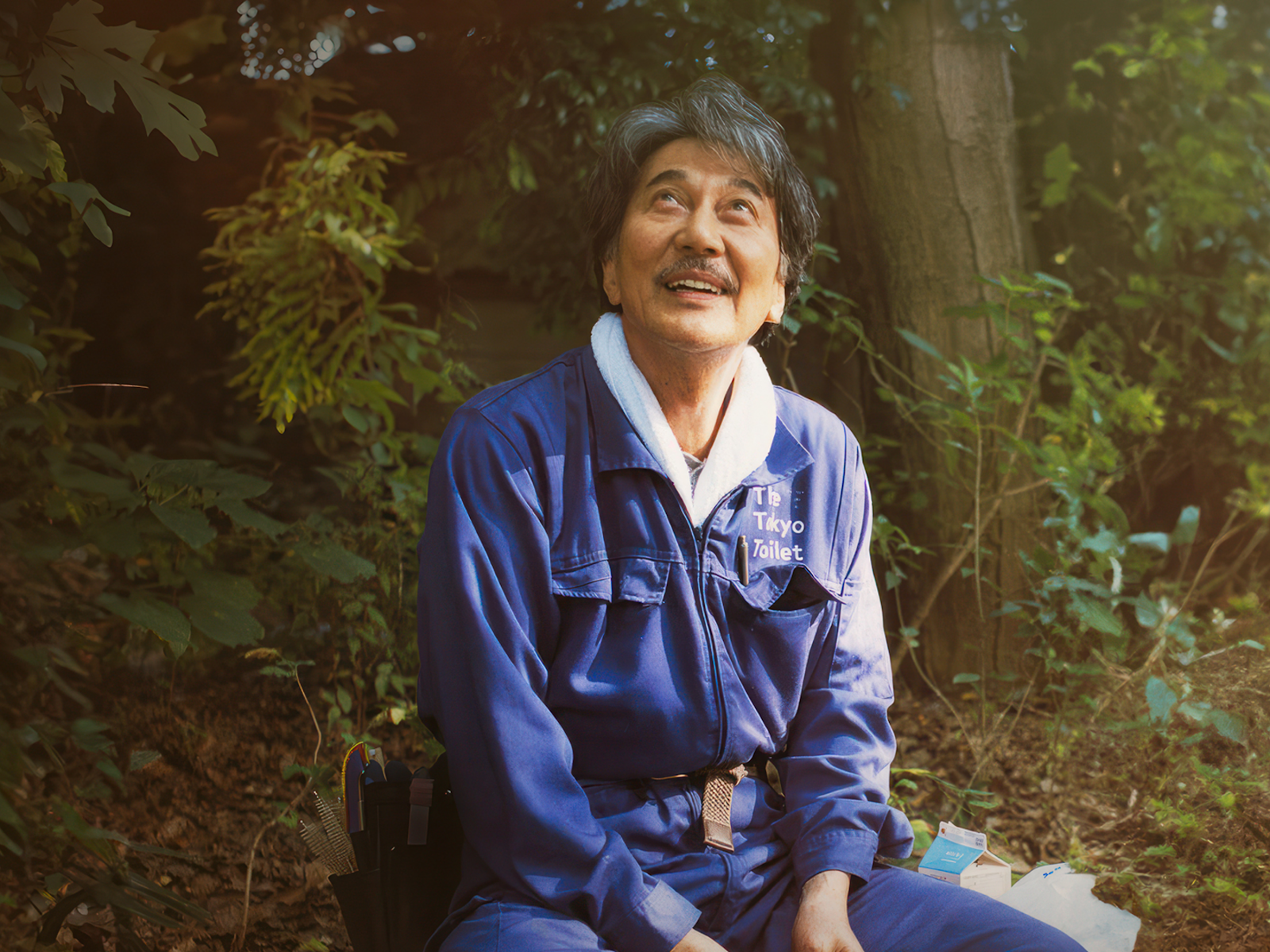
fully accepting of his lot, that chooses peaceful routine. Wim Wender’s ‘Perfect Days’ is one of those films that feels
decidedly minor and wholly life-affirming at the same time, the kind of low-key
ambience that puts your entire existence in perspective just by advocating for
tiny moments. Hirayama spends his time between cleaning impressive Tokyo
toilets, listening to rock classics and smiling to himself. Kôji Yakusho as
Hirayama is delicious, happy to spend the film not talking and just soaking it
all in – it’s a long time before we even know if he can talk. Even when some
drama disturbs this calm, there’s no trauma; there may be tears but there’s no
devastation. Whatever his past – and perhaps the brief interaction with his
sister implies something difficult – he has reached a place where he is consistently
kind and at the edges, just as he like it. It is a film about living life
rather than a story, and much like Jarmusch’s ‘Paterson’, the apparent
lack of Big Drama should not be mistaken for insignificance or inconsequence. We
may conjecture what brought Hirayama to this place – maybe nothing at all – but
there is no doubt it is exactly where he wants to be. Magnificent music taste,
too.
To
men that were far more discontent:
Alexander
Payne’s ‘The Holdovers’ was
far more narratively conventional. As a recreation of beloved films from the
Seventies, it was every bit astute as homage as a Ti West horror. Kudos to the
trailer for capturing that exact spirit. So you knew what you were getting, but
the performances and writing were uniformly assured – after all, you have Paul
Giamatti and Da'Vine Joy Randolph –and it proved a nice warm and comforting
drama.
Cord
Jefferson’s ‘American Fiction’ also housed many excellent performances – Sterling K. Browning stood out as
the estranged brother – but was far more tonally unbalanced between its
impressive family drama and a far broader satire on the publishing industry. The
moment where Jeffrey Wright spoke to his characters as he was writing them was
a highlight, but the film is never quite as inventive again.


.png)
