Showing posts with label series. Show all posts

Wednesday, 27 May 2026

Star Wars: The Mandalorian and Grogu

Star Wars: The Mandalorian and Grogu
Director ~  Jon Favreau
Writers ~ Jon Favreau, Dave Filoni, Noah Kloor
2026, US
Stars ~ Pedro Pascal, Brendan Wayne, Lateef Crowder

Okay… (deep breath): first two seasons of ‘The Mandalorian’ were hugely enjoyable for undemanding pulp sci-fi. Aside from ‘Andor’, many of the endless Disney ‘Star Wars’ spin-off series that I have tried have inspired me to abandon them at various stages because of, oh I don’t know, that the franchise is plagued with negible writing and characterisation, for example. It seemed that ‘The Mandalorian’ was what we sort of expected Boba Fett to be, and maybe only the Sandpeople episodes of the ‘Boba Fett’ series seemed to hit expectations, although there was sporadic fun to be had. ‘Boba Fett’ even turned into ‘The Mandalorian’ for a chunk, explaining why the latter’s third season was quite messy. I was won over by Grogu, even though that kind of cutesy thing was expected to be why I wouldn’t be convinced (ref. Ewoks, and Ja-Ja Binks). That Grogu is a puppet and doesn’t do the CGI thing so much is the key ingrediant to his success.

Which is kept for the film ‘The Mandalorian and Grogu’ where the fun is in the buddy chemistry between the former’s bounty hunter seriousness and Grogu’s muppety goodness: the former’s daddy disapproval and the latter’s todler behaviour. The general consensus and criticism is that it feels like a TV series dressed as a film, but I am wondering if that is just a side-effect of the fact that TV is looking more cinematic than ever. ‘The Mandalorian and Grogu’ frequently offers some gorgeous visuals – TIE fighters in the sunset, spaceships in warp drive, Frank Frazetta inspiration, for example – and never lacks for that even if it is mostly Mando punching CGI for a lot of the time (physics optional). It is one long sequence of action CGI set-pieces and only slows down to let Grogu step down from his shoulder-parrot position to take centre stage. What is clear is this is very much leaning into the children’s entertainment angle of ‘Star Wars’, and for that it is far more successful than the series’ pretentions to adulthood (I’m not including ‘Rogue One’ or ‘Andor’, which are legitamately mature). In fact, I will argue that it is the most successful of the outright kid-friendly element of ‘Star Wars’, perhaps even a better crossover than ‘Skeleton Crew’ (which I lost interest in; and ‘Ashoka’ was ultimately just embarassing). The stoic father-figure anti-hero of Mando is offset by the unapologetic cuteness of the Grogu puppet.


An undemanding romp with simple narrative that gets Din Djarin the Mandolorian from one fight to another, Martin Scorsese and Sigourney Weaver cameos for the film nerds, a little politics of some double-crossing, some nice spaceship porn, some daft extraterrestials which have always been a staple of ‘Star Wars’ even since the cantina, some pleasing synth score by Ludwig Göransson rather than the Williams orchestral approach, and … buff slug aliens? No matter how much Rotta the Hutt (voiced by Jeremy Allen White) is meant to be the tragic figure of this adventure with the most story-arc, there’s no getting away from how funny the buff Hutt look is, although the rolling maneauvre when fighting is a nice, logical touch. 

‘Star Wars’ has always been a mess and a platform for disagreements, so for obsessive fans that take it very seriously, ‘The Mandolorian and Grogu’ is likely to outrage because it uses the universe just as a playpen, or it will be embraced just for being in that world. It’s very much the ‘PEW-PEW-PEW!’ end of pulpy scifi made with a huge budget: just enjoy the sets and the ambience – one city has a little ‘Blade Runner’ overcrowded neon vibe. No, it is nowhere near the heights of ‘Rogue One’, which jettison’s the juvenilia, but it lies at the other end of the ‘Star Wars’ spectrum and is nowhere near the nedirs of other sequels. It is long enough for you to note the weaknesses in full and there’s no real substance, so if you’re looking for more, you won’t get it. But Jon Favreau knows what he is doing and delivers, embracing the silliness in a non-condescending way that makes this a very family friendly crossover. 

Tuesday, 2 April 2024

The Immortal & Gomorrah: the series


The Immortal

Director ~ Marco D'Amore

Writers ~ Leonardo Fasoli, Maddalena Ravagli, Marco D'Amore

2019, Italy-Germany

Stars ~ Marco D'Amore, Giuseppe Aiello, Salvatore D'Onofrio


Robert Saviano’s book ‘Gomorrah’, about the Neapolitan Mafia the Camorra, is an outraged diatribe against the influence organised crime has on ordinary citizens, the fashion world, etc, etc. There is a section about how the gangsters started imitating films; for example, how a female gang started dressing like The Bride from Tarantino’s ‘Kill Bill’, or how one crime lord wanted a bath like Pacino’s in ‘Scarface’. There is perhaps no better symbol for Saviano’s disgust than when he reports that he pissed upon that bath when researching.


The Italian TV series very loosely based upon the book is more soap opera, but despite lots of garish often tasteless jumble to symbolise wealth, there is never the sense that these people are happy or joyous. There’s little showboating because they’re too busy being morose, plotting and grim to cosplay films. There is little glamourisation of the lifestyle. Soap opera miserabilism helps to convey that this is not a life of contentment: after all, for all the garish trimmings, nearly everyone ends up dead.


Since the look and feel of the series ‘Gomorrah’ tended towards the cinematic by nature, this spin-off film resembles an extended episode, but for that there’s no disappointment. This film is directed by its star, Marco D’Amore, so the look and feel is of a piece. The show stuck to its staples: people facing-off constantly; men glaring into each other’s faces, close enough to kiss; women quite often toxic and enabling; men swaggering; women crossing their arms disapprovingly; occasionally characters will decry their lot or swing between declarations of loyalty and angst. Our main man Ciro (D’Amore), for example, says little but occasionally laments his existential loneliness and lack of feeling. Occasionally, the actors get to flutter vulnerability and lost humanity on their faces; and sometimes it is unintentionally amusing as posturing tends to be.


This spin-off tells the tale of what Ciro was doing while season four was taking place, the difference being that we get flashbacks to when he was a little proto-gangster orphan shit. It’s not a show with much sympathy, being more fascinated with the politics and betrayals with a little weepiness over male bonding. If the crucial ingredient with Ciro is that he was a mystery (but don’t cross him), then the flashbacks perhaps attempt to give him some context or motivation, but it also reaffirms that he was always thus and no crush on an older girl is truly a redeeming backstory.


Marco D’Amore continues smouldering as Ciro and his work as director on some of the episodes, and this certainly doesn’t scare the horses or go any deeper. This doesn’t have the outrage of Matteo Garrone’s original film, nor, for example, the deconstruction of machismo, mythology and fighting that Kinji Fukasaku’s ‘Battles Without Honour and Humanity’ series, but ‘The Immortal’ follows the format of the series. You won’t get the moral challenges of ‘The Sopranos’ or the jaw-dropping facts of 'Narcos'. But as with the series, most of the cast are scumbags so guilt levels and empathy is not a high demand; the betrayals are thick and occasionally surprising, the turn-over is high, the pace swift, the locations of backstreets and alleyways are excellent, interspersed with beatific panoramas of the city.


It all makes for diverting gangster soap and this film fills in the last jigsaw piece from the series.


Wednesday, 7 December 2022

Guillermo Del Toro’s Cabinet of Curiosities

Lot 36

Director – Guillermo Navarro

Writers – Regina Corrado, based on an original story by Guillermo del Toro 

Stars – Tim Blake Nelson, Sebastian Roché, Elpidia Carrillo


Graveyard Rats

Director – Vincenzo Natali

Writers – Guillermo del Toro, based on a short story by Henry Kuttner 

Stars – David Hewlett, Alexander Eling, Ish Morris


The Autopsy

Director – David Prior

Writers – David S. Goyer, Michael Shea, based on the short story by Guillermo del Toro

Stars – F. Murray Abraham, Glynn Turman, Luke Roberts


The Outside

Director - Ana Lily Amirpour

Writers - Haley Z. Boston, Emily Carroll based on a short story by Guillermo del Toro

Stars – Kate Micucci, Martin Starr 


Pickman’s Model

Director – Keith Thomas

Writers - Lee Patterson, Guillermo del Toro based on a short story by H.P. Lovecraft 

Stars – Ben Barnes, Crispin Glover, Oriana Leman


Dreams in the Witch House

Director – Catherine Hardwicke

Writers – Mika Watkins, Guillermo del Toro based on a short story by H.P. Lovecraft

Stars – Rupert Grint, Ismael Cruz Cordova, DJ Qualls


The Viewing

Director – Panos Cosmatos

Writers – Panos Cosmatos, Aaron Stewart-Ahn, Guillermo del Toro

Stars – Peter Weller, Steve Agee, Eric André


The Murmuring

Director – Jennifer Kent

Writers – Jennifer Kent, based on a short story by Guillermo del Toro

Stars – Essie Davis, Andrew Lincoln, Greg Ellwand


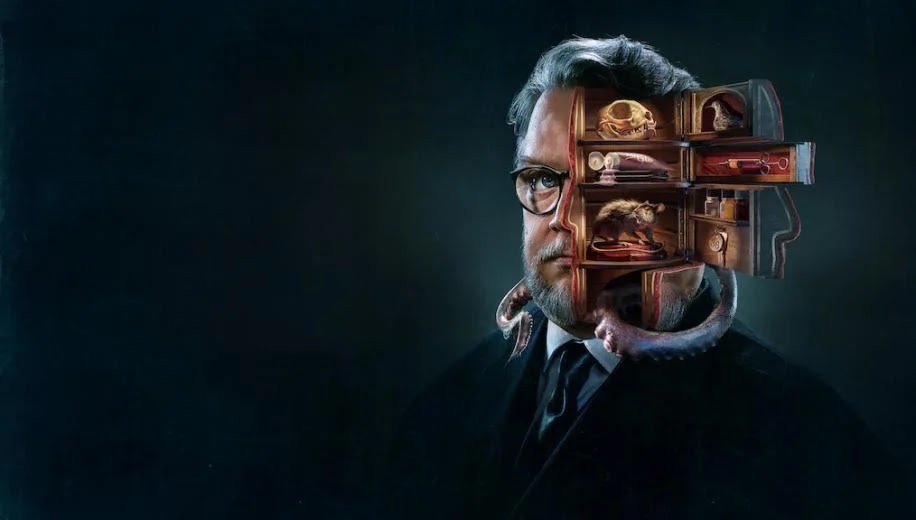
‘Guillermo Del Toro’s Cabinet of Curiosities’ is a handsomely mounted series, containing many vivid, memorable performances and set pieces. It’s a much more intriguing and impressive selection than the cartoonery and scrappiness of ‘Creepshow’, and arguably more consistent (different aims, of course). Del Toro introduces each episode, pulling an item from the puzzle-box-like cabinet that triggers the story forthcoming and names the director. This generosity also acts as a badge of quality, for this is a bunch of pretty esteemed filmmakers. Ultimately, it’s a cut above as a selection. 

In the first episode, ‘Lot 36’, Tim Blake Nelson’s angry performance is all. It’s directed by Guillermo Navarro who has collaborated with Del Toro several times previously and is chiefly a cinematographer (he did ‘The Devil’s Bone’, ‘Hellboy’ and ‘Pan’s Labyrinth’, for example). The setting of a storage facility and Nelson’ abrasiveness as Nick Appleton are the hooks, but the narrative is a bit front-loaded; meaning when things take a turn for the supernatural, it seems like it hasn’t left itself enough time. The monster is the kind beset by CGI and it’s just a bit average and underwhelming, despite a superior adult tone.

Vincenzo Natali’s ‘Graveyard Rats’ is the kind of genre fare that, having established its protagonist as somewhat reprehensible, sets about gleefully putting him through the slapstick horror wringer. Rats, claustrophobia, taphophobia and more horrors are poured onto greedy, graverobbing Masson’s head (a game David Hewitt) to absurdist amounts. Natali – who established his genre credentials with ‘Cube’, ‘Splice’ and many episodes of genre series – channels his inner-Raimi and delivers one of those wild horror rides that fits just nicely in the 40 minute format. Nothing original but Natali’s direction delivers a better and more enjoyable slice of EC comic-style Gothic terror than many. The dental examination of a drowned corpse was one to make me wince.

And if corpses being messed with makes you queasy, then ‘The Autopsy’ will hit your buttons. David Prior’s ‘The Empty Man’ had plenty of genre savvy and mashing-up and ‘The Autopsy’ exhibits further his sure hand. Starts off in earnest looking like a police procedural (a serial killer tale, perhaps) and then moves into realms more … otherworldy. It helps that it has scored a seasoned veteran like F. Murray Abraham as the lead, especially when he’s working solo for the most part and can carry it all effortlessly. The tone shifts subtly and the shocks creep up accumulating in a go-for-broke gruesome ending. A full bloodied horror that gives equal attention to creeps and squirms and, wherever else it goes, has no intention of pulling punches.

It's true that this series doesn’t really try with its titles. However, Ana Lily Amirpour’s ‘The Outside’ is the one that hits something heartfelt and horrific more than any other entry, It has an almost Joe Dante feel, in that Dante was good at surface gloss and the truly creepy in equal amounts, at serving up acidic slabs of brightly hued satire. Ana Lily Amirpour hit renown with ‘A Girl Walks Home Alone at Night’, so you know you’re in safe hands with the social commentary. Kate Micucci gives a brave performance as a woman who finds the pack of pretty but vacuous work colleagues fascinating and impenetrable and just wants to belong. Martin Starr’s performance as her husband is wonderfully warm and humane, and between these actors there’s a hook that goes deep. It’s the episode that has haunted me most and has begged that I mull it over. The shock did hit hard (oh yeah, of course: taxidermy) after the surreal turns had surprised, and it eventually ends up as tragedy. 

Keith Thomas’ ‘Pickwick’s Model’ has a winning period setting as an upcoming artist stumbles upon another whose paintings, in typical Lovecraftian fashion, acts as insights or instigations into untold otherworldly horrors. Or something. A chief pleasure of Lovecraft is that much of the horror remains abstract, of the imagination, untouchable. In visual adaptations, this can be a muddle, but this, as many are are prone, goes for what gross-out it can find for an anchor. Get past Crispin Glover’s distracting accent and it’s an entertaining if undemanding creepy tale.

But Catherine Hardwicke’s ‘Dreams in the Witch House’ is a depiction of goggle-eyed Rupert Grint stumbling through a Lovecraftian mess. Period recreation, the scary and the goofy and the maudlin barely hold together, leading to an end note that we don’t really care about. But it least it can be credited with the best title. 

Panos Cosmatos’ ‘The Viewing’, however, puts things firmly back in the singular vision vain. His beautifully composed shots, the auditory immersion breaking out into synth numbers to hit the pleasure zones, his broad use of colour plus his usual tweak of psychedelia – a kind of sunburnt trippiness – gives the simmering build-up and escalation a somewhat truer sensation of Lovecraftian horror, of meddling in and unleashing unimaginable horrors. One of Cosmatos’ dodgy guru types (Weller on fine form) gathers a group of artists and scientists together to try and penetrate the secrets of something he has acquired. The last image of set free horror is one to linger long after. 

Jennifer Kent’s ‘The Murmuring’ is the nadir of the series’ titles; yes it’s alluding to the murmurations of birds as well as ghostly voices, but even so. It gets all the marks for performances of Essie Davis and Andrew Lincoln and an increasingly unsettling build-up. Kent knows that jump-scares don’t haunt, even if she knows that noises in the night do. But as with her breakthrough triumph, ‘The Babadook’ there isn’t much subtext or thematic subtlety, with all the analogies pretty upfront. If the slow burn ultimately arrives at something quite routine - horror being a way to process grief, etc - there are enough creaks and bangs, empathy and quiet ghosts to hit the mark.

Monday, 21 February 2022

All of Us are Dead

ALL OF US ARE DEAD


Directors - J.Q. Lee & Kim Nam-Soo

Screenwriter - Seong-il Cheon

series 1, 2022, South Korea


Another zombie splurge, I thought, which is just my thing so let’s see how long I last. There have been a few series where I have bailed out after a few episodes. I like to stick to things to the end – after all, ‘American Vandal’ only proved its depth given time, for example – but when you’re dealing with a series, there’s only so much time you have.


But the first scene in ‘All of us are Dead’ – the South Korean High School Zombie epic – had a long take that suddenly zipped away from the intimacy of bullying on the school rooftop and circled round before diving up close again. Then a Bible is brandished, which made me giggle at its feint at a possession possibility before it’s used to pummelling-by-silhouette.* Later, there was another long take where a teacher attacks and bites a student and then the camera stays on the student as he turns into a zombie (blood spurts from his cheek) and then he gets up to attack his peers. And then the camera pulls out of window, seemingly through the glass. Long takes and trick shots, as if Iñárritu was slumming it by directing a zombie show. But these moments are what I am a sucker for, and I realised that, no matter how standard the drama, I am going to be compelled to watch more to see what they do each episode.


And then episode two is off and running with a startlingly choreographed zombie assault on the canteen. A mixture of hand-held and drone camera. It is breathless stuff and feels a full meal and cinematic rather than TV. Of course, that’s not such a surprise in this Golden Era of Television where the lines are blurred – the ‘Daredevil’ series had a few long-take fight scenes, for example – but it doesn’t feel hampered by television dramatics like, say, ‘The Walking Dead’ and its imitators. That’s because the action is brilliantly choreographed and feels as orchestrated as those of, say, ‘The Raid’; let’s say it’s no accident that ‘Train to Busan’ is namechecked. Perhaps a suitable comparison is the organised crime series ‘Gangs of London’, with its thrillingly composed fight scenes.


With episode three of ‘All of us are Dead’, it’s time for things to slow down for some character development and conflict.  This also means that things suffer from the Stupidity Of Characters, which may leave you scowling (Really: it’s time for the love triangle right now? & Snap out of it! & Just put him in the other room! etc) Mostly, this involves Queen Bitch against the group and loss of friends, the former designed to get the blood boiling and the latter fair enough in a zombie scenario.


One of the dominant themes throughout is that of bullying. Certainly, films like ‘Last Child’, ‘Pluto’ and ‘King of Pigs’ present Korean schools as hellholes of bullying and abuse. Here, the feelings of persecution and fear a teen may feel about his/her peers are fully justified by the zombie epidemic. A disgraced scientist father reacts badly to his son’s bullying and when his lab mouse bites a student and unleashes the epidemic, his nihilism and disgust at humanities’ cruelty comes full force. And then, of course, there is the school trying to cover up that bullying and the abduction of a student by a teacher to save face. There’s also teen pregnancy and a group of politicians to take us outside while our main group of teens are trapped in one classroom.


Episode 4 continues this but also spends time with a subject which is often neglected and often challenges my suspension of belief with films and TV: they discuss the problem of toilets and how it will work for the group. This even deserves its own montage and wins points for addressing this often unaddressed reality (I am often left thinking “But what about going to the toilet?” in a film as much as “Yeah, they wouldn’t get up from that.”). Then the action picks up elsewhere with a run for the rooftop with the politician’s group whilst the chief concern admirably leaves our teens in one room working out what to do. There’s also a policeman running about the city and some arrow-shooting teens also scrambling about the campus.


And with episode 5, we’re back to less questionable character behaviour. There’s an excellent library confrontation, but the showy long takes have been abandoned. The pace is impressively swift again, with all the subplots getting their moments. Now it’s got rid of the Queen Bitch student, there’s no recourse to cheap confrontation to keep things going, which is refreshing. This main group of teens is just trying to work things out and they are a solid bunch of characters. I appreciate the emphasis being upon their bonding in a time of need rather than incessant bickering.


Episode 6 starts with a montage of all the subplots and promises a swift pace. But it’s mostly a filler, shoving along these subplots with further nuance. The zombies are evolving (“hambies”), our teens risk their lives from one room to another, our policemen almost but don’t get far. It ends with the teens making video blubs with the school camera, but that seems appropriate.


So by this stage in the series, it is obvious that the bravura flourishes of the first two episodes have given way to more standard aesthetic. It is twelve episodes long, and a lull in the midsection is perhaps expected. This is why ‘Squid Game’ being nine episodes long was an indication that it was wisely as long as it wanted and needed to be, with little padding. Even so, ‘All of Us are Dead’ had won enough good will with me initially and established enough subplots to keep things lively. The hallway fights and fleeing from one place to another are all thrilling, with the battle in the gym a late-stage highlight. Every time the teen troubles threaten to drag, one of the subplots kicks in to keep interest and throw in some action. At least until the end. And I like the more realistic dilemma of being trapped in one place for a while; that on more than one occasion characters make a dash for it but have to run back. So they don’t discuss toilet arrangements on the rooftop, but the show has at least nodded to those real problems.


What is also impressive is the sense of widespread desolation within a limited scope, especially in the penultimate episode. The undead bullies keep coming; the army wavers between uselessness and overreaction; a father braves the situation solo to save his daughter. You’ll probably be inclined to shout at the characters to do something/don’t do that/why’re you just standing there emoting?? as dramatics occasionally overtake the narrative.


So it doesn’t match the promise of its opening, but ‘All of Us are Dead’ remains entertaining throughout, and you might even find yourself caring about some of the kids. And the series doesn't skimp on casualties, and even musters up investment in many. Certainly, a cut above average even if doesn’t achieve distinction.


Sunday, 12 April 2020

Dr Who: The Visitation


Peter Moffat,1982, GB, 4 episodes


‘Dr Who’ is comfort food for genre fans. The TARDIS is a genius narrative device for getting the protagonist anywhere, anytime so that it covers everything from the Gothic to alien planets, and that ability to go anywhere is key to the Doctor’s longevity. Oh, that and regeneration. It can just make up the rules as it goes along, more-or-less, so when things get sticky, just move the goalposts and add something new to the mythos. And always the monsters and aliens. That’s a big part of what we came for.

Oh, but let me make this clear that I’m mostly talking about the original series now, some way into Colin Baker.  The new era riffs too much on The-Doctor-as-Rock-Or-Pop-Star-God for my taste. I mean, I like the way The Doctor would just turn up in the middle of a world or universe threatening situation and sort out the bigger plot: it was never just about him, but rather what he did to resolve the threat. But David Tennant was good at the manic-zany stuff and I liked the way Matt Smith would just walk in a room and be both charming and sinister simultaneously.


With ‘The Visitation’, we are with the Eighties “nice” Doctor, Peter Davidson. Well, I say that but he’s a dick to Adric throughout... I know that Adric (Matthew Waterhouse) is generally considered the least liked companion, but, I mean, you have Ace? And I always found Tegan (Janet Fielding) more annoying and tedious, although she really isn’t so grating in this story. The story by Eric Seward is vintage ‘Dr Who’ storyline: the TARDIS ends up somewhere unplanned (Heathrow several hundred years too early in an attempt to return Tegan) just as an alien invasion is kicking off; the TARDIS crew get involved, run to-and-fro a bit, have run-ins with the locals and the aliens and thwart the invasion. What distinguishes this one is that the alien threat, the Terileptils, are intending to use the Black Death to wipe out humanity to take over Earth themselves… somethingsomething. On the commentary, the actors talk about how in rehearsal they would question the logic, but when you see the story in action, it all makes a holistic sense.

There’s a definite need to go with the flow with ‘Dr Who’: has a series ever relied on its audience’s generosity? It’s true that ‘Dr. Who’ was always a triumph of imagination over execution. There’s a kind0f free-for-all logic that carries you along and entertains away so that you are enthralled and critical in equal amounts and you are just left with a hub of enjoyment. You say: “Oh, don’t leave the TARDIS Adric, because that’s stupi - oh, he’s captured! Pfft!” Question marks on the collar? *groan* Is the android wearing… cricket gloves? But it really doesn’t matter because there’s a wholehearted enjoyment of genre tropes that make The Doctor’s adventures addictive and pleasurable and overcomes its glaring flaws. There’s the claw shot. Unconvincing explosions. Forced drama for padding, but perhaps less here than usual. The cliff-hangers aren’t so much, somewhat perfunctory. Threat of beheading? Someone will interrupt next episode so it doesn’t happen.

The clunky monster suits delight in their hand-made fallibilities: the Terileptil designs are bright and memorable – something like an amalgamation of armadillo and iguana? – using the animatronic lips to make them look more like they are actually talking. The fact that Michael Melia plays the Terileptil Voice as straightforward instead of over-exaggerated grounds the outrageousness and any impracticability of the costume. On the other hand, Michael Robbins gives a prime example of how to ham it up handsomely for ‘Dr Who’ as the story’s requisite Doctor ally in just the right way that is fully enjoyable without falling into laughability; although the commentary tells that he thought this was the worst thing he’d ever done. It’s a shame if he was not having as much fun as his performance is.

And ‘The Visitation’ doesn’t really have that one special effect that really requires a flagon of generosity from the audience to get over (like the rat in ‘The Talons of Weng-Chiang’, or the clam-like threats in ‘Genesis of the Daleks’, or K-9 going sooo slowly, etc, etc…). There are the usual deus ex machinas and just pure luck to solve things, but also some nice conceits like the spangly android dressing like Death to scare the locals. And in typical ‘Dr Who’ fashion, it sneaks in some agreeable nastiness with a defigured alien face, a briefly bubbling Terileptil corpse and witch-hunts.

But why do we see so little of the other Terileptils?

I first saw this as a teenager and the final twist that The Doctor caused the fire of London always stuck in my memory. You know when the background to a Doctor story is historically based that he is going to be involved or responsible somehow. It’s not at all an exemplary story, but it was a ratings hit and it’s solid old school ‘Dr Who’ entertainment that ticks all the right boxes, good and bad, but that’s all part of its popularity.