Friday, 26 February 2016

The Revenant


Alejandro González Iñárritu, 2015, USA

‘The Revenant’ is as much a box-of-tricks as Alejandro Iñárritu’s previous critic-pleaser ‘Birdman’, but it’s a box-of-tricks designed to win over a viewer like me. The unwavering long takes… repeatedly I found myself thinking Wait – this is a single shot! And it hasn’t finished yet… The camera moves from participant to participant in the opening camp raid, for example, and it doesn’t break. Then it goes underwater to follow a near-drowning and then back up again without cutting away. Long takes like this are showboating but also exemplary cinema. I am always a sucker for them.

The fact that this is supposedly based on the true story of frontiersman Hugh Glass is much touted, but of course one must always take such claims with a pinch of salt. It seems that Based on a True Story is equated with depicted truth and, maybe, a superior narrative. But this is rarely that case because films are fabrications and they have the habit of making the truth a pliable thing: they use oppressions, elaborations and omissions, usually not giving the complex truth at all and aggravating those well versed in it. For example, apparently Hugh Glass did not have a son. Besides, this true tale is surely just a framework to dazzle with cinema rather than narrative, although one can see why the idea of this tale is compelling. 

And then the bear attack. I thought perhaps they had blown a trump card by featuring it in the trailer. The trailer that baffled me at first and then slowly got me more-and-more intrigued. But the trailer does not prepare you for the length and execution of the bear attack. About halfway through the scene, I realised my jaw had dropped. So smitten was I with this scene that at first I wondered if it was setting a precedent for CGI in narratives, the interaction between the artificial and real actors. But then of course I came to my senses and remembered that we had Richard Parker from ‘Life of Pi’ and it is probably easy to forget that almost the entirety of ‘Rise of the Planet of the Apes’ was a CGI animal showcase. Or even 'Paddington'. But yes, the bear attack in ‘The Revenant’ is an exceptional special-effects sequence. This is not the only jaw-dropper, but it probably tops all the others the film offers.

And of course the film’s length and slender narrative will cause criticism, but there is always another visual jaw-dropper around the corner. It is fuelled by ambience, showstoppers and themes. The length and episodic tribulations are narratively coherent when the theme is given as only God decides when vengeance is over. In this sense, DiCaprio’s defeating death multiple times puts him in some way as God’s envoy, or at least under some Divine protection until he has completed vengeance (and what this says about God is another discussion).  And there is the moment when Hardy/Fitzgerald states that there is nothing else to him but the identity his work gives him, which furthers the questions of what makes a man. But the film squarely puts the revenge fantasy centre-forward and that is always popular in American cinema. The film in not really interested in skewering this theme, just impressive rendering. 

And of course, it has to be noted that this is a Boy’s Own Adventure so no real room for womenfolk, except in Terence Mallick-y maternal and floating form. And speaking of Glass’ dreams: the pile of skulls may be impressive production design work from Jack Fisk, for example, but it’s not original symbolism (even if justifiable as rendering the limits of Glass’ imagination). As such, these excursions into dreams are the least convincing aspect of the adventure, even if the try to colour Glass with some softness against the relentless theme of revenge. It also nods to the villainy of colonialism and the savagery and nobility of colonialists and natives alike, but these are more asides, gesturing to a more complex humanity that Glass is forgoing on his quest. 

Tom Hardy swings from being impressively sullen to scenery chewing, often at the same time: at least these tendencies are fused here unlike ‘Legend’ where, playing both the Kray twins, one could see his tendency between both brilliance and gimmicks. He seems to be trying to trump Jeff Bridges and Nick Nolte for occasionally incomprenhisble mumbling accent. Quietly, Will Poulter steals the film by getting on and not trying to show off, using his vulnerability to make an impression at odds with the other heavyweights. And of course, DiCaprio’s physical trials in this role will demand accolades – he looks so obviously like he’s suffering! 

S. Craig Zahner, the director of another exceptional western ‘Bone Tomahawkreally doesn’t like ‘The Revenant:

"I certainly hope there’s going to be a western resurgence. My view on it is, The Revenant got made, Leonardo DiCaprio is a huge star and Inarritu is a big director. I think that movie is probably the single worst movie I’ve seen in the last five years and just totally empty and terrible and didactic. And it’s just awful—lacking humor and characterization, and anything I ever want to see in a movie. But that movie got made because there are two powerhouses there."

But ‘The Revenant’ isn’t about humour and characterisation (which both feature strongly and impressively in ‘Bone Tomahawk’). It’s about a world with the humour sucked out and reduced to survival and retribution and state-of-the-art film making. And the magic-hour vistas are just the start.


Wednesday, 24 February 2016

Massive Attack with Young Fathers - "Voodoo In My Blood"

 Massive Attack with a "Phantasm" homage and Rosamund Pike.


Sunday, 21 February 2016

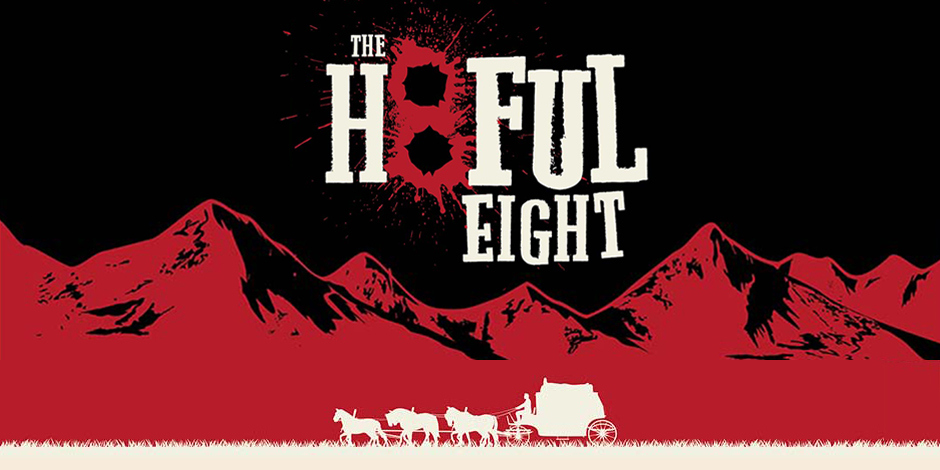
The Hateful Eight


Quentin Tarantino, 2015, USA

The Hateful Eight’ is both expansive in its 3 hour running time and use of Ultra Panavision 70 and claustrophobic in its locations, namely a carriage and then Millie’s haberdashery (of course it helps that this haberdashery is a big place). The snow and a storm outside keeps everyone in. It’s no surprise that this has been adapted into a stage play. It wants to be both epic and a chamber piece. And of course, there was the typical controversy that comes with each of his new releases: firstly, the leaking of the script and then, upon release, the Ultra Panavision 70 proved a stumbling block as the Picturehouse, Cineworld and Curzon chains did not have the equipment to screen this format and so would not be showing the film.

On the epic side, the snowscapes that define the opening act are glorious. They reminded me of ‘The Great Silence’, but you expect blatant homage in a Tarantino flick and I am sure they allude to others I don’t know. Homage is part of Tarantino’s language.

That and rip-offs: on the soundtrack, you will hear not only a grand new score by Ennio Morricone, but also the expected choices from Tarantino’s album collection: now using The White Stripes and Roy Orbison is one thing, but the score also includes ‘Now You’re All Alone’ from the ‘Last House on the Left’ and more Morricone with ‘Regan's Theme (Floating Sound)’ from ‘The Exorcist II: The Heretic’. I had the same reaction as I had with the ‘Inglourious Basterds’ use of the Moroder/Bowie title song for ‘Cat People’: I could get past the post-modern incongruity, but here was the use of another film’s entire theme song and not only would this kick me out the film’s internal reality, but it felt a steal rather than a homage. It's as if Tarantino can't get past other people's films. And besides, ‘The Hateful Eight’ already had music by Morricone so why need anything else, let alone take from another Morricone score? Aside from that, Tarantino’s narration leading the audience into the second half was a gigantic misstep that also kicked out any goodwill the film had gathered until then. You can almost feel him enthusing, “See, I’m storytelling here!” But this proves only a momentary glitch.

The length of 'The Hateful Eight' (yeah, about that counting...) will of course trigger claims that it’s too long, but the joy is surely in its taking time to unspool. There may be padding, but if it’s working for you, the indulgence of the padding will provide enjoyments too. The script wants to take its time setting characters up and letting the true identities reveal themselves. The basis of the plot is that John Ruth (Kurt Russell) is a bounty hunter transporting notorious Daisy Domergue (Jennifer Jason Leigh) when they bump into another bounty hunter, Major Marquis Warren (Samuel L Jackson), and then find themselves holed up at Minnie’s Haberdashery with other suspicious types. But Ruth is certain that someone will try to spring Daisy – but who?

And as a chamber piece, the cast give it their all, as you would expect, and enjoyable they are too. There has always been room in Tarantino’s universe for hamming it up and Tim Roth channelling Christophe Waltz leaves no chamber pot unturned, redeemed by the fact that it all turns out to be an act. Only Zoe Bell truly fails to hit the right pitch. And although there is no one to care about – these aren’t real people but movie types – there is fun to be had in the unfurling of the interactions.

The gravest critical thematic conclusion is that all these hateful men are unified in their misogyny against a hateful woman.  But I don’t believe this is so: I perhaps wouldn’t go as far as to say it’s equal opportunity to have Daisy as loathsome and as formidable as any of the men, but I think accusations of misogyny are misplaced when Tarantino’s full oeuvre is taken into consideration. The first time she is punched, it is perhaps the only time in the film that the audience’s empathy is engaged with the violence: it’s hurts and there’s no doubt it is gratuitous and feels wrong. From then on, when she is physically abused, it’s more slapstick and a running gag. I would say the ugliness is equal opportunity. Otherwise, the violence is just part of the palette. 

The shallowness of the film, whilst in no way impeding the enjoyment, perhaps makes me have greater respect for the bonkers ending of ‘Inglourious Basterds’, which at the time I felt betrayed the subtleties of its earlier scenes: there is no doubt it was reaching and perhaps there's some merit to that. ‘The Hateful Eight’ has no such genre peculiarities. Deeper readings of narrative may have the opening snow on a crucifix resembling a KKK hood, Minnie’s Haberdashery as an American democracy  which is then divided up as a platform for Civil War grievances*. And maybe all that is there, but I wouldn’t venture ‘The Hateful Eight’ as meaningful or thematically profound: it’s just a well presented and enjoyable film, featuring many of Tarantino’s strengths and weaknesses.


There certainly seems some inconsistencies with the Major’s claims that Minnie was bigoted against Mexicans although there is an argument that is just another of his lies. Sure, I'd say without doubt to Tarantino's attention to detail; but then there's some to-do about a revelatory blood stain and candy caught in floorboard gaps, and then considering the recent massacre revealed in the second half, don't those floorboards seem greatly absorbent of bloodstains?

Saturday, 13 February 2016

Young Romance

Young Romance are a band that I have been fan of for a long time and last night I saw them live at the Shacklewell Arms, Dalston. Claire’s drums stomp and Paolo’s guitar roars and the vocals are like a honey trail through the shrapnel being kicked up. Thrilling.

Monday, 8 February 2016

Killdozer


Jerry London, 1974, USA

Through which you might be thinking How much more 1970s can one film get? It’s so much of its time that’s a surprise it doesn’t play disco or prog-rock on the killer vehicle’s radio (surely a missed soundtrack opportunity, and one Stephen King would not miss out on with ‘Christine’). However, the score by Gil Melle is mostly setting the synth on “spacey” and achieving a fair bit of ambience with it. For unintentional humour and campness, it helps of course that this was made for TV with all the limitations and earnestness that format brings with it. It helps that the cast, lead by Clint Walker, treat this with complete deadpan seriousness. 

A meteor lands on an African island a long, long time ago and when inadvertently discovered by a construction crew in 1974, and – apparently being an alien entity that knows no better – it possesses the bulldozer banging into it. Of course. This somewhat limited alien invasion requires that the crew of six men on the island act somewhat stupidly to ensure that the killdozer meets its kill quota: there’s a lot of standing in front of ‘dozer blades and not getting out of cars when the dozer is bearing down at a moderate pace – that kind of thing. It also requires macho-bonding of a latently homo-erotic kind in the example of Dutch (James Wainwright) going on and on about his dead best pal and what great times they had (“Hey, did I ever tell ya the time when me and Mack, well we…”). And when he gives up on that, he goes on and on about swimming, so much so that you just know it’s going to be his undoing. The script by Theodore Sturgeon and Ed MacKillop is full of tough guy talk: maybe Sturgeon's original novel has more in the plausibility stakes or revels more on it's gleeful absurdities. (Certainly the comic book adaptation appears to have more females, judging by the cover.)

All this gives off a meagre enjoyment for nostalgia’s sake for a time when this kind of sci-fi scenario was everywhere, and of course it’s agreeable bonkers if not quite as good as it ought to be. And you could read into it a cautionary tale about shoddy work safety... But as far as these kind of possessed-thing threats goes, ‘Killdozer’ is unlikely to make you look at passing construction vehicles with anxiety.


Saturday, 6 February 2016

First Blood


Ted Kotcheff, 1982, USA

Although it set the template for many an action movie, ‘First Blood’ is far more influenced by the social conscience of Seventies cinema: that is, it’s more ‘Deliverance’ than ‘Die Hard’, more Bob Clark’s ‘Deathdream’ than Michael Winner’s ‘Death Wish’.  John Rambo (Sylvester Stallone) is a Vietnam vet suffering from PTSD who wanders into town looking for an old war friend, only to find the friend has died from the toxic gases used in the war. Right from the start, from the tone and expression of the friend’s mother telling Rambo this, the film reeks of bitterness at the official treatment of vets, resentment at those that gleeful warmonger at the expense of other’s children. Then, just wandering his way out through town, the sheriff sees how Rambo is a stranger dressed down and assumes the worst of him, sees him out and tells him he shouldn’t bother coming back. Of course, he has crossed the wrong guy.

First Blood’ appears to be two competing films, one pushing for the good-guys-versus-bad-guys dynamic that will typify action films and justify their carnage, and the other film featuring Stallone as a highly damaged vet, pushed into warfare by the uncaring civility that he fought for. Perhaps there is some trace of the reason for this in the story on IMDB trivia of how Stallone hated the first cut of the film and suggested his material be cut to let the others do the talking. This maybe accounts for the disconnect between the bravado of the dialogue and the harshness and bleakness of the action, which makes ‘First Blood’ more of discussion on machismo than one might expect. It would seem a lot just flew over people's heads: indeed, as a kid, I first heard about Rambo from friends going on about how he stitched himself up.

The other characters go on about how bad-ass Rambo is and act as part-time soldiers with their town as the battleground to protect, yet they’re not about to put themselves at risk unless the odds are irrevocably in their favour with a rocket launcher: they’re perfectly willing to kill the enemy (which for them is just a violent hobo) and pose for heroic pictures. Meanwhile, Stallone plays a broken mind, defaulting to soldier mode when misunderstood and provoked, but never really celebrating in this: there is a silent despair to his performance, helpless to what has been made of him. Rambo’s retaliation at wannabe tough guys may be translated as heroic, but he himself doesn’t really read his behaviour as such; no quips and one-liners from him, no sense that this is all some party or showing-off. Indeed, there is no heroic final act: the film ends with Rambo breaking down and sobbing about how he has been treated and what he experienced and then surrendering to the authorities. The sense is that the men will talk tough and tell tough stories about this long afterwards without understanding at all. And the action genre went on to mostly do the same. 


* Tagline: "This time he's fighting for his life." As opposed to what? When he was in war?

Sunday, 24 January 2016

Ex Machina


Alex Garland, 2015, UK


Alex Garland’s ‘Ex Machina’ does what all good sci-fi does: questioning our views of humanity and reality, giving a subjective vision of what we mean and our context. It plays games with its characters and therefore with the audience. Smarter people than I may have seen the end coming, but I was so busy watching for the moment where everything fell apart  that I wasn’t predicting anything else - but it didn’t. Quite the opposite.* One of the complaints I’ve always had the screen versions of robots is that an urge to anthropomorphise something that is innately inhuman is rarely resisted (‘Star Wars’ is a great offender of this). But Garland premise takes anthropomorphising as the very basis and weaves a who’s-being-played? chamber piece from it. Is it Caleb (Domhall Gleeson) being played as the unsuspecting programmer who wins a week with his hero Nathan? Is it even Nathan (Oscar Isaac), the creator of Bluebook and, it turns out, of a breakthrough in Artificial Intelligence? Or is it Ava, the thoroughly convincing AI robot/android sitting in the basement as the next potential manifestation of consciousness? 

Garland draws from recognisable digital age technology (which will probably date this in the future) and quotes and art to create a wide, recognisable canvass from which Ava springs from and exists in. She herself is a work of technology and art, and by extension humanity. This is ultimately what Nathan forgets and it causes his undoing, forgetting humanity’s (and his own) potential for violence and abuse. And its resourcefulness. It is a premise full of things to think and talk about afterwards and it feels very connected to the possibilities of the digital age. It’s sleek and stylish, looking like a magazine spread from a modish home magazine (How does it stay so clean? Where are the cleaners?). Ava herself is a formidable creation, seducing as much as she’s whirring, impeccably performed by Alicia Vikander: Vikander finds the right balance for acting something that is mimicking human behaviour, restrained but fluid. She taps into those much talked about micro-expressions to turn tables, but not going over the top to make the audience forget that she’s been programmed. Gleeson has an easy-going, appealing charm that makes Caleb instantly relatable and sympathetic. Oscar Isaac gives a cunning performance as Nathan, at once winningly disarming, frank but manipulative. The disco moment where he dances with the servant robot is a highlight, showing that Garland knows that such seemingly throwaway moments can tell an audience so much whilst entertaining.

It would seem that the accusation against ‘Ex Machina’ is one of misogyny, but this appears completely in character to me: if Nathan is holed away in his research centre by himself all the time and it would follow that he would make, shall we say, fuck buddies. His awareness of others’ humanity and agency would be greatly compromised not only by his own ego but by being so detached. Who’s to stop him? Which is probably the key to his greatness and his downfall. That is, surely the plot becomes Nathan’s punishment for that misogyny: it would not seem superfluous that he is finally murdered by Kyoko (Sonoya Mizuno). Ultimately, it is that old story of mankind’s hubris being its own comeuppance. A logical and worthy extension of Mary Shelley’s ‘Frankenstein’.

And, of course, if we’re talking Deus Ex Machina meaning a happy ending for all…


I was not a fan of Garland/Boyle’s ‘Sunshine’ and felt the weaknesses of their ‘28 Day Later’ overwhelmed its strengths. I enjoyed ‘Dredd’ more the second time around. Alex Garland wrote scripts for all of these.

Saturday, 16 January 2016

Star Wars: The Force Awakens - some notes


Yes: there will be spoilers.


·        It’s fine.
·       You know that ‘Star Wars’ thing you liked? Plot-wise, this just traces over that with more effects.
·     Even as a kid, I sensed that the dialogue of ‘Star Wars’ (it wasn’t quite ‘A new Hope’ to us then) was deeply lacking, even though I wasn’t able to articulate it. Something about how the dialogue onscreen could be transposed word-for-word to the comic book adaptation that I bought highlighted its limitations. And don’t worry: that dialogue will now be catchphrases and they will be quoted here.
·           John Boyega is good. Of course, I was pre-disposed to be in favour of him because I love ‘Attack the Block’ so. Even so, he shades Finn with just a degree of cowardice that makes him far more interesting and three dimensional than his written gusto demands.
·     But if Stormtroopers are no longer clones here but kidnapped children programmed to be evil, then are we supposed to consider them as more than disposable henchmen and start colouring in their life stories with empathy? I mean, they are kidnapped children…
·   And if, quite clearly, Finn’s brainwashing didn’t take, what does that say about The First Order’s programming?
·  Daisy Ridley as Rey is good too, less sappy than the Luke Skywalker persona coz feisty girls sell these days (and there’s some debate as to whether Leia was short-changed on this in the original series).
·    These are nice alien vistas. Gigantic spaceships in dunes, X-Wings flying over water,  etc.
·   Well okay, this is a universe where robots are programmed to be cute. And where a future Sith lord built a gold robot and programmed it to be whiny and camp. I guess I’ll have to just suck it up and accept.
·  Wow, Rey is sure instantaneously excellent at knowing languages, flying the Millenium Falcon, lightsabers and The Force. Luckily, she doesn’t need any training scenes like Luke in the first series.
· Speaking of which, Finn is pretty instantly nifty with a lightsaber for a former Stormtrooper too. A sanitation Stormtrooper. And they put sanitation Stormtroopers on planet raids? (Yeah yeah, it's a callback to the original or whatever...)
·   Wait, if Han is sacrificing himself for his son’s betterment, doesn’t that getting-ahead-in-the-Dark-Side include blasting entire planets and killing billions and billions? What on earth was going through Han’s head??
·    I like Chewbacca. Why don’t they make anything of his super-strength? He also spends about a scene grieving over Han before reverting to Chewieness.
·   And speaking of destroying planets on a grudge and a whim: what about the planet's resources? Seems like a foolhardy waste... And this is the point where I suspect I’m over-thinking this trifle.
·  The in-jokes and call-backs are everywhere, all the time. This simultaneously will please nostalgic fans and prove annoying.They help to poke a little fun at itself, like when Rey gets Kylo Ren to take off his mask because it makes him harder to understand. Or no, it’s a new jacket. But it’s probably just a lazy cop-out when another Death Star planet destroying thingy is revealed and they just act light-hearted about his groan-worthy development by jokingly justifying it because it’s bigger.
·    There’s a lot of good visual stuff that comes at you so rapidly it bypasses a lot of critical faculties straight to the pleasure zones. The screen sure is busy and going back to the more DIY and lived-in feel of the original series is a good, good move. Even so, I find I’m dwelling on the arbitrary logic and plot holes so large you could build another Death Star in them. It seems it’s as careless as it is satisfying to franchise fans.
·    JJ Abrams is good at revamping old franchises. The structure of action scene/change location/another action scene is greatly limited but it mostly works for this.
·     It looks the part and mostly captures the tones of the original but the thin storyline does not hold any surprises at all, so there’s a feeling of disappointment.
·           It’s fine.
·        I bet if I still had it, my collection of ‘Star Wars’ comics from when 1977 right past ‘Return of the Jedi’ would be worth a  small fortune now, if I still had it.


Sunday, 3 January 2016

2015, Favourites at the cinema


  • Mad Max: Fury Road
  • Dear White People
  • Ex Machina
  • It Follows
  • Turbo Kid
  • Scherzo Diabolico
  • Sicario
  • Carol
  • Brooklyn
  • Sunset Song
Honourable mentions..
  • We Are Still Here
  • 99 Homes
  • What We Do In The Shadows


It was surely a great year for performances.

There was Kate Blanchett in Todd Haynes' ‘Carol’, and Saoirse Ronan in John Crowley's  ‘Brooklyn’, and Agyness Dean in Terence Davies' ‘Sunset Song’ was no slouch. There was Alicia Vikander in Alex Garland's ‘Ex Machina, convincingly using careful mannerism to convey something inhuman faking humanity. And then there was Charlize Theron in ‘Mad Max: Fury Road’, meeting the action guys on their own terms without compromising vulnerability. You could almost feel these women swaying between confidence, assertion and insecurities, bristling against the restrictions of their lives. There was ‘Suffragette’ to bring women’s issue to the centre (which I didn’t see), but these other films surely brought attention to those issues, to how women are portrayed in cinema, proving themselves with great performances and characters.

Kevin Guthrie in ‘Sunset Song’ and Emory Cohen in ‘Brooklyn’ both offered refreshing and affecting takes on maleness. Guthrie gave a portrait of a soft-natured man not suited to fighting whilst Cohen gave an open-hearted portrait, full of generous smiles and a desire to do things the girl’s way to win her over. It was as far from the violent machismo of  ‘Black Mass’ as you can get, and all the more refreshing for that. Actually, Steve Carrel’s prosthetically enhanced performance in ‘Foxcatcher’ had previously proved far more successful than that of Johnny Depp in Scott Copper's Black Mass’.

And then there was Oscar Isaac in JC Chandor's ‘A Most Violent Year’, struggling not be the Italian gangster cliché that everyone expected him to be. Issac was also impressive in ‘Ex Machina’, dancing with android he had made, but alongside Domnhall Gleeson and Alicia Vikander he was only one in a trio of impressive performances.

And so on.

It was a bumper year. These were performances that weren’t just acting, but also colouring in character with nuances that rung true.

‘Brooklyn’, ‘Sunset Song’ and ‘Carol’ all possessed a quality that can only be described as literary. This had as much with letting the imagery tell the story as the scripts.


Justin Simien's direction and script for ‘Dear White People’ was full of tasty morsels to satisfy.  An excellent ensemble cast, cutting observations and a deceptively easy-going surface that perhaps hasn’t been this truly felt since early Spike Lee. Funny, political and warm-natured.

I kept waiting for ‘Ex Machina’ not to follow through on its premise, but it did. It reminded me of the thoughtful, existential science fiction films of the Sixties and Seventies – a chamber piece with significant ramifications on humanity. It also showed the genre its cinematic form fully aware of the digital age.


‘Sicario, on the other hand, overcame any tropes and narrative over-familiarity by great set-pieces and direction by Denis Villeneuve and a consistent tension that never let up.


Carol’ had gorgeous costumes and set design but proved not only to be winning as a purely visual piece, which was perhaps Guillermo Del Toro's Crimson Peak’s failing – trying too hard visually and feeling rather artificial for it. ‘Carol’ proved assured in its visual sense from the opening shot where a pretty pattern proves to be street grating. Glances that spoke volumes beneath a pretty veneer proved its language.

But subtlety proved to not be the only lingo going. I read from some casual commentators that Mad Max: Fury Roadwas just a great action ride, but it’s the details that I found a layers and layers to dig in to. Details such as the tattoos, the smiley faces drawn onto Nux’s tumours,  the casual way it deals with Imperator Furiosa’s disability – the metal arm – which didn’t make it a hinderance at all for her role as action queen – and so on. It’s far from subtle but rarely is in-your-face action this well orchestrated, thought-out and dense.

Aside from ‘Mad Max’, ‘Turbo Kid’ offered acres of genre fun. Starting out as a homage to the cash-in VHS fodder of the 80s, just as ‘It Follows’ harked back to the John Carpenter influence, but it soon cycles past its influences to become its own thing whilst never dropping the humorous pastiche (“Hey, we can’t afford ‘Mad Max’ cars, but what if we use… BMX bikes??!!?”).

Speaking of ‘It Follows’: so this is what grunge horror looks like? As if suffering from the same teenage awkwardness it depicts by perhaps having an element of trying too hard, David Robert Mitchell’s film offers up angst and dread as the genre’s meat instead of jump scares (although it’s not adverse to those either). Despite an overreliance on homage (which is a key affliction of the genre right now) and an unlikely premise (“So, wait, what, the monster just walks to the victim?”), ‘It Follows’ rewards thinking about and repeat viewings and succeeds as a meta-commentary on the genre’s worrying about growing up.

And speaking of homage’s that succeed, whereas ‘Turbo Kid’ is hilarious with it and ‘It Follows’ is a little self-conscious, ‘We Are Still Here’ shows how to make a modern film look like it’s from decades past. It’s not trying to be genre-clever, but it’s a fine, straightforward horror with memorable acting and ghosts.

And speaking of which, ‘Some Kind of Hate´ offered up an unforgettable spook in Moira, the ghost that dispatches her victim with self-mutilation. This was the flip-side of the kind of heavy-metal horror offered up by the outrageous and funny ‘Deathgasm’.

Both ‘Deathgasm’ and ‘What We Do In the Shadows’ proved exceptionally genre-savvy comedies. The former fondly sent up the Heavy Metal end of Horror whilst the latter found endless parody at the expenses of vampires.

Adrián García Bogliano’s ‘Scherzo Diabolico’ wasn’t quite what was expected, but that’s par for the course with this director. Twisting and turning, a tale of grudges and getting ahead and taking things further than usual to see where they go. With an unforgettable final shot, as it were.

Rahmin Barami’s ’99 Homes’, which felt like it roamed the same streets as ‘Killing Them Softly’ and ‘Nightcrawler’ and possessed of reliably fine performances from Michael Shannon and Andrew Garfield. Like many others in my selection, it was about how work shapes us as people.


And I also want to mention Nightcrawler’, ‘Foxcatcher’ and ‘Whiplash’, each of which I love but wouldn’t quite be appropriate on this list, even though I saw them in January. Oh, and ‘Birdman’ is great too.

And of course I am neglectful for not seeing ‘Inside Out’, ‘Tangerine’ (not to mention that 'Star Wars' film) and a host of others that were essential watching. I'll spend this year catching up.


Saturday, 19 December 2015

Big Man Plans


Eric Powell & Tim Weisch

‘Big Man Plans’ is a revenge story of a small man that has been beaten up and mistreated all this life, making him bitter and super-violent. As a child, the only true sympathetic voices came from his father and a girl named Holly, who he of course falls in love with. We join him as he starts on a path of vengeance. The narrative goes back and forth between his wreaking vengeance and flashbacks to an unhappy and abused past, giving a foundation as to why he is who he is and why he says the tagline, “I’m here to rage and get respect.”

Eric Powell’s art mostly concentrates on faces and figures and the violence drawn is surely the kind that people demanding The Comics Code couldn’t have dared imagined in their wildest nightmares. That is, it’s outrageous, gory and extreme. The flashbacks, however, are conveyed in more detail, because it was surely a bigger world for him back then, not just concentrating upon enacting revenge on hideous wrongdoers. He learns early on to react with double the force that those that beat on him and insult him expect. He is probably afflicted with some form of PTSD long before he is enlisted by the army for secret missions that take advantage of his size. And there is some comedy with vignettes of people he spared telling their kids a bogeyman story of “the tiniest version of death.”


It is these flashbacks that give pathos to the story, giving its single-minded intent to depict graphic violence some weight. Of course, the antagonists are far deserving of what they receive, being despicable in the extreme, so we don’t really have to question the revenge visited upon them too much. The bitter and visceral nature of the story scours the page, leading the narrative by force away from the sadness deep down that our protagonist carries. Relevantly, there is a look of fear and sadness on his face when, as a child, he first fights back (“Chin up.”). It’s in these details that Powell and Weisch’s stripped-down brutal vengeance tale substance. It’s a story of someone that never had a chance and the unending nature of violence.


Friday, 11 December 2015

"The God Damn Beauty of it All" - The Art of Joe Sangre exhibition


BMST Space, 5 Stoke Newington Road, Dalston, N16 8BH


My friend Joe Sangre currently has an exhibition in Dalston. Okay, it’s bound to be gone by the time you read this, but you should browse his website at www.joesangre.com.

Joe Sangre’s exhibition of art offers appealingly nostalgic imagery for mostly parodic effect, most evidently harking back to the cartoons and imagery of Max Fleischer and early Twentieth Century branding. For example, “Man vs Cactus” seems to propose machismo in a bottle, utilising the ridiculousness of the idea that drinking makes maleness. Or the repetition of “The Quitter” ~ a centrepiece for the exhibition as the kid chases the balloon all around the place ~ suggests always reaching for that thing that is just … out of … reach… but which you still pursue. Or then there’s the paranoia of “Kittie Got Dead”, where the blindfolded and sweating persecuted kitty shows some defiance in the pouting of the (presumably) last cigarette.


There’s a pleasing straightforwardness and spare aesthetic to these drawings whose simplicity draws you in directly. Joe Sangre doesn’t want to clutter the imagery or the meaning up with an abundance of detail, but this art harbours deeper connotation, creepiness and a black humour, should you want it.

Sunday, 15 November 2015

“Too Drunk to Fuck” – Nouvelle Vogue

Songs for Girls #4: "Too Drunk to Fuck" - Nouvelle Vague

A perfect example how changing the gender of the singer can change the feel/meaning of a song: Nouvelle Vague’s cover version of The Dead Kennedys' song turns it from a somewhat angry party-boy anthem to alcohol-induced impotence to a party-girl expression of care-free excess. A “girls just wana have fun” kinda thing rather than a portrayal of male assholishness. It’s telling that the Nouvelle Vogue version ditches the arguably more unpleasant blow job verse in order to do this. Certainly, chanteuse Camille plays it up for all its “don’t care” qualities, retaining the song’s satire while using it for a defiant female sexual expression.  Maybe die-hard punks won't like it but it's a great version of how changing a song's genre and woman singing can really bring out different angles in a song.  The live version certainly rides the party qualities.


Saturday, 14 November 2015

The Lobster


Yorgos Lanthimos, 2015, Ireland-UK-Greeece-France-Netherlands-USA


Anyone looking for an alternative, intriguing premise is bound to be lured by Yorgos Lanthimos’ new film: a man goes to a hotel and is told he must find a partner or, should he fail, he’ll be turned into an animal of his choosing. He chooses a lobster.

Which surely seems whimsical and farcical but the film isn’t quite those things:  rather, it sets up a world where the social demands of partnering up is filtered through Dystopian tropes. Where it succeeds mostly is when it is relating the pressures of finding a partner to the methods of political propaganda. For example, in the stiffly acted amateur dramatics vignettes about the perils of being a loner; or, humorously, in the savaged-by-karaoke of Gene Pitney’s ‘Something’s Got a Hold of my Heart”. There is no true romance here, just people subjected to rigorous peer pressure to pair up using superficial defining traits. 

Much of this is (very) deadpan funny and satirical and gets close to the more dictatorial burden of dating and hooking up: what we do to find someone, for example, and the lies told (to others and ourselves) to claim we are similar and therefore compatible. All this conveyed by flat dialogue and affected performances that’s built upon expectation: mostly characters won’t say things out-of-line but it becomes apparent that perhaps these characters don’t know how to. And by conveying this in the desperation and confines of social strictures you have a surprisingly “Nineteen Eight-Four”, “Brave New World” feel to the proceedings. 

But then David (Farrell) joins the revolution of singles in the forest outside and he falls genuinely for a short-sighted woman (Rachel Weisz) and the narrative becomes a far more obviously about forbidden love (singles aren't allowed to pair up). But the focus starts to seem lost and decidedly less compelling in this second half and therefore feels too long. It’s not so successful at depicting individuality as a revolution just as uncompromising as the coupling up. Or rather, doubt about the premise sets in because the experimentation and surrealism seems more indulgent than revealing. 

Nevertheless, there is much to respect here and the cast is notable for making the affectations work. It also has a final beat that brings it all back into focus and implies that David is so immersed in this world he knows no better. But as a drama it feels so top-heavy that this ending is more staggered to than follows a direct path.


Monday, 2 November 2015

It's Alive


Josef Rusnak, 2008, USA

Another mediocre remake which only goes to reveal just how sharp-toothed the original was. Larry Cohen - who created the initial “It’s Alive” films (the first in 1975) and drew out the concept and implications thoroughly and interesting across the sequels - also has a hand in writing this remake, but there nothing here updates or expands the idea. This version seems neutered by all the mannerisms that have often compromised mainstream contemporary horror. 

Firstly, as contemporary horror films are apparently only fleeting interested in real adults, we have ludicrous casting in Bijou Phillips and James Murray as a hot young expectant couple who look as if they have only just graduated from High School Musical. If there is an enlightening horror film about young women giving birth to monsters as an analogy for post-birth mental illness, this is not it. For his part as dad, Murray gets to do very little but maintain his designer stubble and turn up for the denouement. For all of his early interest in looking after the kid, he actually seems to do very little of it. No agonising conflicts of the roles of fatherhood for him: there’s world of difference between his part here and John Ryan’s father from the original – one is nuanced and interesting and one isn’t. We are left with the mother as the focus, but Bijou Phillips - who maintains her attractiveness no matter how messed up we are told she looks or how crazed she is becoming - cannot hold up a role that asks for so much more maturity. Her motivation and mental health are never truly explained or convincingly rendered as she tolerates her baby’s slayings and hides the mess (with barely a trace left, it has to be noted). Just because, you know, she actually really, really wants a baby, just like all girls do, and all mommies love their babies, no matter what they do - to the point of mania, right? 

Another side effect of the youth of this central couple is that the supposed ‘son’ role from the original “It’s Alive!” is now a younger brother. We are presented with details for him - he is wheelchair bound, a loner and melancholic, and a girl at school tries to befriend him - but this go nowhere. Similarly, the missing cat - disappearing in the film’s one great surprise moment - is barely mentioned. Corpses pile up and get disposed of with so much ease, it’s a wonder Bijou just doesn’t slap her head and put her hands on her hips and go, “Oh, not again! Will you quit this, monster baby?” The film looks slick, has a general aesthetic of moodiness but suspense is squandered and emotional involvement is nonexistent.

This is one of the films generated by the revived Amicus studios, and it does seem a misspent opportunity, full of aimless performances and subplots that go nowhere. Again, a mediocre re-imagining feels simply like a cash-in on a cult favourite. By reducing the scope of the original to one family and one remote house (and how do they afford that big place??), the wider social commentary evaporates and all we are left with is a queasy pro-life morality tale warning that girls who have sex young and then try to abort will be punished with monstrous children.