Showing posts with label road movies. Show all posts

Wednesday, 27 May 2026

Passenger

PASSENGER
Director ~ André Øvredal
Writers ~ Zachary Donohue, T.W. Burgess
2026, US
Stars ~ Jacob Scipio, Lou Llobell, Melissa Leo


André Øvredal has submitted fun and agreeable horrors before (‘Troll Hunter’, ‘The Autopsy of Jane Joe’, ‘Scary Stories to tell in the Dark’ and ‘The last Voyage of the Demeter’, although I understand I saw an edit of the latter that was much better than what you’ll currently find)  but ‘Passenger’ is mostly dull and rote with an underwhelming characters, a meagre malevolent entity and laughable St. Christopher hocus pocus. It contains one vivid “outdoor cinema in the woods” sequence where Øvredal gets to show what he can really do and almost making this worth the pitstop, but it is tired folk horror stuff with a cruel rule of “Just don’t stop to help” and resolved by simply conforming.


Sunday, 15 January 2023

Film Notes 2022 part 2: Borderline genre & mash-ups


Film Notes 2022 part 2: Borderline genre & mash-ups

Or rather, films that used genre flavouring for other concerns.

There were two pandemic horrors of note.  Alfonso Cortés-Cavanillas’ ‘Ego’ took a thoroughly locked-up approach. 19-year-old Paloma is suck in Madrid lockdown and still getting over her breakdown. However, she seems a typical brattish young woman until she seems to be victim of identity theft by a doppelgänger.

Unless we don’t get the point, “Girls Just Wanna Have Fun” is a constant motif, but it’s soon apparent that beneath Paloma’s bullish exterior, there is a troubled soul. María Pedraza’s remarkable performance only gets more involving and devastating as Paloma feels that her identity, her reality is being threatened. By herself. And no one will believe her. A supernatural peril or a portrait of increasing mental instability, the film carefully maintains ambiguity – ‘Repulsion’ is an obvious comparison, but there are moments when it verges on ‘Insidious’ style scares – and it really doesn’t matter. What matters is that, as Paloma gets into more of a state, you suddenly realise that you are likely just as unnerved for no good reason – which is exactly her plight and distress.

Not only a horror incorporating the digital world but also a bona fide lockdown drama using the horror genre to empathise with the mental health crisis running alongside as a direct result of the pandemic years. Some may begrudge that there is no big showdown, but the film ends with something more insidious and heart-breaking. And the final symbolism implies this is just one of many.

And then there was Andy Mitton’s ‘The Harbinger’, an exceptional downer and unnerver. Horror being the perfect genre for expressing the personal and global anxiety and terror of the pandemic. ‘The Harbinger’ starts with standard ghost/demon spooking, but as it goes on its use of dreams and despondence gets increasingly sophisticated so that it becomes apparent that the film is after deeper existential horror.

Rooted in crucially warm and believable performances, the failing reality and psychological threats are layered on to capture the dread and fear of the early pandemic years, especially the psychological toll. It proves itself something truly haunting and captures that sense of being at a loss and losing all the time which defined that period.

Then there was Arsalan Amiri’s ‘Zalava’, which I saw as part of the virtual  Glasgow Film Festival programme. If I was watching this at FrightFest or Grimmfest, I would have been more sure of where this was going. However, this Iranian drama dresses up in a horror clothing to speak of the dangers of superstitious and blind belief, and one can extrapolate to religious faith, in a way that feels bold in is lack of ambiguity. It's not shy about it's targets

1978: Massound is a gendarmerie sergeant sent to a village in Kurdistan to investigate complaints of being under siege by demonic possessions. But Massoud does not believe in such things, which puts him at odds with the townsfolk, especially when an exorcist gets involved. Soon, the general hysteria infuses every shadow, breeze, creak and empty pickle jar with supernatural potential, not tot mention the cute black cat cameo. The pickle jar is the central macguffin. And the audience will play into that too because, as this a film, anything is possible. The atmosphere is thick with portent and the location is fascinating, and we will not get so deep into the characters, although we don’t necessarily need to. The abstract nature of a person is part of the point.

Ryan Lattanzio calls it “slight”, perhaps with expectations of a more conventional horror. It felt to me more akin to the work of Aharon Keshales and Navot Papushado (see 'Big Bad Wolves'). When a film is the dangers of mob delusion, about the battle between the irrational and rational, I wouldn’t call it slight. Being about man’s hysteria and inclination for lynching, it’s more of a genuine horror than just the spookily inclined drama than I perhaps initially assumed.

Luca Guadagnino’s ‘Bones and All’ was a genre-blender that allowed you to lean on whichever side you preferred: horror, road movie, young adult angst, romance, adventure, indie downbeat ramblings, etc. Of course, publicly it tried to underplay the first, but all its cannibal moments were genuinely gruelling and genre satisfying. 

Jean Luc Herbulot ‘Saloum’ was equally a genre mash-up, this time of lowlife crime, disenfranchised cult communities and then demons. African mercenaries extract a drug lord from Guinea-Bissau and hide out in Saloum, impersonating good guys – a storyline that takes up a majority of film, featuring flashbacks, a clean and bright veneer and gruff, macho striking performances. They’re compatriots and blood brothers, but there’s still distrust and suspicion. Then revelations ensue and increasingly the film shows itself to be a heady mash-up of genres that nevertheless doesn’t lose any hold on its forward-momentum, careening right through.

Bright and quite unique in tone, with picturesque vistas, flashbacks, tough guy plotting, mercilessness and gunplay, folklore and regional history effortlessly segueing into demons that look like gatherings of swarms. Another example of cultural specifics and genre blending giving traditional horror new angles.

Although ostensibly a biopic based on Marilyn Monroe – although the makers would shrug at this – Andrew Dominic’s ‘Blonde’ was troubling. Monroe through a disturbed/disturbed lens that often felt like a Lynchian Hollywood nightmare. Much to commend, not least its black-and-white aesthetic, but also to doubts it intensions as it leered a little hard into exploitation. 

Mariama Diallo’s ‘Master’ did not quite gel for me. It hits many of the right beats in build-up but doesn't quite resolve it's mash-up and conflation of underlying racism and the supernatural. And all the subplots end in defeatism without any real insight other than "it's everywhere", or "it's America" to what feels like little purpose or catharsis.

More successful with its verge-of-horror drama was Nikyatu Jusu’s ‘Nanny’, in which a nanny’s guilt at being an absentee parent seemingly allows the presence of something supernatural to exert its influence. Just a little. Or maybe she’s just losing it under the strain, ever so slightly. Leaning psychological rather than supernatural, Anna Diop’s performance is captivating in its pride in the face of exploitation and taking on the domestic troubles of her privileged Manhattan employers. Rina Yang’s cinematography is appropriately décor magazine crisp, and the sound design maintains the consistent unease. As a horror-inflected film about work-life, it’s chock full of themes such as privilege, exploitation, maintaining pride and that guilt, etc. Impressively proving again that there is nowhere the genre cannot go to use its tools to shine on the everyday horrors of existence, whether existential or not.

Then there were genre odd couple dramas with genre contexts, like ‘Something in the Dirt’ and ‘Next Exit’.


‘Something in the Dirt’ was another wonderfully heady offering from the Moorhead & Benson duo. What starts seemingly as a couple of guys find incredible phenomena in their LA apartment, which thy then intend to document/exploit, unfolds into full-scale conspiracy theorising and increasing sadness. Filmed by the duo and producer during lockdown, again it’s the stacking up of ideas that engross (morse code in fruit!), but their evocation of male relationships are always excellent. As an vocation of thinking you have something wold-shattering that you can't quite reach so head into conspiracies and delusion, it stands as a striking analogy. 

From the first flush of friendship to the moment where the more you know of someone, the more you can hit your target when you criticise, they excel at providing deep characterisation so that even their arguing during mid-phenomena doesn’t strain credibility.


Mali Elfman’s ‘Next Exit’ presented a world where the existence of ghosts has some scientific proof, a mismatched couple head across the country with the intention of giving up their lives to further study.

Despite the supernatural/sci-fi backdrop (and a fine creepy opening), this is mostly a road trip of two central brilliant performances of an odd couple going through existential crisis. If it perhaps becomes a romcom for horror fans, the characters and performances convince hard, with a lot of humour and pathos on the way.


Even a more minor film like Jacob Gentry’s ‘Night Sky’ offered another well-acted odd couple. It reminded me of the likeable VHS sci-fi thrillers of the Eighties. Like ‘Next Exit’, another slow-burn road movie with good central performances this one is like 'Starman' crossed with 'No Country for Old Men'; although Alan Jones namechecks road movies from the '70s. With the thriller element in play, the narrative keeps moving until the canyon and bright lights finale, and up until then its proven decent if not quite profound entertainment. Includes a decidedly nasty, pontificating hitman and Brea Grant effortlessly doing "innocent".

If magic surrealism/oddness was what you were after rather than genre mash-ups, then there was Quentin Duprieux’s ‘Incredible But True’. Accessible Duprieux comes in a satire of magic realism that doesn’t feel the need to go further than a limited time portal in your house and an iDick to illustrate human absurdity. In this case, how people will go to extraordinary lengths and delusions to keep up gender constructs of youth and desirability. Light, easy and surreal, this is not quite the divisive film I anticipated as it's fun with a little cruelty to spice things up.


More oddness: Nikias Chryssos’ ‘A Pure Place’ pretty soon reveals itself as a cult narrative, but there’s a lot of offbeat edges that leave it a slippery beast, such as Jodorowsky, a nod to magic realism, a hint of ‘The City of Lost Children’. On a Grecian island, a delusional man has created his own narcissistic religion and class system with homeless orphans working below and white-wearing upper class above. They earn money by making soap, which fits Furst’s fascistic obsession with cleanliness. Furst’s mixture of unforgiving fascist classism mixed with Hygenia as its God makes for a credible belief system (and no telling how ugly it would all be if race was a factor), topped with Romanesque pomp and theatre.

Beautiful imagery, courtesy of the Greek island and heightened set design, and layered with themes of exploitation, delusion, class, abuse, etc.; but it leans towards fairy-tale rather than horror in its tone. Indeed, there’s a permanent doubt of just how much this is set in the real world, being somewhere between Lucile Hadzihalilovic’s ‘Evolution’ and Ariel Kleiman’s ‘Partisan’; and even the poverty magic realism of ‘Tigers are not Afraid’. The acting highlights are Sam Louwyck’s performance as Furst, his natural dancer’s tendencies giving the character an innate elegance and charm, and young Claude Henrick’s feisty turn as Paul.

Intriguing, entertaining, sunny, slightly ethereal and slightly disturbing, the tone is one where lacunas barely matter. Certainly, in discussion, Chryssos talks of its grounding in real cases of cults, but the tone is not one that relies on veracity. A curio which maintains its oddness to the very end, where escape is a strip joint.

Mark Jenkins’ ‘Bait’ was a sensation in its DIY formation. His follow-up ‘Enys Men’ is similarly constructed with a clockwork Bolex camera and an even more audacious post-production sound design comprised of often sharp diegetic sound and blaring drone. (If there is any evidence is needed more that lazy jump-scares are simply results of volume, see if you jump and innocuous Cornish landscapes because the music here blasts out.) The feel is of a 70s folk horror with bold colours, some print flares and speckling, and this is intrinsic to the success of its feel. What seems to be the tale of a volunteer on an unpopulated Cornish island taking the temperature of some flowers and dropping a stone down a mine shaft gradually evolves into something inscrutable, fascinating and disquieting. Past and present seems to increasingly overlap and, for me, her world became a lost continent of ghosts. If it hits your buttons, it’s a superior horror-inflected ambient mood piece. Mike Muncer (Evolution of Horror) calls it ‘Penda’s Fen’ meets ‘the Lighthouse”, and that’s a fair description. 


But it was Andrew Legge’s ‘LOLA’ that really wowed me. Hugely impressive and inventive alternative history filmed with a Bolex camera and vivid imagination, blended with reimaged historical footage. A  highlight is the music by Neil Hannon, reinventing popular songs for this alternative reality. It's all thoroughly convincing. The scope the film is able to achieve is wide, with the skill to hand to make it work while formally playing with the medium. Quietly stunning, provocative and a highlight.


Wednesday, 30 November 2022

Bones and All


Bones and All

Director – Luca Guadagnino

Writers – David Kajganich (screenplay by), Camille DeAngelis (based on the novel by)

2022, Italy-United States

Stars – Timothée Chalamet, Taylor Russell, Mark Rylance


All I knew was that Luca Guadagnino was directing and that this was covered on the Evolution of Horror podcast. I knew nothing else, and that the poster looked like a coming-of-age drama but being featured on EOH peaked my interest even more. So, thoroughly clueless, the opening shocker came as a pleasant and gruesome surprise. Oh, so this’ll be the real deal, I thought. And it is that too.


[And here’s the spoiler alert.]


Then Maren (Taylor Russel) is left by her father and starts a road movie to find her mother. Then she meets a tour de force performance of ambiguous creepiness from Mark Rylance – a balancing act he keeps up right up to the end – and then meets Timothée Chalamet, translating their otherness as a junky hustler’s odyssey. This otherness, outsiderness, is what they call being an “eater”. Then they meet Michael Stuhlbarg, who matches Rylance creep-for-creep, possible threat for possible threat. It becomes obvious that this tale is almost as freewheeling as a Jarmusch ramble, except a little more control of the pace and a little trimming might have stopped the Young Adult source starting to dominate. This is despite the fact that the editing will chop short scenes to keep the flow (the opening montage of the empty school hallways that begins the film immediately set the tone and got me). And yes, we are in the realm where screenwriter David Kajganich says he doesn’t really think it’s a horror and seems a little disappointed when Mike Muncer says that’s how he sees it (Evolution of Horror podcast). Horror has long been gleefully eloquently mashing-up genres so somewhat dreamy coming-of-age horror for strong stomachs really shouldn’t be seen as beneath intelligence or sophisticated emotion.


But the horror moments are strong stuff, and the film-makers conviction that it had to be was why it had to be independently financed, surely why the supporting cast is so, so impressive – everyone gets a memorable showpiece – and why the YA tropes don’t quite come to dominate. Indeed, Guadagnino will fade out the dialogue when it threatens to get bad and leaves Reznor and Ross’ score or a moody song take over, which simultaneously circumnavigates cheesiness but steers unapologetically into wordless melodrama. As well as the eating.


Perhaps a little too slacker, a little too YA for those looking for straight-out horror, but it’s a fascinating wandering road movie horror with the dangerous youths just trying to mimic normality and fit in. That it takes its potentially adolescent concept of all-consuming love equating to cannibalism means it is never quite sentimental or silly - and the players steer clear of this too - grounding their moral conflicts in the gore set-pieces. And yes, as is typical of the road movie genre, it’s quite often a series of vignettes and for that occasionally it feels it isn’t quite gelling. But the cast are fantastic, it’s beautifully shot, Guadagnino leaning on the poetic-romantic and gonzo-gruesome in equal measure, and although it is not poignant or revelatory in its portrayal of outsiders, its meandering nature means you never quite know which genre it’s going to pit stop next. It also means you can take the morsels you want from it, romantic, mood piece, actor's showcase, arthouse road movie or horror.


Friday, 28 August 2020

FrightFest 2020 digital - day 2

Okay, got a handle on this digital edition stuff, and it's running pretty smoothly. Oh, there have been a few connection scares but a quick set-up adjustment and I've missed nothing yet. The promos and the skits and the Q&As are delightful as always. It's got me wondering if the festival can't do something consistently online this way... even if just for the short film showcases?

THERE’S NO SUCH THING AS VAMPIRES

Logan Thomas, 2020, USA

Director Logan Thomas – a very agreeable fellow in the follow up Q&A – says that he has to research a lot before he invests in a project, because he’ll be directing, scoring, shooting, etc, but ‘There’s No Such Thing as Vampires’ offers only standard genre thrills. Vacuous beefcake Joshua (Josh Plasse) gate-crashes a midnight showing of ‘Nosferatu’ and disturbs every one of the half-dozen audience. From there, he crashes into Ariel’s (Emma Holzer) life and brings with him an ancient vampire in hot pursuit. Logan cites ‘Mad Max’ as an inspiration, just for that drive-in good time, and the film stops for a John Carpenter and ‘Halloween’ tribute, but as it’s based around an vampire RV cruising open North American desert roads there’s a heavy ‘Near Dark’ vibe. The epic score occasionally reminds of Tangerine Dream too, so that adds to the feel. It descends into that vampire lore stuff that seems more derived from the kind of vampire thing that TV shows like ‘Buffy’ set as standard; and then it doesn’t-really-end so maybe there’s meant to be a sequel. Meg Foster turns up as Sister Exposition to chew scenery, and other bonuses are that it’s nicely shot and has a decent vampire mask design.


12 Hour Shift

Brea Grant, 2020, USA

Black humour horror farce set around black market organ trading during one hospital shift. Our main female protagonists are unscrupulous, the men are mostly clueless if not absurd. The central conflict is between corrupt nurse Mandy (a wonderful Angela Bettis) and her loose cannon cousin (by marriage) Regina (an equally beguiling Chloe Farnworth) when the latter’s waywardness loses/forgets some organs. Elements pile up in the hospital – cops, a convict, a lockdown, etc – and the joy is in seeing how everything piles up, converges and plays out. The script and contrivances are sharp and a delight, the performances uniformly great and the jet black humour is the amoral kind that horror laps up.

Brea Grant, in the Q&A, speaks of how horror is welcoming of women and certainly a premise like this allows a certain kind of female focus. The women all run rings around the men as the craziness mounts. Here is a crime caper comedy or errors where the men are something to be dealt with, where the women don’t have to play second fiddle or even equal footing with them. There are also hints of class context that, although unspoken, hints at some reason if not justification for Mandy’s behaviour. It’s a hint that, somewhere and at some time, she deserved empathy. But this kind of set-up is all about enjoying seeing the anti-hero deal with and overcome the pile on of adversity. Lots of amoral fun.


Thursday, 11 April 2019

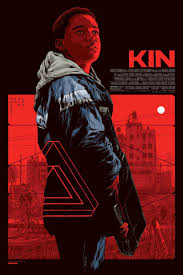
Kin


KIN

Josh and Jonathan Baker, 2018, USA 

Against a backdrop of low-income struggle and a scenery of deserted buildings, black teenager Eli goes scrapping and finds an alien rifle. Meanwhile, his white brother returns from prison to a tetchy father’s homecoming but still has issues with local and lethal lowlife. 

A Tough Love father, a wayward but fun older brother and a stripper with a heart-of-gold. A hint of “chosen one” syndrome. And a ray-gun. With all these elements, the Baker brothers’ ‘Kin’ acts as a full-blooded young male adult fantasy. In this sense, it’s best evaluated as young adult fiction that still has a lot of maturing and self-reflecting to do.

Besides this, the problem seems to be for many commentators that it’s also made up of a blend of genres and the argument is that it satisfies none. Part indie crime drama, part road journey, part sci-fi, part coming-of-age family drama. But such a mash-up is fine by me and keeps things on its toes. It reminds me of such eighties favourites as ‘Tron’, ‘The Last Starfighter’ and ‘Flight of the Navigator’ where a slightly dull and tatty real world gives way to special-effects and Chosen One excitement. I’m far more likely to raise an eyebrow buying into the idea that a ragtag group of bad guys would attack a police station; or that it probably stays too long in the nudity free strip-club where Jimmy (Jack Reynor) acts like an asshole and gets them into trouble. But the genre-blending that might not quite gel and yet marks it out as likable entertainment is surely a central pleasure of genre b-movies: the lack of genre mainstream conformity often redeems the failings and rough edges.

I’m amused at ‘Kin’ acquiring a “not present” grade on commonsensemedia for “consumerism” as we spend a long time in a strip club (but no actual stripping): surely the selling of objectified women qualifies? And then, of course, the central theme of “a magic gun makes boy heroic” is greatly problematic. The film is weak in self-reflection in these areas and leads Glenn Kenny to see it as “insufferable, self-seriously combining shut-in nerdiness with wannabe macho pyrotechnics.  It’s Bro Cinema in all the worst imaginable senses of the term.” Well, I wouldn’t say insufferable, more that it has b-movie charm despite these obvious flaws. I certainly found it less obnoxious than McG’s ‘The Babysitter’ (2017, NetFlix), another male teen fantasy (again, ‘Kin’ reminds me of those eighties young adult flicks). I also probably find it a less stupid male teen fantasy than ‘John Wick’. It helps that it is boosted by the inclusion of two veterans that know this turf well with Dennis Quaid and Jesse Franco, but it’s the unassuming appeal of Myles Truitt as young Eli that grounds the freewheeling drama.

Even with its streak of immaturity, ‘Kin’ still contains comic fun and charm, even if it is distinctly less than its promise.


Tuesday, 24 October 2017

Cohen & Tate

Eric Red, 1988, USA

There was a time in my youth when my friends and I would drawl “Piss on you!” in terrible Southern American twangs, mimicking Harley Cross in ‘Cohen & Tate’. I’ve waited a long time for this to feature in the DVD/Blu-Ray revolution and now here it is. There was a time in the eighties when its director Eric Red seemed a reliable name, being the writer of ‘The Hitcher’ and ‘Near Dark’, but he never quite lived up to that promise after those cult titles that helped define the era’s horror. Even so, I always had a soft spot for ‘Cohen & Tate’, the tale of two mismatched hit-men sent to kidnap a nine year-old boy (Cross) who some mobsters somewhere think saw something he shouldn’t have. 

What follows is a nocturnal road movie – which typifies these early Red favourites – in which it is quickly apparent that the two hit-men are thorough opposites and get on one another nerves. The kid senses this quickly and plays them off of one another. You will have to allow that a preteen can manipulate a couple of hardened killers, but it shouldn’t be underestimated just how tricksy and smart kids can be; and viewing it through the filter of a fairy tale about a child using wits to overcome odds bolsters suspension of disbelief. 

Red’s often quotable script gives everyone nuance and weakness: a hearing-aid; a temper that, when thwarted, dissolves into childish self-pity; childish precociousness giving way to tears. Hit-men coming undone when their victim proves quite a match is a staple thriller storyline but nevertheless this doesn’t try to be groundbreaking, it’s just a good thriller. Perhaps Baldwin is over-ripe and cartoonish, but Cross is more than a match for his adult co-stars, amusingly annoying one minute and a scared little kid the next. Roy Scheider is the backbone, delivering all the stolid adultness to hold it all together; it’s a fine portrayal of a man caught up in something he’s tired of. The stripped-down narrative and locations give this a direct intent and nightmarish edge, with the deleted scenes on the disc showing that this was intended to be even more brutal. These sudden moments of brutality, a crisp script and some memorably framed shots makes this a stand-out. A highly entertaining black humoured thriller with a centre of how adult weaknesses can capsize simple plans.

Sunday, 17 July 2016

Aferim!

Radu Jude, 2015, Romania-Bulgaria-Czech Republic-France

Radu Jude’s film gives voice to a community that has been unrepresented in cinema in a similar way to Embrace of the Serpent; in this case, the Romani people bought and sold as slaves during the 1800s. It uses primary sources to elaborate on truth with fiction which to me, like ‘Embrace of the Serpent’ and ‘The Witch’, makes this more convincing than claims to “based on a true story”. ‘Aferim!’ ~ an Ottoman Turkish expression translatable more or less as  kind of “Bravo!”, but give it a sarcastic spin ~ is set in Wallachia 1835 where a policeman is sent to track down a runaway slave. This policeman, Costandin (Teodor Corba), sets off across Wallachia with his teenage son and it is obvious very soon that he is an abusive, bigoted braggart and that the boy Ionitā (Mihai Comānoiu) is haphazardly but blindly trying to follow his father’s example.

It is when they get a hold of the runaway slave, Carfin (Toma Curzin), who then starts to tell them stories that colour in his humanity that conscience is poked at. It would seem that, yes, the slave is guilty of having an affair with his master’s wife, but it was the wife that seduced him; and also his worldly experience goes far beyond that of his captors. So, perhaps, maybe, he doesn’t deserve death as punishment and they should let him go, Ionitā suggests? It’s not that Costandin disagrees but he’s too afraid of losing the position he has and wrongly assumes holds more influence than it has: he says, rather, that he can persuade the master to mitigate the punishment to a near-death beating. But by the end, the punishment having been horribly meted out, it is obvious that he is dimly aware that he has no power other than that associated with his feudal masters, to do their bidding and that all along he has wallowed in the licence to brutality that allows him without really questioning. If his son so blindly follows his father’s ways afterwards is not known, but it’s obvious that Constadin himself is unlikely to change. He is the middling authority that carries out the prejudices ordained by the rulers. This is brought to the fore when Constadin wonders if people will say a good word about them in a few hundred years: a moment that’s perhaps a little self-conscious but also evidence that maybe this character does have doubts. But he’s too busy enjoying the power of privilege and practicing a casual racism it allows and deluding himself he’s doing good.


Aferim!’ as much about human cruelty as an ingredient of history as ‘Hard to be a God’. Having taken incidents and speeches from primary sources only amplifies this argument, as if it was ever in question. Slavery and racism are the backbone of society here with little active kindness on display for mitigation. Indeed, the point is surely that bigotry has always propped up cultures. Few scenes are as despairing as the runaway boy Tintirc (Alberto Dinache) begging for his slavery. It is a beautiful film, defined by Marius Panduru’s black-and-white photography where there are few close-ups, the general view being of mid-shots and panoramas, which keeps the audience at an observer’s distance. ‘Aferim!’ is darkly funny and accessible as a typical Western narrative structure, but it has a documentary feel and neo-realism that is totally European. A demonstration of how discrimination is timeless and a deft character study set in a credibly cinematically recreated past