Showing posts with label school drama. Show all posts

Saturday, 15 June 2019

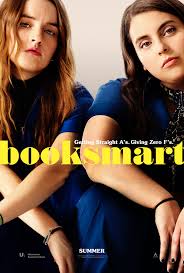
Booksmart


Booksmart

Olivia Butler, 2019, USA

Written by: Emily Halpern, Sarah Haskins, 
Susanna Fogel & Katie Silberman

Count ‘Booksmart’ as another film ill-served by its trailer. It’s not a just a ‘Superbad’ for girls, a gender-reversal on the standard hormonal (possibly obnoxious) young men gross-out comedy, although it is that too. It’s the tale of two girls at their last day of school realising that in having made the choice to forfeit fun for a more academic approach, they have been missing out. After all, their peers who apparently have just been goofing around are still going to good universities. So, they embark upon an odyssey to go to a party one last time to make up for what they’ve lost out on. Because partying defines young America.

It’s directed in a no-fuss style by Olivia Wilde that allows Beanie Feldstein and Kaitlyn Dever to fully indulge in evoking a believable friendship between the two nerds, Molly and Amy. The screenplay is funny all the way through with a couple of surprises thrown in. The fact that Molly isn’t a Barbie doll is never mentioned. The fact that Amy is gay is just an excuse for more risqué gags and for offbeat crushes: no angst here. Even when the girls have a falling out, music mutes the argument and the camera strays to look around, because although the argument matters, ‘Booksmart’ doesn’t dwindle so that it drags the comedy into dull dramatic cliché (although Pat Brown sees this as a misstep). There a real let’s have fun! philosophy at work here.

The cast fully embrace the broad strokes of their archetypes (everyone wants to be in ‘The Breakfast Club’) and, of course, over the course of the film their deeper layers are revealed: Hey, jocks like ‘Harry Potter’! Insufferable dweebs are just trying too hard and are actually sweet and interesting! The seemingly dumbass guy who has re-taken years is going onto coding! Hey, do you think maybe those guys are gay? etc. As Molly and Amy are defined in more complex and believable ways – for example, their ritual of praising each other to high heaven when dressing up is both endearing and cringe-worthy – this does leave a gulf of characterisation between them and others, but the sense of all-inclusivity wins out. There’s a benign agenda of acceptance that eschews, say, the tougher terrain of ‘Eighth Grade’ for an agreeably positive outlook. It’s more like ‘The Edge of Seventeen’ in its message for “get over yourself and have a good time” and “this is just a phase”. They are presented as a very self-aware generation but not with the tiresome privileged and narcissism of ‘Assassination Nation’. Untypically, peers aren’t vehemently nasty or bullying: indeed, these girls are generally welcome wherever they go. It becomes clear they’ve been their own worst enemies when it comes to socialising, that actually it’s they who have been indulging in snobbery. And then, as the genre demands, over one night they learn their lesson and it’s all good. This generosity of spirit makes ‘Booksmart’ highly likeable and uplifting. 

Butler and team wanted to make the kind of teen comedy they loved as adolescents, but ‘Booksmart’ is better than John Hughes candyfloss because it’s less prone to platitudes. It’s not above the broad humour of falling into claymation for a drug rip, but even this turns out to be a jab at the Barbie Doll fantasy. It benefits from updating the perspectives of its influences. It all makes for highly agreeable, slightly edgy and consistently funny light entertainment. 

Tuesday, 10 July 2018

What have you done to Solange?

Massimo Dallamano, 1972, Italy-West Germany

Italian gym teacher Enrico “Henry” Rosseni (Fabio Testi) is drifting down the Thames (apparently) and carrying on an affair with his student Elizabeth (Cristina Galbo) when she sees a murder on the embankment. But he’s too busy trying to have his way to believe her, insisting her protestations that she witnessed something is just a tactic to avoid intimacy (but he does take “No” for an answer, albeit much perturbed). Someone is killing the girls at a school run by somewhat skeevy white middle-aged men, who Elizabeth turns to after some time rather than the police. (Wait: why does she wait…?) The first thing that Inspector Barth (Joachim Fuchsberger) does is to show the school staff explicit pictures of the girl’s body with a knife in her vagina: “It’s a necessary formality,” he says (?) – and he doesn’t even seem to have spoken to the parents as yet; and when he does, he shows the x-ray of the killing to the father (!). Anyway, when Elizabeth is murdered too, Rosseni investigates the murders (as immigrant teachers are prone to do) – which includes roughing up potential leads in the style of tough-guy cops from the movies – even as he is in conflict with his frigid wife (Karina Baal). Well, actually she becomes totally sympathetic and lets her hair down when Elizabeth is killed and is told she was a virgin. And where would the police be without Rosseni turning up where dead bodies are? But he’s never under suspicion, really. And then in the third act, Solange (Camille Keaton) herself turns up in earnest and proves the key to it all - her hair long and unkempt and her finger permanently hovering at her bottom lip to signify she isn't quite all there but yet conveying some kind of broken innocence.

“Only sixteen and surrounded by secret boyfriends, petty jealousies, orgies and lesbian games,” Rosseni laments, apparently shocked and unaware that his own affair contributes to this tapestry of scandal. "I wouldn't be surprised if they were doing the drug scene too." Of course, this also reads like a checklist for a certain male fantasy. Adele of Foxspirit gives ‘Solange’ a more feminist spin: 

"Set in London, but using Italian dialogue, What Have You Done to Solange? chafes against the restraints of the typical Giallo by contrasting the conservatism of a Catholic girls’ high school with the sexually charged atmosphere of Italian cinema."

But I always found such analysis is left a little unreinforced by the text; that it doesn’t align with the mixture of silliness and salaciousness that typifies giallo. All the females here are a response to masculine priorities with their autonomy often dismissed by the generally creepy men: a little more substance to the women would have made this more a persuasive criticism of misogyny, but the all-round shallow characterisation has no gender preference. 

Mark Edward Heuck gives context for Dallamo’s “scared schoolgirls” trilogy – but not to worry if you don’t work out the mystery because Inspector Barth will helpfully explain it all in closing, even if it’s doubtful he would have worked it all out at that point as he’s been pretty clueless all along. What we get is a parade of pretty girls and a ridiculous police procedural that isn’t convincing at all as a killer goes around murdering girls in the most lurid manner. As Kyle Anderson says, these giallo films “exist in worlds where logic in narrative doesn’t mean nearly as much as shocks and salaciousness.” Giallo doesn’t exist in realism, but in an alternative realm seemingly made of adolescent horror and fantasy, grazing against nightmare logic but never usually competent enough to truly achieve this, despite the often excellent aesthetic. Of course, you have ‘Suspiria’ and ‘Footprints on the Moon’ as examples where this does work, but ‘Solange’ is more of that which is fun for the daft character outbursts and dialogue, for the sensationalism and exploitation. But it's most confrontational framing is reserved for the abortion scene and indeed it's whole tone is more like one big tut at the goings-on of the young with a bit of a lurid cautionary tale for girls to keep their legs closed. 

What this does have less of is bad dubbing which is often part of the fun: they are dubbed but the actors are speaking English so the incongruity between the soundtrack and the visuals are less likely to induce amusement. And of course the whole sordid enterprise is given oodles of credibility and atmosphere from Ennio Morricone’s dreamy score. 


Wednesday, 10 January 2018

My Life as a Courgette

‘Ma vie de Courgette’
Claude Barras, 2016, 
Switzerland-France

Laika studio’s ‘Kubo and the Two Strings’ showed how stop-motion animation can now be as smooth and seamless as CGI, but the joys of ‘My Life as a Courgette’ are the old-school rough edges, the tangibility of the aesthetic and movements. It’s so tactile that the ridges of a crayon line stand out like Braille and the felt of the character’s mask catches the light like and seems as textured as sugar. The backdrops and clothing are full of scope and detail but retain the charm of a kid’s homemade set. The colourscheme bears the pallet of a kid’s watercolour selection and the lighting is as dense and considered as any live action feature. In shots such as a high-angled view of a house as a train goes by just above, modern and older techniques seem to meet to revel in both contemporary smoothness and the delight of a DIY history.

With a screenplay by Céline Sciamma adapted from Gille Paris’ book, it’s a tale of simple kindness and friendship overcoming trauma which, in the name of dramatics, we perhaps don’t get enough of without lapsing into trite sentimentality. There is sentiment but it feels earned and genuine, offering the empathy of giving the kid characters respect and autonomy. It’s rooted in valid darkness as all the kids come from backgrounds that speak to real trauma, but despite the threat of the loneliness of suffering, ‘My Life as a Courgette’ pays tribute to the resilience of children and their friendships, as well as the unfussy kindness of adults always in the environment. 

It’s succinct with a running time of just over an hour, written in a direct but unpatronising manner and lush with its stop-animation delights. Its mildness may be mistaken for inconsequentiality rather than strident humanitarianism, but it’s a small and considerable gem.

Thursday, 18 October 2012

For Love's Sake

For  Love’s Sake:
The Legend of Love & Sincerity
Ai to makoto
Takashi Miike, Japan, (2012)

Takashi Miike is so prolific and diverse that’s it is almost a chore to keep up with him; he’s a master of genres and as punk as he is classical and consistently unpredicatable and surprising. Of late: “13 Assassins” and “Hari-Kari” one moment and “Yatterman” and then “For Love’s Sake” next. This also means that he shall often throw anything but the kitchen sink in if the material is a little, shall we say, silly and underwhelming. This is helpful when he is doing his Manga adaptations, because Manga is often quite bonkers and narratively wild and emotionally hyperbolic and ridiculous; or at least the bulk of Manga that gets adapted seems to be. “For Love’s Sake” is, for the most part, delirously silly and over-egged: it comes across like a parody not only of overwrought Japanese school dramas but also of Baz Luhrmann’s “Romeo + Juliet” and the teen romance genre as a whole. The performances of the musical numbers are, for the most part, very funny: the tracks are a mixture of Japanese ‘60s pop tracks and original songs with straight enough lyrics, but it is the characters lauching into musical numbers as if they believe they are in their own musical (which they are) when most characters around them aren’t quite so sure that makes it so all so amusing. Manga and Miike is often prone to changing mood and mashing up extreme and sentimental elements indiscriminately, and if the first half of “For Love’s Sake” feels like barmy parody, and is definitely funny, the second half is dragged down by that sentiment that asks us to take seriously the absurd and unhinged declarations of love by characters that feels very much like unhinged psychology.

No one in “For Love’s Sake” is in good mental health. We are expected to go along with a main macho character, Makoto (Satoshi Tsumabuki) who solves everything with violence and who is indeed so violent that he will happily take on entire gangs and come out on top. Oh, and who happily slaps women around. Then there is Ai (Emi Takei), a girl who is delusionally obsessed with Makoto and whose insane pursuit of him with declarations of anti-violence and love are so trite, they are hilarious and surely satirical of youthful romancing; all that being in love with the idea of being in love, etc. When he keeps telling her where to go, you agree with him. Then there is Hiroshi who is also obsessively in love with Ai with that nerdy tactic of hanging around her in the hope that one day she might fall in love with him: the gag becomes that he turns up everywhere after her, but make no mistake that he is a stalker. The school of delinquents adds to the bunch of Asian dramas that make it look as if Asian education is a hellhole (I am thinking of, oh, “Confessions”, “All About Lilu Chou-Chou”, “Whispering Corridors”, “Friend”, etc etc). That the gangs are mostly femal dominated is a nice mixing-up of typical classroom gangs and this leaves plenty of room for the gag that most of the main bad girls are in love with Makoto. Oh, and there is the seventeen year-old boy who has the body of a middle-aged man too (he has some kind of aging disease??). It all comes across as the fantasy of some dysfunctional lovesick teenager with a fevered pop-addled imagination.
My favourite moment of violence? An unbroken take where the camera stays over Makoto’s shoulder as he wipes out an entire gang stuffing full a hospital corridor. But there is also the opening fight during which Makoto sings throughout the punches and kicking. All the dance numbers in the first half have their moments, though.
It’s overlong by at half hour and at least two songs and the earnestness drags as much as the emotional outpourings, although even the later passages are alleviated by sudden bursts of inventiveness: a bad girl’s flashback to her childhood trauma is brilliantly rendered as animation, for example. Even the closing Anime flashback feels like it might possess genuine emotional effect if we were not being asked to associate it with such ridiculous and two-dimensional characters. This, however, is typical of Manga and Anime where we are often to take at face value that people are in love, despite the lack of convincing romantic detail. Characters generally just end up shouting one another's names in various states of hysterics. Miike is also not always one to turn to for emotional engagement: there is often the sense that his films are experiments in free-form cinematic tricks and tropes rather than speaking deeply to the audience, but this depends upon the particular project (films such as "Rainy Dog", "Hari-Kari" and "Big Bang Love: Juvenile A" are different stories altogether).

“For Love’s Sake” is gorgeous to look at, funny and violent for the most part, then undone by the typical Manga sentimentality. If you are looking for the real deal about growing up with neglect and violence, look to Miike’s two “Young Thug” films for revelations, scathing insight and some genuine emotional engagement. “For Love’s Sake” shall not win many new Miike fans, but even at his most conventional, he often seems to be making all the films all at once and no one quite does it like him. There is no doubt that it is at least unforgettable, because Miike's work always leaves some kind of aftertaste, even if this example is candyfloss with punches and pretences of substance.


P.S.: The British Film Institute puff piece for "For Love's Sake" by Tony Raynes says, "This is the kind of movie that hits you, and it feels like a kiss." This indeed is indicative of the problematic nature of deciding what one is meant to take from the film if looking for any depth. It is also one of those faux-poetical nonsense summaries that seems to think equating hitting with kissing is something lyrical.