Showing posts with label literature. Show all posts

Sunday, 18 March 2018

'The Prodigy' by Herman Hesse: nature vs eduction

‘The Prodigy’ – Herman Hesse


Originally ‘Beneath the Wheel (Unterm Rad), 1906 
Peter Owen Publishers translation, ‘The Prodigy’, 1957
Translated from the German by WJ Strachan


Herman Hesse’s bildungsroman 'The Prodigy' - the original title of 'Beneath the Wheel' is more explicitly aggressive -  focuses on Hans Giebenrath, an intelligent and sensitive boy, eager to please and excel from his provincial origins. But having successfully entered a theological school, he finds that its focus on the technical rather than the emotional education of the young drives him to a breakdown. Hans’ ambitions, wants and needs rest between the poles of the natural and educational worlds and the establishment falls far short of meeting these. 

School in ‘The Prodigy’ is a serious business which, if it is not openly abusive, is oppressive and devoid of compassion. There is no satirical take on teachers as in Mark Twain’s ‘The Adventures of Tom Sawyer’ (1876), or elongated sequences where the classroom is a chamber of humiliation and physical punishment as in James Joyce’s ‘A Portrait of the Artist as a Young Man’ or David Storey’s ‘Saville’ (1976). In Joyce’s ‘Portrait’, the protagonist rejects the source of his torment, namely Catholic education, and, even if he is not happy by the book’s close, he has survived. Storey’s ‘Saville’ also features a prodigy, a son of a miner who, by strength of natural intellect, may ascend from his class origins; yet he is unable to escape the front room of his home and subsequent destructive bitterness sets in. In ‘The Prodigy’, it is not outright cruelty and sadism that defines the boy’s experience but simple indifference to whom Hans may be – an emotional depravation. It is Hans’ inability to truly rebel that is finally his fatal flaw. His friend Heilner personifies all the youthful and successful rebellion and bitterness that Hans cannot achieve and barely acknowledges within himself. Heilner is to some extent Hans’ inverse reflection, a parallel set up upon the first time that they meet. Both boys are strolling alone in the woods and meet at a lake. Both flatly agree upon the beauty of the place: their friendship is sealed. With Heilner as a companion, Hans can gradually fail his school and survive the consequences; but when Heilner is gone, Hans is lost, friendless and at the mercy of lessons and expectations, which leads to a breakdown. Friendship then emerges as a natural element, a counter-active force to the unnatural climate of education. 

In Twain’s ‘The Adventures of Huckleberry Finn’ (1884), education is – albeit humorously – something to be avoided and the knowledge of the natural world becomes central and superior. Civility is to be satirised. Tom Sawyer may not be able to reject society absolutely – he always needs an audience to play to – but Huck can manage alone just fine. He is smart, cunning and eloquent in an effortlessly self-educated sense, and these qualities make him a survivor. He can take or leave culture. And not for Hans the precocious insubordination of the boys of Kipling’s ‘Stalky and Co.’ (1899), or Compton’s ‘Just William’ who quite happily pal up to upset establishment. It is not learning in itself that pressurises Hans – indeed, he has a voracious appetite for it – but rather the demands and concepts that culture has of education as an institution. There are a number of passages in which Hesse lays out this institution for indoctrination and compliance:

There was something wild, untamed, uncultured in him that must first be broken, a dangerous flame that must be extinguished and stamped out.

And: 

...it is the school’s job to break in the natural man, subdue and greatly reduce him; in accordance with the principles sanctioned by authority is its task to make him a useful member of the community and awake in him those qualities, the complete development of which is brought to a triumphant conclusion by the well-calculated discipline of the barrack square.
 [Penguin edition 1973, pg. 43]

It is not blatant brutality or unkindness that breaks Hans but rather that the education is at the expense of humanity, ignoring his sensitivity for his propensity for learning: school as a passive-aggressive tool for dehumanisation.
***

In 'The Prodigy', there is a moment when the order of narrative seems shuffled: the book begins with a brief account of Joseph Giebenrath’s life and then his son Hans’ candidacy for the ‘Lendexamen’; it is only late in the book [chapter five] that Hans’ earlier childhood pre-candidacy is detailed. Having “failed” at school, Hans returns home and visits the Falken where a host of memories come back to him as a prodigy. It has not always been local priests and teachers that have educated Hans. There is his brief but densely sketched friendship with a sickly orphan Hermann Rechtenheil [pg. 114] who taught Hans how to fish, to “study the weather” and a whole litany of practical and observational tricks. Even in this Hans has been an excellent pupil for his friend, but Rechtenheil dies quickly and leaves way for the subsequent influences of Heilner’s friendship. He too disappears and Hans’ need for a stronger, educating friend leaves him vulnerable and lost. But in Rechtenheil, Hans’ need for being taught and for the natural world had once been perfectly embodied. This sequence in which Hans’ early life is conveyed comes latterly in order to show that which he had forgotten and has lost in his quest to become a great student. 

Hesse endows Hans’ world with lengthily and beautiful passages on rivers and woods and nature, almost as eloquent and poetic as those of Laurie Lee in ‘Cider With Rosie’ (1959) (“almost” because ‘Rosie’ is pretty much peerless). Fishing is tied to Hans’ bond with nature and with giving him the respite and autonomy he desires as much as academic skill. When Herman is attracted to a girl, the imagery is of animals and (with the cart) the threat of civilisation and technology:

… this one was so lively and talkative and so indifferent to his presence and awkwardness that he drew in his horns helplessly and, slightly offended, withdrew into himself like a snail brushed by a cartwheel. 
[pg. 123]

It’s a lovely passage evoking the shyness and inelegance of first crushes and feelings of perplexing attraction. A similar mixture of the natural world and feeling runs through his desire, expressed by the imagery of breezes, of gardens, of clutching fences and stopping halfway across bridges listening to rushing waters. [chapter six] This isn’t quite innuendo, but the symbolism is clear. It’s overwhelming to Hans, being the susceptible soul that he is.

After a night of revelry that puts his observations and extroversion to the test, Hans is found drowned: but was this an accident or was it suicide? The ending argues that if we do not balance nature with nurture then disillusionment, alienation and self-destruction is, perhaps, the tragic end for sensitive souls who cannot cope. How we failed them. Or certainly this is how sensitive souls like to tell their narratives. This is a typical outcome for fictions based on outsiders of some form victimised by society (early texts exploring female roles who always seem driven to death, for example) and here it blends tragedy, suffering and a kind of wistfulness. If perhaps this sides too much with victimhood, Hesse nevertheless presents a fine tirade against education as a tool of indoctrination, and as such as antithetical to individualism and the natural self.


Tuesday, 19 July 2016

vs Ian Fleming's "Dr No"


"Dr. No" by Ian Fleming

Once you get past the misogyny and the racism - which you can’t because neither are particularly subtext - the problem with reading James Bond is that James Bond is a dick. His plans frequently require innocents getting killed; he generally blames the women; he is unable to treat women as adults; he antagonises and insults his captors instead of playing clever; he sulks when he doesn’t get his way. 

As presented by Ian Fleming, if this is an exemplary example of their agents it is a wonder the British Secret Service resolves anything. Head of the Secret Service, M, seems equally dickish, apparently only happy throwing his agents into serious danger without proper forethought. Assumedly, he is meant to be the stern paternal type, but he too seems like an idiot. For example, in “Dr No”, M16 agent John Strangways fails to send his daily message to headquarters: Fleming goes into great detail how Strangeways follows stringent routine every day, mentioning how even the keyboard he uses can pick-up his particular typing technique so recognise whether anyone unauthorised is making a report, etc, etc; and yet, when Strangways fails to report in one day, his superior M’s first reaction is to simply dismiss the matter on the assumption that Strangways has eloped with his female co-agent. It is only because Bond needs an easy assignment to help him recover from a previous mission that M thinks he might as well send someone to investigate, despite being certain that Strangways has simply done a runner for some sex. If I was a secret agent, I would surely hope for a little more concern and support. 

And when Bond arrives in Jamaica to pursue the disappearance, he arrives to find they have provided him with Strangways’ car… not so good at secrecy and subterfuge, this Secret Service. Well, let’s not forget that Bond uses his real name all the time upon arrival anyway. Most hilariously, when finally captured by Dr No – in a secret base that treats its prisoners like hotel guests – and his captors ask him for “next of kin”, he gives them M’s real name, we are told. And before that, he simply arrives in Jamaica and assumes Dr No’s guilt due to a mixture of xenophobia and local gossip; oh, there are certainly clues for concern about Dr Julius No, a Chinese-German, and his army of Chigroes (that people of mixed Chinese-Negro heritage, according to the book) but Bond jumps to the conclusion that the Doc is up to no good on his reclusive island almost from the off. He hires a local boatman, Quarrel, as his sidekick – not sure what training and qualifications Quarrel has for such covert operations, but…. - and Bond manages to survive a couple of assassination attempts, most memorably one involving a poisonous centipede crawling over his crotch and up his body. But what to do about being such a recognisable target in Strangways’ car? Well, Bond gets Quarrel to hire a couple of look-alikes to drive around in the car to see what happens: and the unfortunate impersonators are both promptly murdered. How about that? 

Anyway, Bond convinces Quarrel to take him over to Dr No’s island, despite the native’s fear of a dragon that is meant to prowl upon it. It is here, apropos of nothing but happenstance, that Bond meets his love interest Honeychile Rider. She is on the beach, collecting shells to sell. But this complicates things: what is what Bond to do with this luscious lovely? And more, how can he possibly ignore the deformity of her broken nose? Yes, the book stresses, this is such a “deformity” for a female; but luckily, like all other disabilities, after a while you hardly notice it! And this is exactly the kind of thing to distract Bond on his adventures. For her part, Honey has had a tough time of it, orphaned and raped (and that’s how the nose was broken) and now living off of her own wits. She has managed to avoid Dr No’s army and collect her shells for some time, and yet as soon as Bond turns up, she becomes a simpering female, clutching to him for protection. She is out of her teens and yet there is a passage where Bond takes time to wrestle with his conscience about whether to treat her as a “girl” or as a “woman”. Well, Fleming evidently makes the decision and for the rest of the book she is simply “the girl”. Doesn’t stop them from closing the book by having what she amusingly (and degradingly) calls “slave time”.

Fleming is quoted as saying, "I write for about three hours in the morning ... and I do another hour's work between six and seven in the evening. I never correct anything and I never go back to see what I have written ... By following my formula, you write 2,000 words a day."  And it shows: the plotting is purely whimsical, its consistency wavering, the plotting and ideas the kind to be expected from a hormonal teenager with all the cruelty, lack of discipline and unintentional humour that comes from that. We are a long, long way from John Le Carre’s George Smiley.


Dr No himself is a remarkable construction, the result of extensive plastic surgery and other physical modifications, let alone the fact that he is “one in a million” with his heart on the right side of his body (which saves his life). He is a heady mix of Chinese-German ancestry, Fu Manchu super-villainy in a Jamaican island hideaway. He also seems to think that Bond is the only one worthy of hearing his masterplan, which means he probably needs to get out more. Well, he thinks this one moment and then tells Bond he is not as clever as he thinks he is the next - which is both true and in keeping with the inconsistency of Fleming’s characterisations. For example, one minute Honey is a resourceful and admirable female presence and the next a weak sex interest in need of Bond’s protection; and the next she has the presence of mind and stamina to wait out an awful mass-crab attack. Bond is meant to be a super-agent, but that doesn’t mean he won’t sulk when imprisoned by a super-villain and when his plan to acquire a weapon falls flat (a plan, it might be mentioned, that features Honey getting a manicure). In one moment, Dr No’s soldiers are ruthless and efficient killers; the next they are intimidated and dissuaded from raping Honey by some vague and unfounded threats from Bond. It is all a little up and down and all over the place. It is as patch-work at Dr Julius No himself.

And it may well all be fun enough if its misogyny and xenophobia didn’t lead the book by the nose. These are not incidental traits as much as a watermargin through every viewpoint, and Fleming is simply not a good enough writer to circumnavigate these weaknesses. If you are not that way inclined, these might be insurmountable obstacles to enjoyment.

It is true that the film of “Dr No” manages to mitigate many failings of the book. M treats Strangway’s disappearance seriously from the start; there is much more detective work from Bond in the first half which is necessarily padded out more, particularly with assassination attempts. Bond is a jerk still, but he is also witty and far more enigmatic; more an anti-hero. The film is no less silly, but it delivers its nonsense with some flare. It is indeed remarkable to see how many of the defining traits of a Bond film are all present in his cinematic debut: the Bond-down-a-gun-barrel inset, the groovy opening titles, that theme tune, a sense of the  tongue-in-cheek rather than the campiness that would overrun the series later: all this dresses up Bond in a far more appealing aesthetic. 


Saturday, 3 August 2013

"The Turn of the Screw" and the Ambiguity of Hauntings


The AMBIGUOUS Ghosts of Henry James’
“The Turn of the Screw”


  Henry James’ novelette The Turn of the Screw [1898] is not an absolute ghost story, in the way recognisable from the works of M.R. James, for instance. Henry James’ ghosts are internalised, unknown and destructive. Through his tale of a naive governess who cares for the children Flora and Miles in a vast haunted house named Bly, James does not present only creeping ghosts. As a straightforward ghost story, it is rather prosaic; creepy but little more. The true ambition of the novel is the exposition of the latent delusions that adults impose upon children. Neil Sinyard concludes that in James, the strange beauty and innocence of children tempts violation, and, rightly, that the novel’s true monsters are the “values and repressions of Victorianism.” [Neil Sinyard, “Little Horrors: the Innocents”, Children in the Movies, (BT Batsford, London, 1992) pg’s. 64 & 67.]

            The ‘possession’ of the children is tied in with sexual awakening, but also in class. If Miles and Flora are possessed by the secrets and sexuality of the dead Peter Quint and Miss Jessel ~ past valet and governess to Bly ~ it is the possession of a sexual lower class over the repressed upper. The new governess is a daughter of a country parson [prologue]; the position of governess feeds her ego. She reacts bitterly to the children’s impenetrable class identities and manners by accusing them of sexual knowledge through their apparently affectionate relationship with Quint and Miss Jessel. Flora need only be playing with a boat (this bit goes in that bit) and the governess will see sexual metaphor [chapter 6].  Her attraction for the children’s absent uncle and the  Quint and Jessel story fuels her fantasies. She sees the latter as ghosts, trying to reclaim the children. Misinterpretation and the incompleteness of character dialogue are the text’s index. The governess’ key conversations with her only believer, Mrs Grose the cook, are crucially ambiguous, and without the susceptible Mrs Grose, the governess’ hysteria may never have escalated. But in looking to Mrs Grose or the prologue’s narrator for verification of the governess’ account and in defending a genuine supernatural interpretation, and, it should be remembered that James’  text is built upon delusion, misreadings and the imposing of one’s obsessions upon others. If anything, the novel asks what is it we can truly know of another person.

            To this end, James’ masterful use of indistinctness, ambiguity and plurisignation, in the narration and dialogue, the open-endedness, misinterpretations and incompletion, they are demonstrated strongest in the abrupt ending. The governess has already detected her own latent sexuality in the girl, and confronting the children with the repressions (and perversions) of adults, she scares Flora into delirium and Miles to death. The novel ends with the stopping of his heart. The orgasmic final crescendo leaves innocence dead, for only by killing ‘Innocence’ can it be preserved.

If a strictly Freudian reading is potentially incomplete or faulty, the text still has such secrets to disclose. The ghosts are conceivably the apparitions diverting both governess and reader from the unspeakable truth, as sleight-of-hand. AL Smith perhaps sums it up by noting that Miles “is more plausibly the one [the governess] is ‘in love’ with.” [Allan Lloyd Smith, Introduction to The Turn of the Screw, Everyman edition, (London, 1998)] And if the governess has ‘romantic’ longings for Miles, then it would explain the narration’s highly contrived self-denial; it would explain why she has not contacted their uncle, kept Miles from school and driven Flora away as well as Mrs Grose and all the servants. The ghosts are both the witnesses and the manifestations of the governess’ self-denial. She calls upon both of them in the last terrible embrace with Miles; if ever there was evidence of Miles’ innocence, it is his denial that he sees Quint ~ “Where?”; the governess finally dejects even the spectre of Quint to claim Miles as her own: “What does he matter now, my own? – what will he ever matter? I have you.” [chapter 24] The novel leans towards not only the uncanny, but the unspeakable. It lies at the centre of the novel’s ambiguity.


Wednesday, 27 February 2013

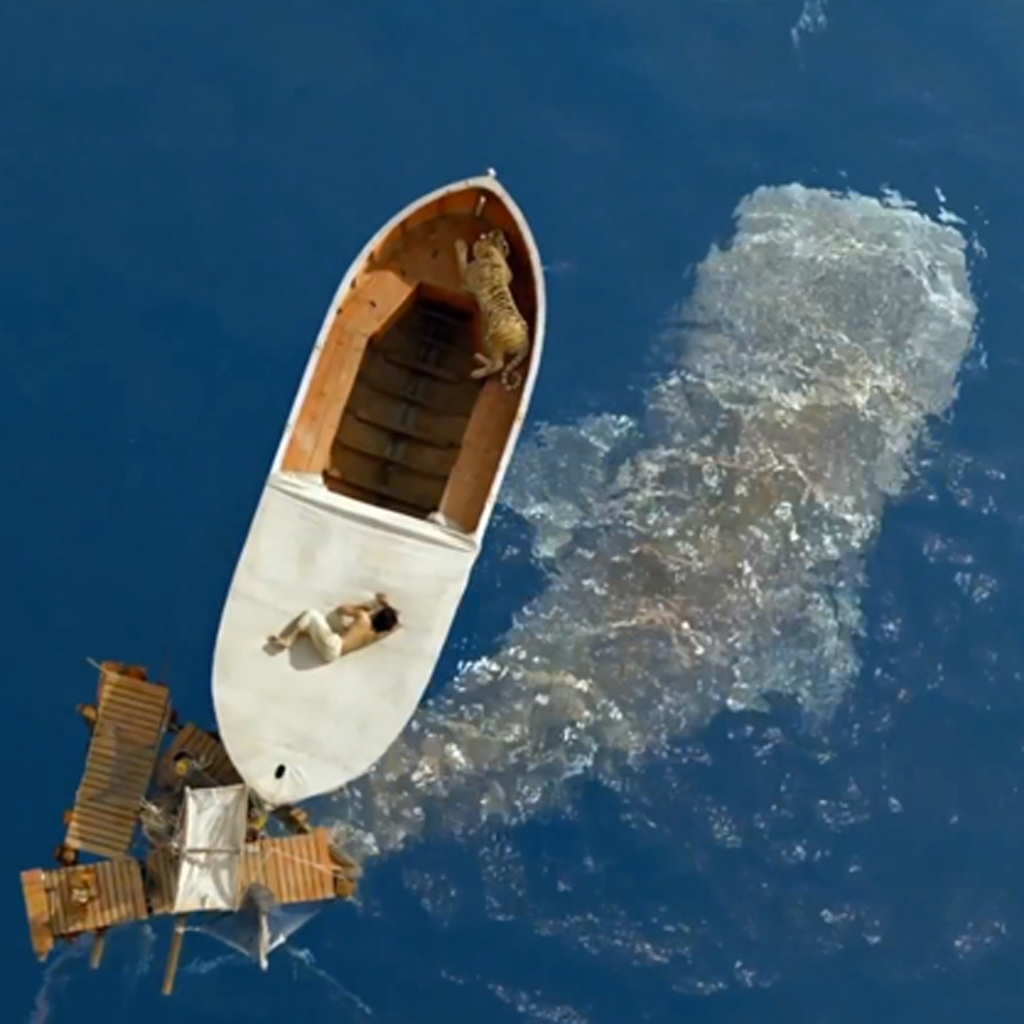
"Life of Pi", in words and pictures, or: storytelling for those that choose it.


LIFE OF PI

A novel by Yann Martel
A film by Ang Lee (2012, Tawian/USA)
(More than ever, this will contain huge spoilers.)

-1-: In Words

Yann Martel’s novel “Life of Pi” bears what I consider to be all the hallmarks and clichés of award-winning literature: a protagonist with a gimmicky name; religious overtones and symbolism (mistaking this for automatic poignancy); post-modern usage of and reverence for story-telling (story-telling is magical!); unreliable narrator; magic-realism; throw together and stir in some historical national crisis. At worse, these feel like the tropes of authors with affections of importance and significance whilst feeling a step disconnected from what is authentic. But Martel’s novel is an example of how these tropes can be made to work and is a fascinating and playful confection, setting up a fantastic premise of a young man trapped on a lifeboat with a Bengal tiger and milking and working the limitations of this scenario for all their worth. How would you survive this scenario?, the book asks, and proceeds to pay great attention as to how our protagonist Pi uses his knowledge, resourcefulness and trial and error to stay alive and fend off the big cat. Martel does not anthropomorphise the tiger – named Richard Parker – but respects the animal for all its primal splendour and terror. By the time the book segues onto the carnivorous island, the sleight-of-hand into more magic-realism is barely jarring due to the lengthy attention paid to detailing already incredible circumstances.

The older Pi, recounting this remarkable tale of survival, says that this is a story that will make the listener believe in God. As a child growing up in India in a zoo, amongst the animal kingdom, Pi is named after the French word for swimming pool, piscine, but abbreviates it to a transcendental number to avoid being mistaken for “pissing”. He trades the crude mispronunciation of his name for something that implies that, well, he is the centre of a watery universe. Pi tries and adopts features of many religions that he becomes fascinated by – a little of this, a little of that – creating in effect his own belief system whilst ignoring the incompatibility and conflicts between any two faiths. When his family is forced to move to Canada – due to national troubles – taking the zoo along with them, the ship is sunk in a storm and only Pi survives, alone with a small menagerie that is quickly reduced to just he and the Bengal tiger. He is indeed strained to his most primitive state, albeit one that calls on his God to guide and save him; but these prayers do not in a way that smother his dilemma and the detail. Keeping from being eaten by Richard Parker becomes his life cause and purpose.

Of course, it is the ending that truly elevates ‘Life or Pi’, for Martel’s work on making the life boat scenario convincing works to distract us from the fact that we are reading a fable. Which version do we wish to believe, Pi asks in conclusion: the one where Richard Parker is the manifestation of his primal, murderous side needed to survive catastrophe, or the prettier version with the animals? And ultimately, does this not cast religion simply as recourse to denial, storytelling and lying in order not to confront our very natures and the truth of things? Does it not cast into light the very brittle nature of the civilised when confronted by nature? In a Godless world where you can pick-and-choose your beliefs and faith, what would Noah do had his Ark been sunk and only he and a few hungry animals were left alive?

Pi’s tale is full of ambiguity. Does it condone lying because storytelling is so “magical”? Or is it a colourful exposure of the fiction of religious fancy? For all its dressing-up in faith, “Life of Pi” never loses sight of the carnivorous, chaotic and arbitrarily cruel inclinations of nature. Its symbolism is far more in the service of the world and psychology around Pi rather than religion. Rather, the key to the novel is surely the fleeting passage where Pi mentions that all animals are a little crazy. Temporary craziness is the key to the novel and religion may certainly be seen as mostly decoration acting like the main attraction.


-2-: In Pictures

Craziness is also the one theme that Ang Lee’s film of the novel does not truly address – screenplay by David Magee. Nevertheless, its symbolism remains intact because it is faithful to Martel’s text. When stranded on the life-boat during the storm, who does Pi see swimming towards him in the manic waves but Richard Parker, the symbol of his pending madness and violence? Pi screams and seemingly fends the tiger off, but the big cat appears again from the depths beneath the tarpaulin at the precise moment that Pi becomes confrontational and murderous. Pi spends his time taming the madness that threatens to consume him, but almost gives in to it during the second storm where he throws open the tarpaulin. And so on. The affection Pi eventually and inevitably has for Richard Parker has great resonance. (But there is a clue that Pi senses he may be losing his mind earlier, for when he swims mid-storm to the cabin to save his family, a zebra swims past him: How would a zebra be come to be there? we briefly think – knowing later that the zebra represents a friendly sailor, this moment nods towards Pi being overwhelmed by tragedy earlier even than Richard Parker's appearance.)

The film is a little softer version of the novel, mostly because the novel is gorier and the ending is perhaps less spelt out. The ambiguity is there almost despite the film being more literal: it is as if Magee’s script takes Pi a little more at face value but Ang Lee isn’t quite buying it. Perhaps this is why Rafe Spall’s writer character seems to embody the film’s weaknesses, as being the journalist that plays into the parlour game of fable-telling (the character acts as the equivalent of those in the audience being distracted by shiny objects). In truth, the lengthy back-story serves well to hint that Pi is in fact a fabulist all along, a bullshitter of the most charming degree. The writer is the sentimental audience, missing Pi’s greater heroism and the true horror of his ordeal by choosing a fancy tale. Nevertheless, Martel’s novel does leave it’s mark in showing how we tend to fall for stories and Lee matches that with a similarly fanciful and beguiling aesthetic.

Visually, the film is a wonder, an extravaganza of physical and computer-generated special effects. The storm sequence is a small masterpiece of action, effects and size; literally awe-inspiring (it is film that really needs to be seen on the big screen). The shot of Pi suspended in the ocean looking at the sunk ship on the seabed below is perhaps the one moment in cinema where I actually wondered if it could be matched by 2D (of course it can, but it is the first time in my cinema-going that I have actually doubted). Indeed, ‘Life of Pi’ is the one 3D film where 3D felt complimentary, and mostly subtle. It is a very bright and colourful film, which helps immensely to combat the light-loss that 3D currently carries; it looks somewhere between splendid animated nature book, state-of-the-art cinematic wonder and Asian kitsch, and it is always surprising, inventive and beautiful.

And the storm sequence is then matched by Richard Parker as a remarkable and convincing special effect. Richard Parker is as much a marvel as “The Lord of the Rings’” Gollum, rendered with convincing physicality and fearsomeness. It is true that so engrossing is the performance of the tiger and Suraj Sharma as Pi that it is easy to forget just what a special effects piece the entire film is. And we are invited in by the warmth of Irrfan Khan as the elder Pi and the vitality of Sharma as the younger, and then to be devastated by Sharma’s near one-take, heart-rending performance where he reveals all from a hospital bed.

But for all this, it is in truth an upsetting tale that has remarkable crossover appeal. I myself am surprised that it has seemingly metamorphosed into an instant family favourite: both times that I saw “Life at Pi” in different towns, the audience was made up of parents and very young kids; there were many children as young as five watching. I would have felt it too distressing at times for younger children, and yet there they were engrossed. As Fox UK boss Cameron Saunders says, with the typical condescension and cynicism of salesmen and businessmen:

“‘Slumdog Millionaire’ was perhaps the closest comp, because we knew it was going to be great filmmaking, run into the awards corridor, have an ethnic slant, and it was a challenging film that could appeal to audiences.”

For me, the trailers for “Life of Pi” were mostly a  misrepresentation of the text, focusing on selling it as a boy-and-his-tiger high adventure: “A life of adventure! A life of hope! A life of triumph! A life of Pi!” Hmm, not a life of tragedy, horror and stark survival, then? And a little more apt: “Believe the unbelievable”. Another trailer, which is otherwise mostly a good summary of the film, adds “A life of friendship”. To which I raise an eyebrow and become sniffy. But it really isn’t quite a Disney’s Mowgli tale (and Disney’s Mowgli is not Kipling’s Mowgli) and yet one can see how this pitch would have helped make this a family film, getting an audience to try out something both appealing and testing. Some critics have berated it for being simplistic in its discourse on religion, but it is not that film either; and if it is simplistic in some way, it is still more revealing and insightful about the mechanics of religion than Terence Malick’s “Tree of Life” (“Tree of Life” has other virtues, but its smug symbolism are surely only poignant to those satisfied with themselves for identifying them: and for them, at least Pi ends up on a beach in a crucifixion pose).

Just as Martel uses each sentence, Ang Lee uses all tricks and resources of cinema to make us buy into the splendour of storytelling, to fool us into believing that storytelling is perhaps one of the greatest forces of nature of all, if not faith. If it feels soft and superficial to some, making it look like a cosy mainstream adventure yarn, well the film itself is all about deceptive appearances. Indeed, it is a film where, more than most, you can take away from it what you want most to see.


P.S. - Rhythm & Hues, the special-effects company that won an Academy Award for "Life of Pi" has filed for bankruptcy. A bizarre and sorry state of affairs. (Thanks to Steve H for the heads-up.)

Wednesday, 11 January 2012

Buck Theorem's "The Third Monster and other oddities"


“This compilation contains 20 tales of mystery, horror, fantasies, monsters, nightmares and dreams. Ghosts both vengeful and sorrowful. Vampires of autumn and cinemas. Murderers who are terrible, horribly young, and occasionally bizarre. Strange big cats stalking dreams and suburbia. Living dolls hunting victims. Schools haunted by bullies. Desert castles and the living dead. Unusual holiday resorts and graves with relentless appetites. In the realms of the uncanny, you shall find all the oddities you could care for.”
THE THIRD MONSTER AND OTHER ODDITIES
Here is my second book of fiction. This one is one of those collections of horror and mystery and, I admit it, abit of whimsy, the origins of which lies in a couple of horror anthologies that I wrote when was between, perhaps, ten and eleven. I have always remembered a few of the stories that I wrote as a child for those collections and those stories appear in “The Third Monster and other oddities”, as well as a bunch of others that come from my youth, dreams and up to the zombie fads of the Twenty-First century. My affection for horror and the bizarre is life-long and shows no sign of going anywhere yet.
The joys of self-publishing haven’t lost their novelty as yet, so I hope you would enjoy this bit of nonsense, should you buy it from Lulu. 


Sunday, 6 February 2011

The Second Jungle Book

“THE SECOND JUNGLE BOOK”
By Rudyard Kipling, 1902


Much of the superficial reputation of Kipling’s “The Jungle Books” is surely down to the Disney adaptation, but Disney could not be further from the source material. The books carry the taste of genuine fables, the kind that came from the fireside tradition and bedtime stories. Firstly, they are not all based around Mowgli; secondly, Mowgli himself is not the cutesy Disney imp one might expect to meet; he is proud and defiant, a killer of enemies and as philosophical as any other of the jungle animals. And these books, like so many true classics ostensibly considered children’s books, are not childish. Kipling’s “Just So Stories” may feel to be and are directed at the young reader/listener, but “The Jungle Books” are denser, less whimsical and more fascinating and complete.
Kipling does not routinely rely upon action to guide his story, but rather rumination on nature, man and violence as spoken through the man-cub and the jungle animals. Many of the stories that comprise the Jungle Books are conversation pieces: animals and characters sitting around negotiating, discussing, telling stories. “The Undertakers”, for example, is founded on a conversation between a pelican, a crocodile and a wolf, talking about eating and hunting: what emerges is a stark and unsentimental contemplation on the food chain. Although “Letting in the Jungle” seems as if it will build up to a chase narrative - wherein Mowgli will help the white couple that adopted him in earlier stories to escape from a town that believes Mowgli to be a werewolf of sorts, and therefore making the couple witches by association - Kipling rather allows conversations to mark the story and all the action to be told seemingly in that retrospective manner of the storyteller. Kipling is a natural storyteller whose prose and dialogue all serve vividly to depict events and conflict and contemplation.
.
Accusations of colonialist mentality and racism have long dogged Kipling’s reputation, and perhaps mostly due to “The White Man’s Burden”. However, The Jungle Books and Kim all exhibit a far more interesting and nuanced depiction of race relations: the eponymous hero of his novel “Kim” is a white boy, but Kim is culturally and psychologically an Indian native. Likewise, Mowgli is of man, and yet is fluent in jungle (animal) talk and finds no place with society other than the jungle animals. Both boys are hybrids of culture and identity and both straddle the divide with great confidence and pride. Kipling was himself much like Kim in that he grew up in India before being brought to England for an education, and the friction and fascination of holding a dual identity is strong throughout these texts. It even extends to the tale of “The Miracle of Purun Bhagat” wherein Purun Bhagat flows across the caste system from being prime minister to pauper to holy man across his lifetime.

Also notable is the portrayal of the animal kingdom as one big jungle democracy: “How Fear Came” has the animals congregate to discuss the upholding of their laws and hierarchy, for the sake of all-round harmony; and “The Law of the Jungle” details some of these in verse form. The latter also details the differences between each class and nature animals. The impression is of an analogy for international entities such as The United Nations, of diplomatic negotiations and respect for various and differing cultures and identities committing to the good of all. Many of Kipling’s protagonists are multicultural and swap castes and class comfortably. This is surely where Kipling’s true sentiment and vision lay, for his text repeatedly and lovingly investigate such transient identities. It is perhaps then inevitable that Kipling himself such a contrary character: as Peter Levi says in his introduction to “Just So Stories”: “I like his criticism of England, which was ceaseless, though I have also been told that he wrote the radio speeches of King George V.”*
His tales attack the artifice of the class system and respecting the many ways people live, and how identity is fluid depending upon environment. “Stalky and Co.” satirising and criticises the artifice of English boarding school educations, its chief success being the story “The ---” which condemns the educating of young men into soldiers. In The Jungle Books, it is true that man is the greatest threat to the jungle kingdom, but Kipling also vilifies unnecessary aggression (the animals the break the jungle laws) and deceit; for example, it is the fact that in “The King Ankus” the White Cobra lies to lure Mowgli into his den, and it is a jewel-studded sacrificial knife that represents all the murderous greed of mankind. The following two stories in “The Second Jungle Book”, however, do feature action sequences that put the reader into the thick of it.
.
Kipling’s fascination with cultures is absorbing. “Quiquern” details the lifestyle of an Inuit boy and his dogs in a thorough, straightforward style, and with respect to the merciless nature of the elements that feels similar to Jack London’s “The Call of the Wild” and “White Fang”: in this story, the dogs do not talk. London alternates from such realism-based tales to the fables of Mowgli and his anthropomorphic jungle folk with ease. They may differ and vary, but their interest in society and different races/classes/species and the outsider characters that move through them unites the two parallel veins of storytelling. It is also this interest that keeps the talking animal strain of tales from the more fantastical flourishes of the fairy-tale: they remain fables. Indeed, the image of the eight-legged and two headed monster wolf has a nice explanation.
.
With “Red Dog”, Mowgli’s story starts to winding down and the wolf pack that brought him up is coming to an end. They go out in a blaze of glory, seeing off a brutal pack of invading dholes. Mowgli’s Jungle, it seems, is not to be overrun and plundered by violent intruders who think it is theirs for the taking. The wisdom of the elders and the defiance of the young are more than a match for the great dhole rampage. It is a subtle enough anti-colonialism allegory. The final Jungle Book story, ---, is a melancholy affair with Mowgli all of seventeen years of age and although at the peak of his powers, no longer at the peak of his legendary status throughout the Jungle people. Dissatisfaction runs through him and he feels the pull of man and their civilisation. Man will always go to man, the animals have told him, and this troubles him but the problem of dual identities prove ongoing. What kind of existence and character could Mowgli achieve amongst mankind, where he will be as freakish and problematic as, say, Tarzan The Ape Man or Victor “The Wild Child”? But we are only left to imagine that, for Mowgli and his animal peers have already served their purpose in providing wonderful tales and criticism of civilisation.
~~~~~~
* Peter Levi, February 1986, introduction to: Rudyard Kipling, “Just So Stories”, Penguin Classics, 2000, pg. 8