Monday, 8 August 2016

Penda's Fen


Alan Clark, UK, 1974


When I think of Pebble Mill, I think of being a kid in the Seventies and the show ‘Pebble Mill at One’, a lunchtime current affairs and entertainment programme. I think of safe daytime TV. Pebble Mill used to be studios outside of London that produced far more than just that, though. Under producer David Rose (whose track record is quite something, including giving us Terence Davies amongst others) Pebble Mill gave us ‘Penda’s Fen’ in the ‘Play for Today’ strand, directed by Alan Clark and written by David Rudkin. Despite its look of rural England and rolling hills, it’s anything but cosy lunchtime viewing.

Stephen Franklin (Spencer Banks) is an uptight youth, mouthing conservative opinions, but his burgeoning sexuality increasingly makes him introverted and questioning all around him. Politics, sexuality, institutions, community and individuality, changing names, kindness and cruelty, art – it’s all here. It’s a quite an abstract piece and Alan Clark himself proclaimed that he didn’t know what it was about, but as a portrayal of an adolescent’s maturation set against his surroundings, rarely has a bildungsroman been so multifaceted on screen. At first the atmosphere is certainly tinged with the kind of abstractions that signalled the era’s uncanny horror, with Hammer Horror being a touchstone as well as the eeriness of serialised M.R. James’ stories and the elliptical narratives of such as Jerzy Skolimowsi’s ‘The Shout’ or Weir's 'Picnic at Hanging Rock'. (And to those ends, there’s a startling hand-chopping dream sequence.) At first, the moments where Stephen seemingly has visions seems to indicate that we are indeed in the realm  of the horror, of perhaps mental illness, but these prove to be simply manifestations of his imagination and alienation, of his thinking process. Through them, we see him discussing with deceased classical artists, envisioning demons and angels, and ultimately meeting Penda, the last pagan King. If it seems atypical of Clark’s work – as he is mostly known for neo-realist depictions and aggressive dramas – it is still characteristically tied to the sociological and English identity. It depicts rural villages as home to just as much personal internal narratives as anywhere else. 

It’s wordy and weird and Rudkin’s remarkable script is a dense tapestry of religion, philosophy, mythology, sexual awakening, socialist politics and the arts, all the realms Stephen has to explore to unlearn the misconceptions and prejudices of his life so far. There is a wealth of difference between when we first meet him spouting disapproval all around him and the youth who later gushes that he wishes a childless woman will have lots of adopted children because she is interesting, embarrassingly effusing like it’s the first time he’s acknowledged and used his own capacity for generosity. He goes on to realise then that he is multi-faceted and contradictory and he embraces all of that: this journey of self-discovery is just the start. When we leave him, he is a far more introverted and sympathetic character than when we met, but there is a sense of sadness as well. He has been humbled by the scope of himself. It is quite a remarkable chronicle of one person’s journey to self-awareness. 

Thursday, 4 August 2016

Amusements


Director Hou Hsaio-Hsien talks "The Assassin".


"Cancelled" podcast on "Eerie Indiana"


BFI Horror film list, and I won't argue with much of it.


...and David Lynch.

Sunday, 31 July 2016

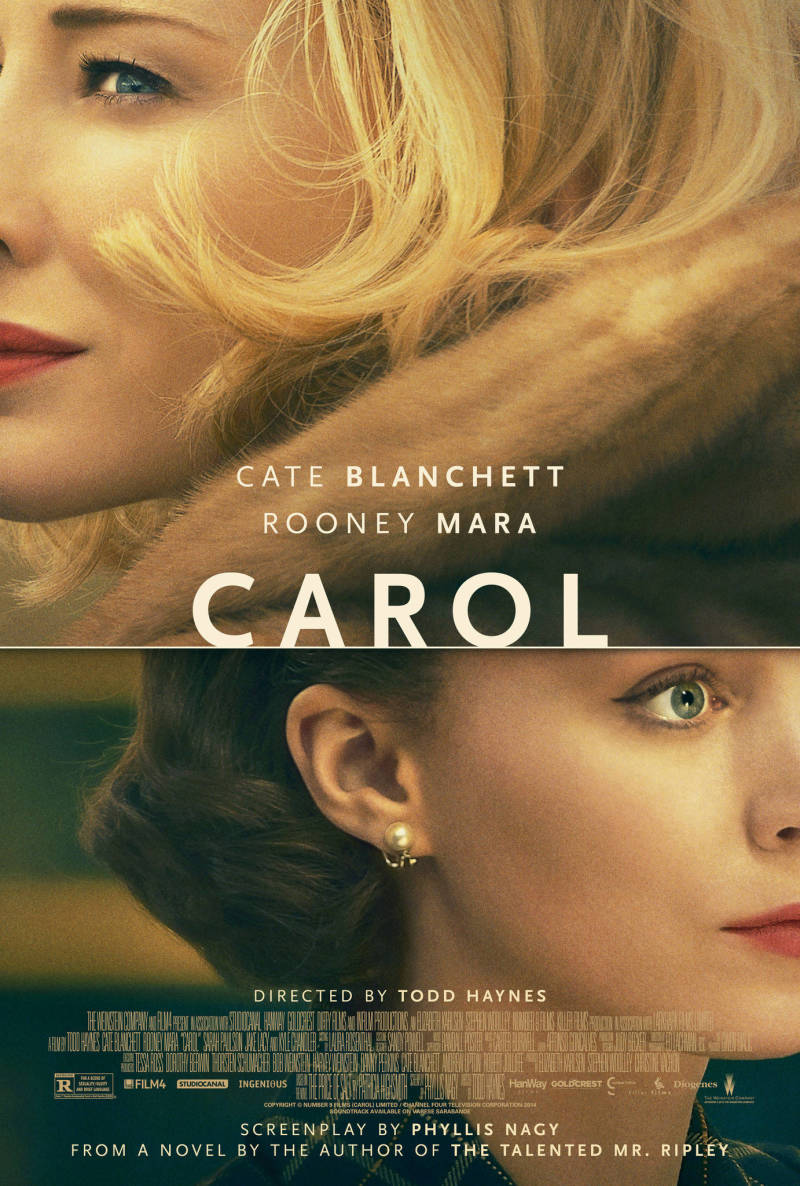
Carol


Todd Haynes, 2015, UK-USA

Right from the start, Todd Haynes taps into the set decoration all around us by revealing that the pattern on the opening credits is in fact a drainage grill. There is a mauve tinge to shadows and a velvety green that touches everything as if that is the colour of nostalgia. The look of the film is dipped in the colours of old fashion photos, sumptuously tinting everything. In this world that is nothing but a film set for our dramas, this story belongs to two women: it’s the 1950s and Therese (Roony Mara) is a shop girl not quite sure of who she is, and then there is Carol (Cate Blanchett) who is older and more certain but struggling to be so against a disapproving world. And they meet when Carol is buying Christmas gifts from the store Therese works in and a romance begins.

Todd Haynes goes one step further than the gorgeous affectations of the Douglas Sirk influenced ‘Far From Heaven’, extending a confident casualness with another period that characterised his exceptional TV adaption of ‘Mildred Pierce’ to achieve something far more naturalistic here. No need for the narrative layers and tricks that distinguished his ‘Velvet Goldmine’ or ‘I’m not Here’.  Edward Lachmann’s cinematography is vibrant, giving each colour a luminance of old photography stock, of a past derived from the era’s commercials. Or think of Edward hopper’s paintings. Adapting Patricia Highsmith’s novel ‘The Price of Salt’, Phyllis Nagys’ script leaves much unsaid, because people know the inherent meaning behind words, and letting looks do just as much heavy lifting. But there are still memorable lines: “I love her.” “I can’t help you with that.” Or, with a first look at a lover’s body: “I never looked like that.” The cast excel. Through Rooney Mara, you can feel the trouble Therese is having finding and being herself, often hiding behind a misunderstood coyness. As Carol, Cate Blanchett’s performance is endlessly beguiling with her resolve, beauty, smarts and elegance. 


And amongst this, Carol, is negotiating the sexism and homophobia of the era whilst increasingly sure of her identity. The story detours into a road movie and pays a pitstop at film noir (there’s a gun) which all helps to broaden the genre and narrative before settling  again on what might be called a woman’s picture – but it does so with subversion. Rarely has the details in a film told so much story (the way Carol puts on her shoes when she’s caught with Therese, for example). This is surely the most mainstream film Haynes has made, being ostensibly a straightforward forbidden romance, but the fact that it can treat its gay theme with such casualness and be accepted on those terms is surely a sign that we and cinema have come far with the subject. This is seductive and jazzy where Abdellatif Kechiche’s ‘Blue is the Warmest Colour’ was confrontational and punky with similar themes.

The direction and script navigate all these elements so effortlessly that it shows that rarely does a film of this kind display such adultness, dignity and grace. It’s a film for people who have lived and matured and gone through troubled times. A film to lose yourself to. Enthralling.


Sunday, 24 July 2016

Satan's Slave


Pengabdi setan
Sisworo Gautama Putra, 1982, Indonesia

“Satan’s Slave” doesn’t waste any time getting into a very chilly scene of a ghost at the window, tapping for attention. But this ghost wants to draw its victim outside rather than ingratiating itself in. It’s the ghost of the mother of a girl and her younger brother Tommy, who takes the loss badly by turning to the black arts. Or at least he buys some horror magazines and acts alien and aggressively towards his sister. A fortune teller in trendy 60s glasses floats around them like an aged film star reading over-sized cards and making creepy phone calls just to keep on performing. Tommy also takes to riding a motorbike through cemeteries, just like Mike from “Phantasm”. It’s all the fault of the housekeeper brought in to do the late mother’s chores, but she has something more Satanic in mind: to punish those that don’t believe in Allah enough, it would seem.

“Satan’s Slave” is an apparent Indonesian version of Don Coscarelli’s  “Phantasm” (1979), riffing on its dream-logic but hitting more closer to  Lucio Fulci’s randomness and precarious dramatics with a thick pretence to the Gothic. People take their time to answer doors which are being benged on by someone outside.. Blood drips on family portraits. Night-time shots outside the house are always accompanied by eerie howling (wolves? neighbourhood dogs?). People throw pillows at ghosts/zombies A manservant wheezes and worries. A blank-faced housemaid who is so obviously in on the malevolence that she comes with “Evil” music cues every time that she appears. It wins points on being bonkers, an electronic score (interrupted by a bout of disco) and remains notable for its version of Horror seen through a Muslim perspective. But any early promise dissolves and “Satan's Slave” just about scrapes through on its daftness.  


Tuesday, 19 July 2016

vs Ian Fleming's "Dr No"


"Dr. No" by Ian Fleming

Once you get past the misogyny and the racism - which you can’t because neither are particularly subtext - the problem with reading James Bond is that James Bond is a dick. His plans frequently require innocents getting killed; he generally blames the women; he is unable to treat women as adults; he antagonises and insults his captors instead of playing clever; he sulks when he doesn’t get his way. 

As presented by Ian Fleming, if this is an exemplary example of their agents it is a wonder the British Secret Service resolves anything. Head of the Secret Service, M, seems equally dickish, apparently only happy throwing his agents into serious danger without proper forethought. Assumedly, he is meant to be the stern paternal type, but he too seems like an idiot. For example, in “Dr No”, M16 agent John Strangways fails to send his daily message to headquarters: Fleming goes into great detail how Strangeways follows stringent routine every day, mentioning how even the keyboard he uses can pick-up his particular typing technique so recognise whether anyone unauthorised is making a report, etc, etc; and yet, when Strangways fails to report in one day, his superior M’s first reaction is to simply dismiss the matter on the assumption that Strangways has eloped with his female co-agent. It is only because Bond needs an easy assignment to help him recover from a previous mission that M thinks he might as well send someone to investigate, despite being certain that Strangways has simply done a runner for some sex. If I was a secret agent, I would surely hope for a little more concern and support. 

And when Bond arrives in Jamaica to pursue the disappearance, he arrives to find they have provided him with Strangways’ car… not so good at secrecy and subterfuge, this Secret Service. Well, let’s not forget that Bond uses his real name all the time upon arrival anyway. Most hilariously, when finally captured by Dr No – in a secret base that treats its prisoners like hotel guests – and his captors ask him for “next of kin”, he gives them M’s real name, we are told. And before that, he simply arrives in Jamaica and assumes Dr No’s guilt due to a mixture of xenophobia and local gossip; oh, there are certainly clues for concern about Dr Julius No, a Chinese-German, and his army of Chigroes (that people of mixed Chinese-Negro heritage, according to the book) but Bond jumps to the conclusion that the Doc is up to no good on his reclusive island almost from the off. He hires a local boatman, Quarrel, as his sidekick – not sure what training and qualifications Quarrel has for such covert operations, but…. - and Bond manages to survive a couple of assassination attempts, most memorably one involving a poisonous centipede crawling over his crotch and up his body. But what to do about being such a recognisable target in Strangways’ car? Well, Bond gets Quarrel to hire a couple of look-alikes to drive around in the car to see what happens: and the unfortunate impersonators are both promptly murdered. How about that? 

Anyway, Bond convinces Quarrel to take him over to Dr No’s island, despite the native’s fear of a dragon that is meant to prowl upon it. It is here, apropos of nothing but happenstance, that Bond meets his love interest Honeychile Rider. She is on the beach, collecting shells to sell. But this complicates things: what is what Bond to do with this luscious lovely? And more, how can he possibly ignore the deformity of her broken nose? Yes, the book stresses, this is such a “deformity” for a female; but luckily, like all other disabilities, after a while you hardly notice it! And this is exactly the kind of thing to distract Bond on his adventures. For her part, Honey has had a tough time of it, orphaned and raped (and that’s how the nose was broken) and now living off of her own wits. She has managed to avoid Dr No’s army and collect her shells for some time, and yet as soon as Bond turns up, she becomes a simpering female, clutching to him for protection. She is out of her teens and yet there is a passage where Bond takes time to wrestle with his conscience about whether to treat her as a “girl” or as a “woman”. Well, Fleming evidently makes the decision and for the rest of the book she is simply “the girl”. Doesn’t stop them from closing the book by having what she amusingly (and degradingly) calls “slave time”.

Fleming is quoted as saying, "I write for about three hours in the morning ... and I do another hour's work between six and seven in the evening. I never correct anything and I never go back to see what I have written ... By following my formula, you write 2,000 words a day."  And it shows: the plotting is purely whimsical, its consistency wavering, the plotting and ideas the kind to be expected from a hormonal teenager with all the cruelty, lack of discipline and unintentional humour that comes from that. We are a long, long way from John Le Carre’s George Smiley.


Dr No himself is a remarkable construction, the result of extensive plastic surgery and other physical modifications, let alone the fact that he is “one in a million” with his heart on the right side of his body (which saves his life). He is a heady mix of Chinese-German ancestry, Fu Manchu super-villainy in a Jamaican island hideaway. He also seems to think that Bond is the only one worthy of hearing his masterplan, which means he probably needs to get out more. Well, he thinks this one moment and then tells Bond he is not as clever as he thinks he is the next - which is both true and in keeping with the inconsistency of Fleming’s characterisations. For example, one minute Honey is a resourceful and admirable female presence and the next a weak sex interest in need of Bond’s protection; and the next she has the presence of mind and stamina to wait out an awful mass-crab attack. Bond is meant to be a super-agent, but that doesn’t mean he won’t sulk when imprisoned by a super-villain and when his plan to acquire a weapon falls flat (a plan, it might be mentioned, that features Honey getting a manicure). In one moment, Dr No’s soldiers are ruthless and efficient killers; the next they are intimidated and dissuaded from raping Honey by some vague and unfounded threats from Bond. It is all a little up and down and all over the place. It is as patch-work at Dr Julius No himself.

And it may well all be fun enough if its misogyny and xenophobia didn’t lead the book by the nose. These are not incidental traits as much as a watermargin through every viewpoint, and Fleming is simply not a good enough writer to circumnavigate these weaknesses. If you are not that way inclined, these might be insurmountable obstacles to enjoyment.

It is true that the film of “Dr No” manages to mitigate many failings of the book. M treats Strangway’s disappearance seriously from the start; there is much more detective work from Bond in the first half which is necessarily padded out more, particularly with assassination attempts. Bond is a jerk still, but he is also witty and far more enigmatic; more an anti-hero. The film is no less silly, but it delivers its nonsense with some flare. It is indeed remarkable to see how many of the defining traits of a Bond film are all present in his cinematic debut: the Bond-down-a-gun-barrel inset, the groovy opening titles, that theme tune, a sense of the  tongue-in-cheek rather than the campiness that would overrun the series later: all this dresses up Bond in a far more appealing aesthetic. 


Sunday, 17 July 2016

Aferim!

Radu Jude, 2015, Romania-Bulgaria-Czech Republic-France

Radu Jude’s film gives voice to a community that has been unrepresented in cinema in a similar way to ‘Embrace of the Serpent’; in this case, the Romani people bought and sold as slaves during the 1800s. It uses primary sources to elaborate on truth with fiction which to me, like ‘Embrace of the Serpent’ and ‘The Witch’, makes this more convincing than claims to “based on a true story”. ‘Aferim!’ ~ an Ottoman Turkish expression translatable more or less as  kind of “Bravo!”, but give it a sarcastic spin ~ is set in Wallachia 1835 where a policeman is sent to track down a runaway slave. This policeman, Costandin (Teodor Corba), sets off across Wallachia with his teenage son and it is obvious very soon that he is an abusive, bigoted braggart and that the boy Ionitā (Mihai Comānoiu) is haphazardly but blindly trying to follow his father’s example.

It is when they get a hold of the runaway slave, Carfin (Toma Curzin), who then starts to tell them stories that colour in his humanity that conscience is poked at. It would seem that, yes, the slave is guilty of having an affair with his master’s wife, but it was the wife that seduced him; and also his worldly experience goes far beyond that of his captors. So, perhaps, maybe, he doesn’t deserve death as punishment and they should let him go, Ionitā suggests? It’s not that Costandin disagrees but he’s too afraid of losing the position he has and wrongly assumes holds more influence than it has: he says, rather, that he can persuade the master to mitigate the punishment to a near-death beating. But by the end, the punishment having been horribly meted out, it is obvious that he is dimly aware that he has no power other than that associated with his feudal masters, to do their bidding and that all along he has wallowed in the licence to brutality that allows him without really questioning. If his son so blindly follows his father’s ways afterwards is not known, but it’s obvious that Constadin himself is unlikely to change. He is the middling authority that carries out the prejudices ordained by the rulers. This is brought to the fore when Constadin wonders if people will say a good word about them in a few hundred years: a moment that’s perhaps a little self-conscious but also evidence that maybe this character does have doubts. But he’s too busy enjoying the power of privilege and practicing a casual racism it allows and deluding himself he’s doing good.


‘Aferim!’ as much about human cruelty as an ingredient of history as ‘Hard to be a God’. Having taken incidents and speeches from primary sources only amplifies this argument, as if it was ever in question. Slavery and racism are the backbone of society here with little active kindness on display for mitigation. Indeed, the point is surely that bigotry has always propped up cultures. Few scenes are as despairing as the runaway boy Tintirc (Alberto Dinache) begging for his slavery. It is a beautiful film, defined by Marius Panduru’s black-and-white photography where there are few close-ups, the general view being of mid-shots and panoramas, which keeps the audience at an observer’s distance. ‘Aferim!’ is darkly funny and accessible as a typical Western narrative structure, but it has a documentary feel and neo-realism that is totally European. A demonstration of how discrimination is timeless and a deft character study set in a credibly cinematically recreated past


Sunday, 10 July 2016

Battlestar Galactica


Glen A. Larson, 1978, USA


An obvious 'Star Wars' rip-off that nevertheless owes much to others such as ‘Star Trek’, ‘Space 1999’, war films and even – with one shot of a planet’s underground caverns – ‘Forbidden Planet’. It certainly grabs from everything it can, being part of a whole post-‘Star Wars’ pulp sci-fi boom featuring the likes of ‘Buck Rogers in the 25th Century’, ‘Flash Gordon’, etc. ‘Battlestar Galactica’ wins no awards for advancing the themes and cause of science-fiction. We are in the future where people have names like Starbuck, Boomer, Casseopia and Athena, where every little boy wants to be a starfighter and where good humans fight bad aliens. The politicians are self-indulgent buffoons, helping the enemy by making all the wrong moves. The family and the military are the only saving graces in this world. Unadventurous ethics, plot and characterisation aside, this is decent and campy if undemanding entertainment. No, it’s not good but it does have charm, although much of this now must be to do with its datedness. The Cylons are perhaps better conceived and certainly more unique than Stormtroopers, perhaps akin more to ‘Dr Who’s Cybermen in pace and attitude.
They certainly make immediate impression with their vocorder voice, aura of humming and their silver armour causing incessant lens flares. They don’t quite break out into the Electric Light Orchestra’s ‘Mr. Blue Sky’ but they’re definitely of their time. It’s open to debate which are the scariest (me, I was always disappointed to discover that Stormtroopers were just men-in-suits rather than androids/cyborgs/robots).


The spaceships look good – agreeably well-used look rather – and John Dyskra’s special effects are above average (vapour trails in space!), yet its origins in television dominates throughout the plotting, uninspired camerawork and especially the clunky dialogue. The streak of tele-sentimentalism simplifies its outlook on family, loss, children, and cute robot dogs. Structurally, having been cut up from episodes of the television series, it starts with a climax, slows down for subplots and build-up, than goes out with a big-ish showdown.There is some welcome mystery when the ‘Galactica’ stumbles upon a desolate planet and discovers a casino, and some ghoulishness is provided by the alien Ovians, but this is absolute pulp. There’s some pretence to a mythical quest, to Noah’s Ark, to the desperation of refugees, and luckily – if less profitably – lacks the born-again subtext of ‘Star Wars’ ‘the Force’. If anything, despite being inferior, ‘Battlestar Galactica’ shows-up ‘Star Wars’ pretensions, if that’s possible, but also its strengths. ‘Star Wars’ is, for all its flaws, the better film because it has a magic ingredient that makes it work. But having said, for all its cutesy trimmings ‘Battlestar Galactica’ is more mature, being a much darker and troubled tale of humans fleeing murderous robots that only want to wipe them out.  Desperation leads this story rather than an ol' fight between 'Good versus Evil'  and,  for all its cutesy trimmings, that makes this premise more interesting  and one that the updated ‘Battlestar Galactica’ series of the early 2000s could run with.


.

Wednesday, 29 June 2016

Hervé - "Bang the Drum"

My friend Lewis Rose is the director of this video for Hervé's "Bang the Drum". Moody, sleazy, funny.

Amusements

Various links:

The art of Fortunio Liceti:


Serious chat about trivial things: Graphic Policy Radio talk "Captain America: Civil War"


Interview with "Embrace of the Serpent" director Ciro Guerra.

A brief history of horror...

Saturday, 25 June 2016

Straight on till Morning


Peter Collinson, 1972, UK

Peter Collinson’s* ‘Straight on till Morning’ is a totally different creature to ‘Fear in the Night’, the film it was doubled up with under the “Women in Peril” strapline. It’s like Hammer as filtered through Nicolas Roeg and Harold Pinter and owes far more to ‘Peeping Tom’ than Hitchcock or Robert Bloch. This is no bad thing. It is a flawed but fascinating chamber piece whose cross-cutting to other tangential and related scenes broadens this serial killer story into a story of how girls get lost in post-Sixties London culture. 1970’s ‘Permissive’ provides another example of this Little Girl Lost scenario.

Public humiliation and the retreat into fantasy underlies the odyssey of ugly duckling Rite Tushingham as she tries her luck in the big bad world to look for someone to make her a mother. This leads her to pretty boy Peter’s neverland, at the end of a road straight out of ‘Coronation Street’ and British neo-realism. In Peter’s world, beauty is rewarded with murder. Shane Briant plays Peter with a mixture of aloofness, poses, articulate gentleness and eloquent bullying. It’s best when Briant reveals through expression how immature, confused and bewildered Peter is. We don’t know why he does what he does, and it is obvious that neither does he.

The undeniably bleak, cruel and nihilistic qualities of the film have brought it some vitriol and dismissal, which reminds me of reaction to Nicolas Roeg’s ‘Bad Timing’, and both are open to accusations of misogyny and outright cruelty. Even if the Peter Pan allusions don’t quite take flight, ‘Straight on till Morning’ has much say on the random mercilessness of the world and the hopes and dreams of normalcy that take people there. It is genuinely disturbing and troubling long after it has finished, and there really aren’t Hammer films one can say that about.


*        Probably best known as the director of ‘The Italian Job’.

Fear in the Night


Jimmy Sangster, 1972, UK


‘Fear in the Night’ is a pretty rudimentary thriller with a “twist”, conceived to go along with a Hammer Studio's “Women in Peril” double-bill with ‘Straight on till Morning’. A woman recovering from a breakdown is going to live with her husband in a boy’s school far out in the country, but just before she leaves she is attacked by someone with an artificial arm. What the film does offer is some excellent direction by Jimmy Sangster and solid acting. Sangster delivers a gripping opening sequence, a school setting which is both eerie and slightly surreal,  some framing that rivals Carpenter’s ‘Halloween’, some excellent segues, and a taut attack-chase sequence that verges on the dream-like. Ellipses manage to muddy the otherwise obvious ‘Diabolique’ plot and characterisation with some fine performances from Peter Cushing, Judy Gleeson, Ralph Bates and Joan Collins that gives the procedure weight. Hammer was frequently about plot standards invigorated with excellent details. ‘Fear in the Night’ also gives a great iconic image of the wonderful Cushing wearing a pair of shattered glasses, and it is his back-story alone that provides the genuine chills right up to the end and after.


Hard to be a God


Trudno byt bogom
Aleksei German, 2013, Russia

‘Hard to be a God’ falls somewhere between Tarkovsky and ‘Zardoz’. By which I mean it contains leanings towards brilliance, campness, pretentiousness, indulgence, uniqueness, something genuinely bonkers. The comparison with Tarkovesky isn’t a stretch at all since since ‘Stalker’ was based on the book ‘Roadside Picnic’ by the same authors, Arkady and Boris Strugatsky: ‘Hard to be a God’ is based upon their 1964 novel. And ‘Stalker’ provides a good example of the science fiction of  ‘Hard to be a God’ which is free of any visual clues that might obvious symbolise an otherworldly setting. There are no futuristic vistas, for example, no alien designs; just people saying and acting bizarre things(although you may note that the costume Don Rumata wears looks like the remains of a spacesuit). It was directed by Alexei German and completed by his son Alexei German Jnr upon his father’s death in 2013.

It’s a medieval science-fiction scenario, which you can’t say about too many films, in which a group of astronauts have landed on a planet that seems trapped in its Dark Ages, bent on killing anyone they deem intellectual. This is why people act like “The Fool” from a play, with added killing. These astronauts aren’t meant to interfere with the development of this society but, of course, they do and have. One, calling himself Don Rumata (Leonid Yarmolnik), is already bearing a “Godlike” status simply because he is more focused and alert in a land of violent idiots. This therefore makes him more successful in his violent outbursts even as he loses himself to the cacophony of squalor and craziness all around him as he tries to blend in. The fact that he has apparently gone so successfully native is another reason it may be hard to distinguish the sci-fi basis as he behaves much like those around him.

Disgust is one of its main attributes: every scene wallows in mud and liquids, people smearing themselves with gunk; a face can’t get a close-up without someone else touching it, or someone else picking its nose; it’s a wonder any skin appears clean in some way at all. And this is before the gore kicks in. Long takes nod towards not only to Tarkovsky but also Bela Tarr and Alexandr Sokoruv, but there is none of the stillness of Tsai Ming Liang. Each scene is bursting with people, filth and the surreal, through which the camera glides following a plot that almost comes to the surface. There is a war nbetween The Blacks and The Greys and Don Ramata is looking for someone…  Much dialogue bears non sequiturs and it quite likely that even as you are being dazzled by the madness onscreen you will moments where you will be thinking “What?”, “Why?”, “Who?”, “Really?” and “W.T.F.?”. It makes little concession to easy plotting, even if the story is simple when spelt out. But dazzling it is. The cast propel themselves into the muck with vigour in the manner of over-eager amateurs who think such wallowing is vibrant acting (and similarly, you can also say this of Di Caprio in ‘The Revenant’): but I don’t want to claim the acting is amateurish because that isn’t so. Merely that the gusto creates some of the aforementioned campness and indulgence, but it knows what it’s doing. Think then of the dense production design and affectations of Peter Greenaway mixed with the black-and-white austerity of ‘Embrace of the Serpent’.

But that is the meat of this, for the story takes secondary importance to the catalogue of grime and cruelty. It is a treatise on man’s penchant for stupidity and barbarism, even as it indulges in a feudal social structure. IMDB quotes a synopsis by Svetlana Karmalita for the Rome Film Festival that says,


This is not a film about cruelty, but about love. A love that was there, tangible, alive, and that resisted through the hardest of conditions.


But it is  about cruelty, surely, as to deny this is to ignore a central ingredient; and it is not so much about ‘love conquering in the worst of times’ as showing a context where affection doesn’t stand a chance. It is about bringing to life a crazed crowded scenario that you might find in classic, renowned paintings. It is about failure; it is about how religion and blind faith can facilitate malice and obstruct progress. It is about the failure of colonisation and where the native culture is too overbearing to be changed by one man, no matter a self-proclaimed God.


Wednesday, 22 June 2016

Embrace of the Serpent


El abrazo de la serpiente

Ciro Guerra, 2015, Columbia-Venezela-Argentina

Ciro Guella’s film is a mesmerising journey into a long dead world of an Amazon in the midst of colonialism, based upon diaries by scientists Theodor Koch-Grunberg and Richard Evan Schultes. Naturally ‘Heart of Darkness’ and the films of Werner Herzog will come to mind , but there is a formal elegance,  uncanniness and style here that has little to do with Herzog’s more neo-realist aesthetic. Gorgeous and haunting vistas of black and white cinematography by David Gallego segue into one another, occasionally crossing timeframes to tell the tale. 

An ailing explorer (Jan Bijvoet) goes into the Amazon jungle and enlists the help of a native, Karamakate (Nilbio Torres and Antonio Boliar) to find a legendary flower, supposedly capable of curing disease. Years later, another explorer with the same objective also enlists the older Karamakate’s assistance, sparking memories even though Karamakate has forgotten some of the rituals he used to know. 

It’s a stark but soulful excursion into a world where white men bring madness and death with little to counter that this is what they symbolise. The second visit to the Spanish Mission where a mad self-appointed messiah has taken over is the material of a horror film, for example, but ‘Embrace of the Serpent’ is only interested in this as part of the texture. In this world, the native fables where celestial animal spirits come to Earth (and where the title comes from) are a poetic tonic to the unforgiving nature of the white man’s religion. Karamakate is aware he is of a dying consciousness, one of the last of his kind and in the end it is all he can do to accept this with a few acts of defiance that will deprive the colonists of the jewels of his people.

Karamakate proves a fascinating character that easily quashes apparent “noble savage” archetypes, a character resistant to typical Western interpretations, always critical of other Amazonians that have befriended the white man. The importance of this film giving a rare voice to the Amazonian tribes-people has been officially recognised as it 

bears tragic witness to colonial atrocities that have ravaged natural resources, devastated indigenous populations, and broken a link between ancient wisdom and Western man's exploitive madness. Accordingly, the Governor of the Guainía Department, one of the locations used for the film, decorated Ciro Guerra with the Order of the Inrida Flower for “exalting the respect and value of the indigenous populations, likewise giving the Department recognition for tourism and culture.”


A haunting and haunted world is evoked and alienation is a near tangible thing, not only in Karamakate’s isolation from the world as the last survivor of his tribe, but also in the Spanish mission’s decent into madness. Karamakate does not appear to have let loneliness and isolation bring on such madness: he is clear of thinking and opinion and radiates a natural pride. He goes on the white men’s excursions for his own reasons and makes little concession to them. 

Time is fluid as the narrative slides from past to present, via as much by the river as by memory. By putting the past foremost the film puts it on an equal level with its present rather than relegating it to “flashback”. Although the editing does not fracture time and find associations and symbolisms by juxtapositions in the style of Nicolas Roeg – ‘Walkabout’, say – Guerra exhibits a similar awareness of the bond between editing and time. By the time it seems to go a little ‘2001: A Space Odyssey’ (it’s only colour sequence), it has long been evident that ‘Embrace of the Serpent’ is also about film as a transcendent, hallucinogenic experience. It’s a film that evokes memories, dreams, the fluidity of time and a lost culture and refreshingly seems scornful of traditional white narrative norms. 

Beautiful, strange, tapping into the potential for film to give voice to everyone, even those long gone. An exceptional achievement.


Tuesday, 21 June 2016

The War

Jon Avnet, 1994, US

Elijah Wood gets top billing, even over Kevin Costner, as a boy who builds a tree-house. The tree-house and his long-running feud with the kids of another family are a metaphor for war, and Vietnam in particular. ‘The War’ starts promisingly, although loaded with rites-of-passage clichés, such as The Summer That Changed Everything... The all-wise nostalgic voice-over... children dancing to songs a’la 'Stand By Me'... It also bears the flashbacks, dead friends and guilt of Vietnam movies. Costner is the Vietnam veteran, back from hospital and a breakdown, full of war stories that have driven him into pacifist principles. Costner ends up too earnest; ‘To Kill a Mockingbird’ still offers the best “good dad of (Southern) peace” archetype, but unlike Atticus, this dad can still be relied upon to use violence when his son is threatened. And so many conservative mythologies are tediously re-enforced, such as the dead that become guardian angels and wishes that come true, etc.

Mostly, despite some appealing moments, the film suffers from a lack of subtlety. A racist teacher is a caricature out of a Joe Dante satire and is treated to a long, unbelievably uninterrupted rebuke from the sassy black girl she picks upon. In fact, the underused black characters have the best personalities, where the adults are a bit too earnest and the kids don’t get to breath from under the contrived scenerios. The building of and the fight for the tree-house also promises more than is delivered, accompanied by an appealing seventies soundtrack left over from an ‘80s ‘Nam film. Slowly the film descends into predictability and, for the last half an hour, is almost unforgivably patronising and obvious: for example, there is no need for the sound of helicopters over the battle for the tree-house to make the point.


Although there is nothing truly disagreeable with Avnet’s film, its earnestness and self-importance work finally to undermine its strengths and to waste Costner at his most appealing and a cast of highly talented child actors (the wonderful Lucas Black – Caleb Temple from the TV series ‘American Gothic’ – has an all too brief showstopper when he beats up the bigger Wood with a devil’s shit-eating grin). almost unforgivably pat, and conservative in its resolution, the War unfortunately shoots itself in the foot, ending up neither a knowing children’s film with adult themes or an adult film with something new to say about childhood. 


Friday, 3 June 2016

Warcraft: the beginning


 Duncan Jones, 2016, USA-China

Of course, there was a lot of goodwill towards Duncan Jones after ‘Moon’ and ‘Source Code’, but I don’t think goodwill has a chance of elevating ‘Warcraft’ into some fantasy classic. There is a sense that supporters are desperately trying to make excuses.  My first doubts came instantaneously with the first shot of the orcs. You know how games have become almost like films? Here’s a film that looks like a game. There is something about the orcs, their design and execution, that means they generally remain unconvincing throughout. If this had been wholly animated, that would not have been a problem, would have been as aesthetic, but being placed in real locations against real actors does not enhance their credibility. But then again, the human actors fair no better and being placed aside orcs shows up how miscast and weak they are. Dominic Cooper as King Llane seems particularly unconvincing. It’s like the joint fantasy of a group of kids playing dress-up who just happen to look like competent actors in their imaginations. Yes, just like role-playing.

Much dialogue rumbles so fierce on the bass frequencies it’s like the orcs each come with their own Dolby speech broadcasters. Bad dialogue with motifs that are so old stock you are constantly thinking of other fantasy trailblazers that managed to inject these clichés with life (‘Lord of the Rings’, of course, ‘Game of Thrones’, I’m thinking ‘Dragonslayer’… even ‘The Hobbit’ films possessed more flair). Of course, this is all based on a game that trades in those story benchmarks – a threatened king; ‘good’ magic and ‘bad’ magic (helpfully colour-coded) and a wizard-figure that succumbs to the nefarious – and all this must be fun if you are directly interacting and navigating these narrative tropes yourself, but a film needs its own way of bringing these to life as an entity in itself. And this script isn’t it. Oh, it tries the usual tricks – humour supposedly elicited by a young wizard clearly out of his depth; the father/son theme – but nothing really comes to life. You may be thinking By the way, what is happening here? But it’s all standard stuff despite all the names and references trying to enliven it and which will fly over the heads of non-fans (I, for example, have never played ‘Warcraft’).

Where it wins is in a sturdy vision of its female characters – they may be fewer but they are every bit as useful and formidable as the males – and, even better, in giving the orcs characters nuance instead of just letting them be faceless villainous hoards. It starts with an orc couple worrying about their offspring after all, which is surely refreshing. This is why they are more interesting than the wet side dishes of human characters. It goes some way to humanising the inhuman “other”. Even so, the orcs come dangerously close to turning into ‘Shrek’. And there isn’t much to the special effects when they all appear to be CGI without much ingenuity in individual moments. It’s all *smash & angst* without really being engaging.

The vibe from the packed audience I saw it with was one of mild amusement and scoffing in equal measure. They openly laughed when the baby snarls at the end… and I wasn’t sure if we were meant to.